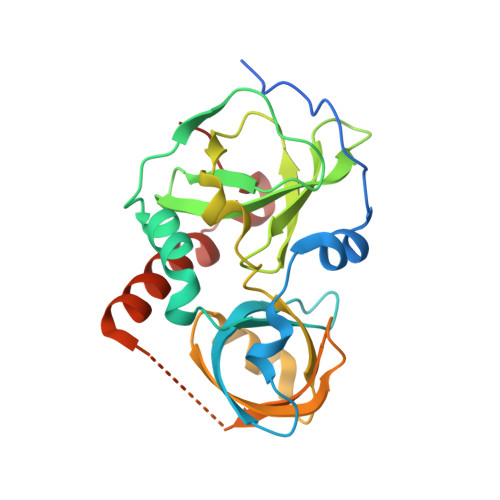
7CFB | pdb_00007cfb

Drosophila melanogaster Krimper eTud1 apo structure


Experimental Data Snapshot

  • Method: X-RAY DIFFRACTION
  • Resolution: 2.10 Å
  • R-Value Free: 
    0.222 (Depositor), 0.221 (DCC) 
  • R-Value Work: 
    0.204 (Depositor), 0.204 (DCC) 
  • R-Value Observed: 
    0.205 (Depositor) 

Starting Model: experimental
View more details

wwPDB Validation 3D Report Full Report

Validation slider image for 7CFB

This is version 1.3 of the entry. See complete history

Literature

Binding of guide piRNA triggers methylation of the unstructured N-terminal region of Aub leading to assembly of the piRNA amplification complex.

Huang, X.Hu, H.Webster, A.Zou, F.Du, J.Patel, D.J.Sachidanandam, R.Toth, K.F.Aravin, A.A.Li, S.

(2021) Nat Commun 12: 4061-4061

  • DOI: https://doi.org/10.1038/s41467-021-24351-x
  • Primary Citation Related Structures: 
    7CFB, 7CFC, 7CFD

  • PubMed Abstract: 

    PIWI proteins use guide piRNAs to repress selfish genomic elements, protecting the genomic integrity of gametes and ensuring the fertility of animal species. Efficient transposon repression depends on amplification of piRNA guides in the ping-pong cycle, which in Drosophila entails tight cooperation between two PIWI proteins, Aub and Ago3. Here we show that post-translational modification, symmetric dimethylarginine (sDMA), of Aub is essential for piRNA biogenesis, transposon silencing and fertility. Methylation is triggered by loading of a piRNA guide into Aub, which exposes its unstructured N-terminal region to the PRMT5 methylosome complex. Thus, sDMA modification is a signal that Aub is loaded with piRNA guide. Amplification of piRNA in the ping-pong cycle requires assembly of a tertiary complex scaffolded by Krimper, which simultaneously binds the N-terminal regions of Aub and Ago3. To promote generation of new piRNA, Krimper uses its two Tudor domains to bind Aub and Ago3 in opposite modification and piRNA-loading states. Our results reveal that post-translational modifications in unstructured regions of PIWI proteins and their binding by Tudor domains that are capable of discriminating between modification states is essential for piRNA biogenesis and silencing.


  • Organizational Affiliation
    • Division of Biology and Biological Engineering, Pasadena California Institute of Technology, Pasadena, CA, USA.

Macromolecule Content 

  • Total Structure Weight: 54.36 kDa 
  • Atom Count: 3,274 
  • Modeled Residue Count: 388 
  • Deposited Residue Count: 484 
  • Unique protein chains: 1

Macromolecules

Find similar proteins by:|  3D Structure
Entity ID: 1
MoleculeChains  Sequence LengthOrganismDetailsImage
FI20010p1
A, B
242Drosophila melanogasterMutation(s): 0 
Gene Names: krimpDmel\CG15707KRIMPkrimp-RAmtcCG15707Dmel_CG15707
UniProt
Find proteins for A1ZAC4 (Drosophila melanogaster)
Explore A1ZAC4 
Go to UniProtKB:  A1ZAC4
Entity Groups
Sequence Clusters30% Identity50% Identity70% Identity90% Identity95% Identity100% Identity
UniProt GroupA1ZAC4
Sequence Annotations
Expand
Reference Sequence

Small Molecules

Ligands 1 Unique
IDChains Name / Formula / InChI Key2D Diagram3D Interactions
SO4

Query on SO4


Download:Ideal Coordinates CCD File
C [auth A]SULFATE ION
O4 S
QAOWNCQODCNURD-UHFFFAOYSA-L

Experimental Data & Validation

Experimental Data

  • Method: X-RAY DIFFRACTION
  • Resolution: 2.10 Å
  • R-Value Free:  0.222 (Depositor), 0.221 (DCC) 
  • R-Value Work:  0.204 (Depositor), 0.204 (DCC) 
  • R-Value Observed: 0.205 (Depositor) 
Space Group: P 21 21 21
Unit Cell:
Length ( Å )Angle ( ˚ )
a = 60.458α = 90
b = 87.692β = 90
c = 90.216γ = 90
Software Package:
Software NamePurpose
PHENIXrefinement
PDB_EXTRACTdata extraction
HKL-3000data reduction
HKL-3000data scaling
PHENIXphasing

Structure Validation

View Full Validation Report


Entry History 

& Funding Information

Deposition Data

  • Released Date: 2021-06-02 
  • Deposition Author(s): Hu, H., Li, S.

Funding OrganizationLocationGrant Number
National Natural Science Foundation of China (NSFC)China31870755

Revision History  (Full details and data files)

  • Version 1.0: 2021-06-02
    Type: Initial release
  • Version 1.1: 2021-09-15
    Changes: Database references
  • Version 1.2: 2023-11-29
    Changes: Data collection, Refinement description
  • Version 1.3: 2024-11-13
    Changes: Structure summary