Download Mendeley
A conserved pi-helix plays a key role in thermoadaptation of catalysis in the glycoside hydrolase family 4.
Mohapatra, S.B., Manoj, N.(2021) Biochim Biophys Acta Proteins Proteom 1869: 140523-140523
- PubMed: 32853774 Search on PubMed
- DOI: https://doi.org/10.1016/j.bbapap.2020.140523
- Primary Citation Related Structures:
7BR4 - PubMed Abstract:
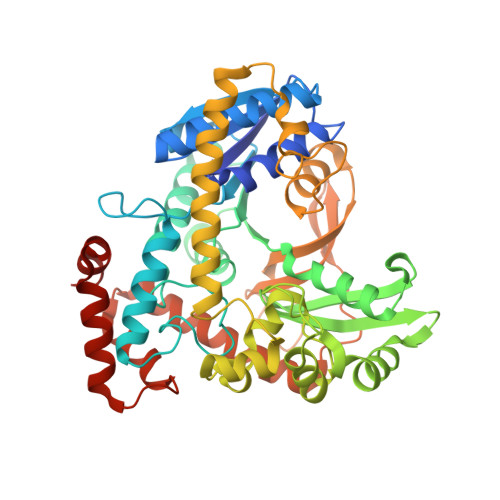
Here, we characterize the role of a π-helix in the molecular mechanisms underlying thermoadaptation in the glycoside hydrolase family 4 (GH4). The interspersed π-helix present in a subgroup is evolutionarily related to a conserved α-helix in other orthologs by a single residue insertion/deletion event. The insertional residue, Phe407, in a hyperthermophilic α-glucuronidase, makes specific interactions across the inter-subunit interface. In order to establish the sequence-structure-stability implications of the π-helix, the wild-type and the deletion variant (Δ407) were characterized. The variant showed a significant lowering of melting temperature and optimum temperature for the highest activity. Crystal structures of the proteins show a transformation of the π-helix to a continuous α-helix in the variant, identical to that in orthologs lacking this insertion. Thermodynamic parameters were determined from stability curves representing the temperature dependence of unfolding free energy. Though the proteins display maximum stabilities at similar temperatures, a higher melting temperature in the wild-type is achieved by a combination of higher enthalpy and lower heat capacity of unfolding. Comparisons of the structural changes, and the activity and thermodynamic profiles allow us to infer that specific non-covalent interactions, and the existence of residual structure in the unfolded state, are crucial determinants of its thermostability. These features permit the enzyme to balance the preservation of structure at a higher temperature with the thermodynamic stability required for optimum catalysis.
- Department of Biotechnology, Bhupat and Jyoti Mehta School of Biosciences, Indian Institute of Technology Madras, Chennai 600036, India.
Organizational Affiliation: