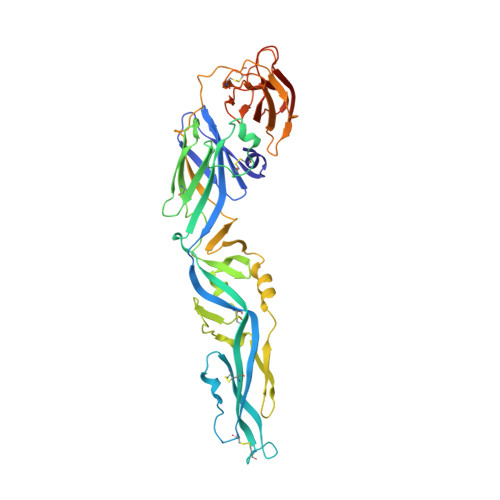
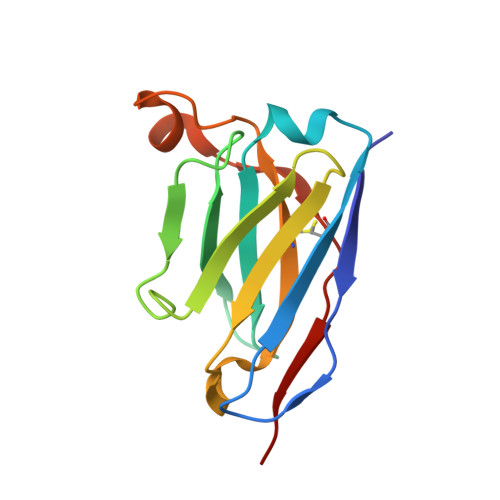
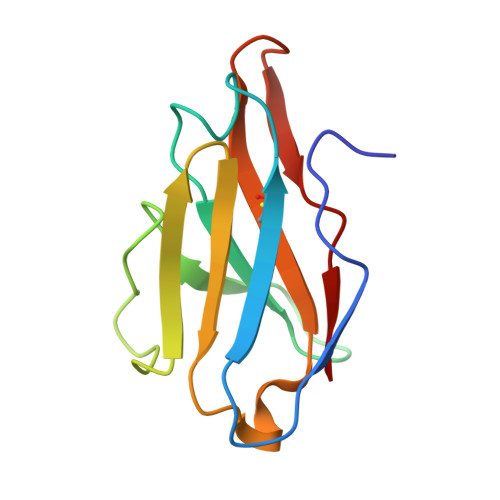
7BPK | pdb_00007bpk

Zika virus envelope protein mutant bound to mAb


Experimental Data Snapshot

  • Method: X-RAY DIFFRACTION
  • Resolution: 3.10 Å
  • R-Value Free: 
    0.268 (Depositor), 0.267 (DCC) 
  • R-Value Work: 
    0.232 (Depositor), 0.235 (DCC) 
  • R-Value Observed: 
    0.234 (Depositor) 

Starting Model: experimental
View more details

wwPDB Validation 3D Report Full Report

Validation slider image for 7BPK

This is version 1.3 of the entry. See complete history

Literature

Protective Zika vaccines engineered to eliminate enhancement of dengue infection via immunodominance switch.

Dai, L.Xu, K.Li, J.Huang, Q.Song, J.Han, Y.Zheng, T.Gao, P.Lu, X.Yang, H.Liu, K.Xia, Q.Wang, Q.Chai, Y.Qi, J.Yan, J.Gao, G.F.

(2021) Nat Immunol 22: 958-968

  • DOI: https://doi.org/10.1038/s41590-021-00966-6
  • Primary Citation Related Structures: 
    7BPK, 7BQ5

  • PubMed Abstract: 

    Antibody-dependent enhancement (ADE) is an important safety concern for vaccine development against dengue virus (DENV) and its antigenically related Zika virus (ZIKV) because vaccine may prime deleterious antibodies to enhance natural infections. Cross-reactive antibodies targeting the conserved fusion loop epitope (FLE) are known as the main sources of ADE. We design ZIKV immunogens engineered to change the FLE conformation but preserve neutralizing epitopes. Single vaccination conferred sterilizing immunity against ZIKV without ADE of DENV-serotype 1-4 infections and abrogated maternal-neonatal transmission in mice. Unlike the wild-type-based vaccine inducing predominately cross-reactive ADE-prone antibodies, B cell profiling revealed that the engineered vaccines switched immunodominance to dispersed patterns without DENV enhancement. The crystal structure of the engineered immunogen showed the dimeric conformation of the envelope protein with FLE disruption. We provide vaccine candidates that will prevent both ZIKV infection and infection-/vaccination-induced DENV ADE.


  • Organizational Affiliation
    • CAS Key Laboratory of Pathogen Microbiology and Immunology, Institute of Microbiology, Chinese Academy of Sciences (CAS), Beijing, China. dailp@im.ac.cn.

Macromolecule Content 

  • Total Structure Weight: 141.99 kDa 
  • Atom Count: 9,754 
  • Modeled Residue Count: 1,278 
  • Deposited Residue Count: 1,302 
  • Unique protein chains: 3

Macromolecules

Find similar proteins by:|  3D Structure
Entity ID: 1
MoleculeChains  Sequence LengthOrganismDetailsImage
Envelope protein
A, B
416Zika virusMutation(s): 0 
UniProt
Find proteins for A0A024B7W1 (Zika virus (isolate ZIKV/Human/French Polynesia/10087PF/2013))
Explore A0A024B7W1 
Go to UniProtKB:  A0A024B7W1
Entity Groups
Sequence Clusters30% Identity50% Identity70% Identity90% Identity95% Identity100% Identity
UniProt GroupA0A024B7W1
Sequence Annotations
Expand
Reference Sequence
Find similar proteins by:|  3D Structure
Entity ID: 2
MoleculeChains  Sequence LengthOrganismDetailsImage
Z3L1 Heavy chainC,
E [auth H]
127Homo sapiensMutation(s): 0 
Find similar proteins by:|  3D Structure
Entity ID: 3
MoleculeChains  Sequence LengthOrganismDetailsImage
IG c307_light_IGLV1-51_IGLJ2D,
F [auth L]
108Homo sapiensMutation(s): 0 
UniProt
Find proteins for A0A5C2GK82 (Homo sapiens)
Explore A0A5C2GK82 
Go to UniProtKB:  A0A5C2GK82
Entity Groups
Sequence Clusters30% Identity50% Identity70% Identity90% Identity95% Identity100% Identity
UniProt GroupA0A5C2GK82
Sequence Annotations
Expand
Reference Sequence

Experimental Data & Validation

Experimental Data

  • Method: X-RAY DIFFRACTION
  • Resolution: 3.10 Å
  • R-Value Free:  0.268 (Depositor), 0.267 (DCC) 
  • R-Value Work:  0.232 (Depositor), 0.235 (DCC) 
  • R-Value Observed: 0.234 (Depositor) 
Space Group: P 21 21 21
Unit Cell:
Length ( Å )Angle ( ˚ )
a = 78.462α = 90
b = 103.79β = 90
c = 205.818γ = 90
Software Package:
Software NamePurpose
PHENIXrefinement
HKL-2000data reduction
HKL-2000data scaling
PHASERphasing

Structure Validation

View Full Validation Report


Entry History 

Deposition Data

Revision History  (Full details and data files)

  • Version 1.0: 2021-03-24
    Type: Initial release
  • Version 1.1: 2021-10-20
    Changes: Database references
  • Version 1.2: 2023-11-29
    Changes: Data collection, Refinement description
  • Version 1.3: 2024-11-20
    Changes: Structure summary