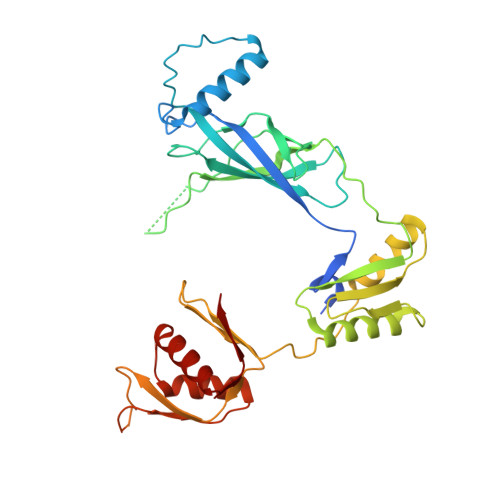
7BJ2 | pdb_00007bj2

Salmonella flagellar basal body assembly intermediate - P ring alone structure


Experimental Data Snapshot

  • Method: ELECTRON MICROSCOPY
  • Resolution: 3.00 Å
  • Aggregation State: PARTICLE 
  • Reconstruction Method: SINGLE PARTICLE 

wwPDB Validation 3D Report Full Report

Validation slider image for 7BJ2

This is version 1.3 of the entry. See complete history

Literature

Molecular structure of the intact bacterial flagellar basal body.

Johnson, S.Furlong, E.J.Deme, J.C.Nord, A.L.Caesar, J.J.E.Chevance, F.F.V.Berry, R.M.Hughes, K.T.Lea, S.M.

(2021) Nat Microbiol 6: 712-721

  • DOI: https://doi.org/10.1038/s41564-021-00895-y
  • Primary Citation Related Structures: 
    7BGL, 7BHQ, 7BIN, 7BJ2, 7BK0, 7NVG

  • PubMed Abstract: 

    The bacterial flagellum is a macromolecular protein complex that enables motility in many species. Bacterial flagella self-assemble a strong, multicomponent drive shaft that couples rotation in the inner membrane to the micrometre-long flagellar filament that powers bacterial swimming in viscous fluids 1-3 . Here, we present structures of the intact Salmonella flagellar basal body 4 , encompassing the inner membrane rotor, drive shaft and outer-membrane bushing, solved using cryo-electron microscopy to resolutions of 2.2-3.7 Å. The structures reveal molecular details of how 173 protein molecules of 13 different types assemble into a complex spanning two membranes and a cell wall. The helical drive shaft at one end is intricately interwoven with the rotor component with both the export gate complex and the proximal rod forming interactions with the MS-ring. At the other end, the drive shaft distal rod passes through the LP-ring bushing complex, which functions as a molecular bearing anchored in the outer membrane through interactions with the lipopolysaccharide. The in situ structure of a protein complex capping the drive shaft provides molecular insights into the assembly process of this molecular machine.


  • Organizational Affiliation
    • Sir William Dunn School of Pathology, University of Oxford, Oxford, UK. steven.johnson@path.ox.ac.uk.

Macromolecule Content 

  • Total Structure Weight: 993.05 kDa 
  • Atom Count: 58,552 
  • Modeled Residue Count: 7,956 
  • Deposited Residue Count: 9,490 
  • Unique protein chains: 1

Macromolecules

Find similar proteins by:|  3D Structure
Entity ID: 1
MoleculeChains  Sequence LengthOrganismDetailsImage
Flagellar P-ring protein365Salmonella enterica subsp. enterica serovar Typhimurium str. LT2Mutation(s): 0 
UniProt
Find proteins for P15930 (Salmonella typhimurium (strain LT2 / SGSC1412 / ATCC 700720))
Explore P15930 
Go to UniProtKB:  P15930
Entity Groups
Sequence Clusters30% Identity50% Identity70% Identity90% Identity95% Identity100% Identity
UniProt GroupP15930
Sequence Annotations
Expand
Reference Sequence

Experimental Data & Validation

Experimental Data

  • Method: ELECTRON MICROSCOPY
  • Resolution: 3.00 Å
  • Aggregation State: PARTICLE 
  • Reconstruction Method: SINGLE PARTICLE 
EM Software:
TaskSoftware PackageVersion
RECONSTRUCTIONRELION3.1

Structure Validation

View Full Validation Report


Entry History 

& Funding Information

Deposition Data


Funding OrganizationLocationGrant Number
Wellcome TrustUnited Kingdom219477
Wellcome TrustUnited Kingdom209194
Wellcome TrustUnited Kingdom201536
Medical Research Council (MRC, United Kingdom)United KingdomS021264

Revision History  (Full details and data files)

  • Version 1.0: 2021-05-05
    Type: Initial release
  • Version 1.1: 2021-05-19
    Changes: Database references
  • Version 1.2: 2021-06-09
    Changes: Database references
  • Version 1.3: 2024-05-01
    Changes: Data collection, Database references