7ARX | pdb_00007arx

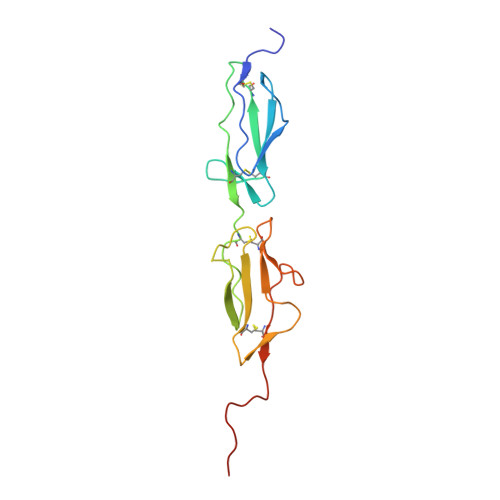
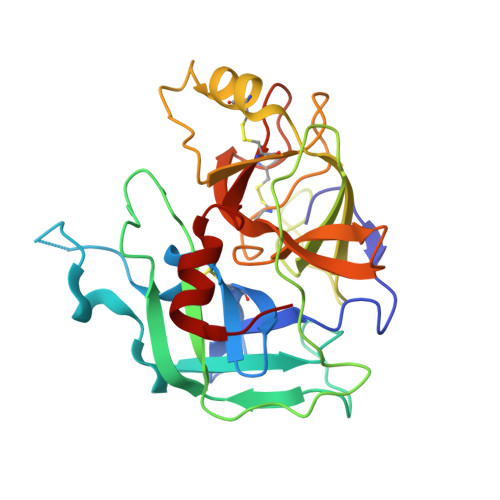
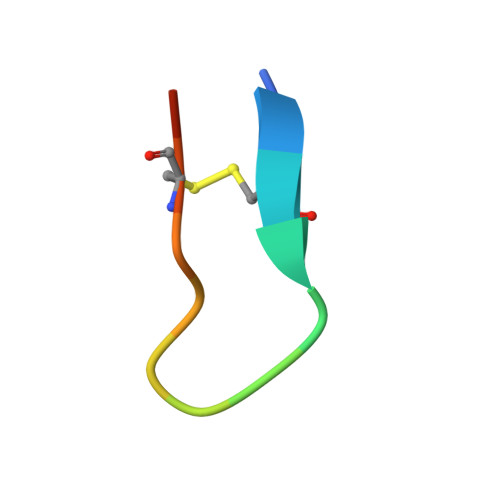
Crystal structure of the catalytic fragment of masp-1 in complex with SFMI1


Experimental Data Snapshot

  • Method: X-RAY DIFFRACTION
  • Resolution: 2.42 Å
  • R-Value Free: 
    0.285 (Depositor), 0.285 (DCC) 
  • R-Value Work: 
    0.256 (Depositor), 0.257 (DCC) 
  • R-Value Observed: 
    0.257 (Depositor) 

Starting Model: experimental
View more details

wwPDB Validation 3D Report Full Report

Validation slider image for 7ARX

This is version 2.3 of the entry. See complete history

Literature

Directed Evolution-Driven Increase of Structural Plasticity Is a Prerequisite for Binding the Complement Lectin Pathway Blocking MASP-Inhibitor Peptides.

Durvanger, Z.Boros, E.Nagy, Z.A.Hegedus, R.Megyeri, M.Dobo, J.Gal, P.Schlosser, G.Angyan, A.F.Gaspari, Z.Perczel, A.Harmat, V.Mezo, G.Menyhard, D.K.Pal, G.

(2022) ACS Chem Biol 17: 969-986

  • DOI: https://doi.org/10.1021/acschembio.2c00114
  • Primary Citation Related Structures: 
    7ARX

  • PubMed Abstract: 

    MASP-1 and MASP-2 are key activator proteases of the complement lectin pathway. The first specific mannose-binding lectin-associated serine protease (MASP) inhibitors had been developed from the 14-amino-acid sunflower trypsin inhibitor (SFTI) peptide by phage display, yielding SFTI-based MASP inhibitors, SFMIs. Here, we present the crystal structure of the MASP-1/SFMI1 complex that we analyzed in comparison to other existing MASP-1/2 structures. Rigidified backbone structure has long been accepted as a structural prerequisite for peptide inhibitors of proteases. We found that a hydrophobic cluster organized around the P2 Thr residue is essential for the structural stability of wild-type SFTI. We also found that the same P2 Thr prevents binding of the rigid SFTI-like peptides to the substrate-binding cleft of both MASPs as the cleft is partially blocked by large gatekeeper enzyme loops. Directed evolution removed this obstacle by replacing the P2 Thr with a Ser, providing the SFMIs with high-degree structural plasticity, which proved to be essential for MASP inhibition. To gain more insight into the structural criteria for SFMI-based MASP-2 inhibition, we systematically modified MASP-2-specific SFMI2 by capping its two termini and by replacing its disulfide bridge with varying length thioether linkers. By doing so, we also aimed to generate a versatile scaffold that is resistant to reducing environment and has increased stability in exopeptidase-containing biological environments. We found that the reduction-resistant disulfide-substituted l-2,3-diaminopropionic acid (Dap) variant possessed near-native potency. As MASP-2 is involved in the life-threatening thrombosis in COVID-19 patients, our synthetic, selective MASP-2 inhibitors could be relevant coronavirus drug candidates.


  • Organizational Affiliation
    • Laboratory of Structural Chemistry and Biology, Institute of Chemistry, ELTE Eötvös Loránd University, Pázmány Péter sétány 1/A, H-1117 Budapest, Hungary.

Macromolecule Content 

  • Total Structure Weight: 47.11 kDa 
  • Atom Count: 2,977 
  • Modeled Residue Count: 410 
  • Deposited Residue Count: 420 
  • Unique protein chains: 3

Macromolecules

Find similar proteins by:|  3D Structure
Entity ID: 1
MoleculeChains  Sequence LengthOrganismDetailsImage
Mannan-binding lectin serine protease 1155Homo sapiensMutation(s): 0 
Gene Names: MASP1CRARFCRARF1PRSS5
EC: 3.4.21
UniProt & NIH Common Fund Data Resources
Find proteins for P48740 (Homo sapiens)
Explore P48740 
Go to UniProtKB:  P48740
PHAROS:  P48740
GTEx:  ENSG00000127241 
Entity Groups
Sequence Clusters30% Identity50% Identity70% Identity90% Identity95% Identity100% Identity
UniProt GroupP48740
Sequence Annotations
Expand
Reference Sequence
Find similar proteins by:|  3D Structure
Entity ID: 2
MoleculeChains  Sequence LengthOrganismDetailsImage
Mannan-binding lectin serine protease 1251Homo sapiensMutation(s): 0 
Gene Names: MASP1CRARFCRARF1PRSS5
EC: 3.4.21
UniProt & NIH Common Fund Data Resources
Find proteins for P48740 (Homo sapiens)
Explore P48740 
Go to UniProtKB:  P48740
PHAROS:  P48740
GTEx:  ENSG00000127241 
Entity Groups
Sequence Clusters30% Identity50% Identity70% Identity90% Identity95% Identity100% Identity
UniProt GroupP48740
Sequence Annotations
Expand
Reference Sequence
Find similar proteins by:  Sequence   |   3D Structure  
Entity ID: 3
MoleculeChains  Sequence LengthOrganismDetailsImage
SFMI1 - Sunflower MASP1 inhibitor14Helianthus annuusMutation(s): 0 
UniProt
Find proteins for Q4GWU5 (Helianthus annuus)
Explore Q4GWU5 
Go to UniProtKB:  Q4GWU5
Entity Groups
Sequence Clusters30% Identity50% Identity70% Identity90% Identity95% Identity100% Identity
UniProt GroupQ4GWU5
Sequence Annotations
Expand
Reference Sequence

Small Molecules

Ligands 1 Unique
IDChains Name / Formula / InChI Key2D Diagram3D Interactions
PEG

Query on PEG


Download:Ideal Coordinates CCD File
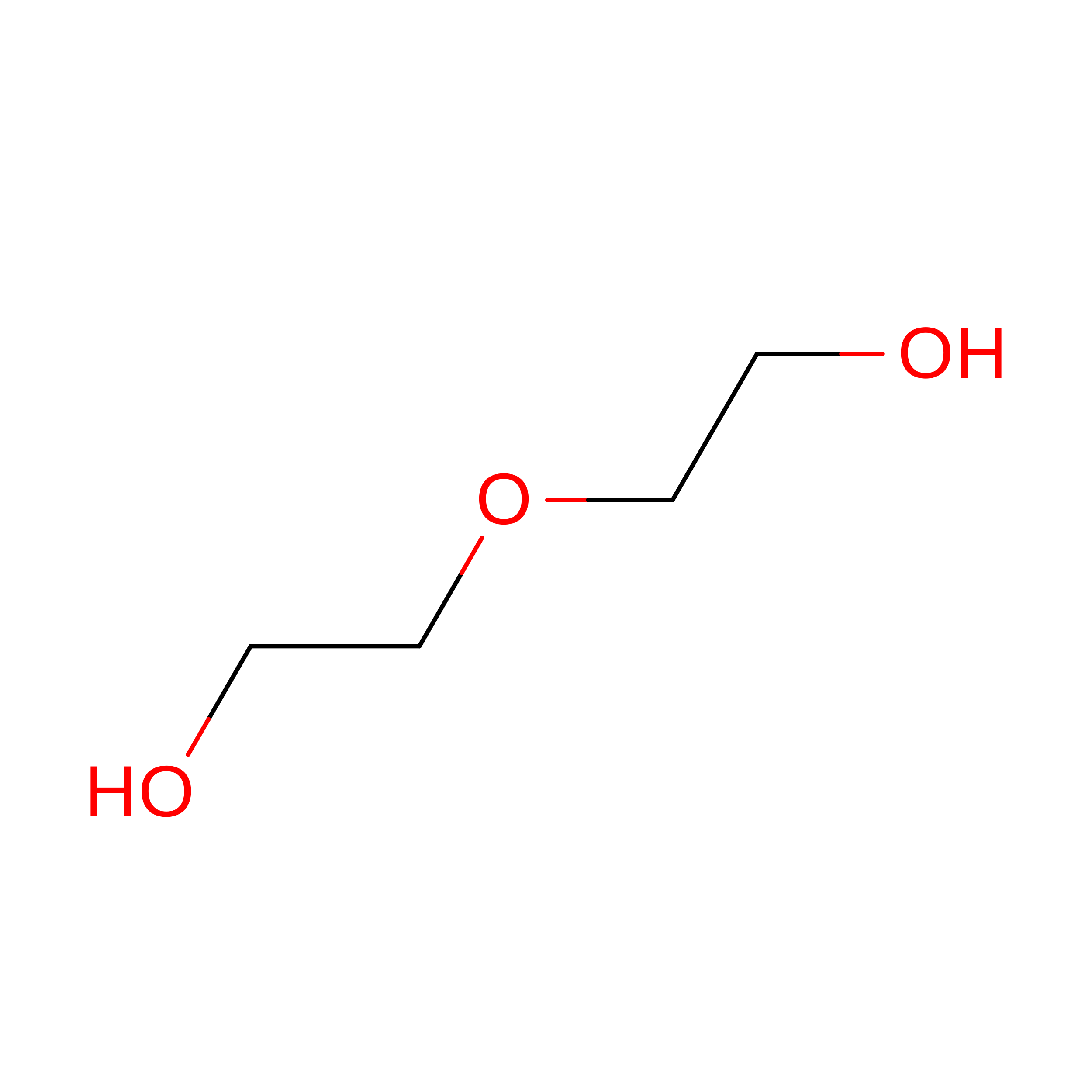
D [auth B]DI(HYDROXYETHYL)ETHER
C4 H10 O3
MTHSVFCYNBDYFN-UHFFFAOYSA-N

Experimental Data & Validation

Experimental Data

  • Method: X-RAY DIFFRACTION
  • Resolution: 2.42 Å
  • R-Value Free:  0.285 (Depositor), 0.285 (DCC) 
  • R-Value Work:  0.256 (Depositor), 0.257 (DCC) 
  • R-Value Observed: 0.257 (Depositor) 
Space Group: P 31 2 1
Unit Cell:
Length ( Å )Angle ( ˚ )
a = 69.3α = 90
b = 69.3β = 90
c = 161.8γ = 120
Software Package:
Software NamePurpose
PHENIXrefinement
PHENIXrefinement
XDSdata reduction
XSCALEdata scaling
PHASERphasing

Structure Validation

View Full Validation Report


Entry History 

& Funding Information

Deposition Data


Funding OrganizationLocationGrant Number
European Regional Development FundHungaryVEKOP-2.3.3-15-2017-00020, VEKOP-2.3.2-16-2017-00014 and VEKOP-2.3.3-15-2017-00018
Hungarian National Research, Development and Innovation OfficeHungary2018-1.2.1-NKP-2018-00005
Hungarian National Research, Development and Innovation OfficeHungaryNK100769, NK100834, K116305, K119374 and K119386

Revision History  (Full details and data files)

  • Version 1.0: 2021-11-03
    Type: Initial release
  • Version 2.0: 2022-02-23
    Type: Coordinate replacement
    Reason: Model completeness
    Changes: Advisory, Atomic model, Data collection, Database references, Derived calculations, Refinement description, Source and taxonomy, Structure summary
  • Version 2.1: 2022-05-18
    Changes: Database references
  • Version 2.2: 2024-01-31
    Changes: Data collection, Refinement description
  • Version 2.3: 2024-11-13
    Changes: Structure summary