7AI6 | pdb_00007ai6

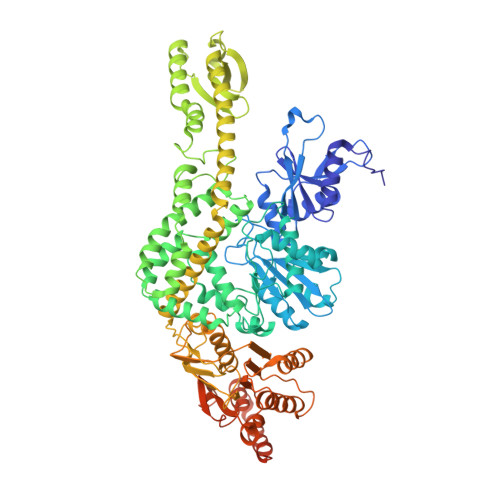
MutS in mismatch bound state


Experimental Data Snapshot

  • Method: ELECTRON MICROSCOPY
  • Resolution: 6.90 Å
  • Aggregation State: PARTICLE 
  • Reconstruction Method: SINGLE PARTICLE 

Starting Model: experimental
View more details

wwPDB Validation 3D Report Full Report

Validation slider image for 7AI6

This is version 1.3 of the entry. See complete history

Literature

The selection process of licensing a DNA mismatch for repair.

Fernandez-Leiro, R.Bhairosing-Kok, D.Kunetsky, V.Laffeber, C.Winterwerp, H.H.Groothuizen, F.Fish, A.Lebbink, J.H.G.Friedhoff, P.Sixma, T.K.Lamers, M.H.

(2021) Nat Struct Mol Biol 28: 373-381

  • DOI: https://doi.org/10.1038/s41594-021-00577-7
  • Primary Citation Related Structures: 
    7AI5, 7AI6, 7AI7, 7AIB, 7AIC

  • PubMed Abstract: 

    DNA mismatch repair detects and removes mismatches from DNA by a conserved mechanism, reducing the error rate of DNA replication by 100- to 1,000-fold. In this process, MutS homologs scan DNA, recognize mismatches and initiate repair. How the MutS homologs selectively license repair of a mismatch among millions of matched base pairs is not understood. Here we present four cryo-EM structures of Escherichia coli MutS that provide snapshots, from scanning homoduplex DNA to mismatch binding and MutL activation via an intermediate state. During scanning, the homoduplex DNA forms a steric block that prevents MutS from transitioning into the MutL-bound clamp state, which can only be overcome through kinking of the DNA at a mismatch. Structural asymmetry in all four structures indicates a division of labor between the two MutS monomers. Together, these structures reveal how a small conformational change from the homoduplex- to heteroduplex-bound MutS acts as a licensing step that triggers a dramatic conformational change that enables MutL binding and initiation of the repair cascade.


  • Organizational Affiliation
    • MRC Laboratory of Medical Research, Cambridge, UK. rfleiro@cnio.es.

Macromolecule Content 

  • Total Structure Weight: 206.34 kDa 
  • Atom Count: 13,466 
  • Modeled Residue Count: 1,627 
  • Deposited Residue Count: 1,756 
  • Unique protein chains: 1
  • Unique nucleic acid chains: 2

Macromolecules


Find similar proteins by:|  3D Structure
Entity ID: 1
MoleculeChains  Sequence LengthOrganismDetailsImage
DNA mismatch repair protein MutS
A, B
853Escherichia coli K-12Mutation(s): 8 
Gene Names: mutSfdvb2733JW2703
UniProt
Find proteins for P23909 (Escherichia coli (strain K12))
Explore P23909 
Go to UniProtKB:  P23909
Entity Groups
Sequence Clusters30% Identity50% Identity70% Identity90% Identity95% Identity100% Identity
UniProt GroupP23909
Sequence Annotations
Expand
Reference Sequence
Find similar nucleic acids by:  Sequence
Entity ID: 2
MoleculeChains LengthOrganismImage
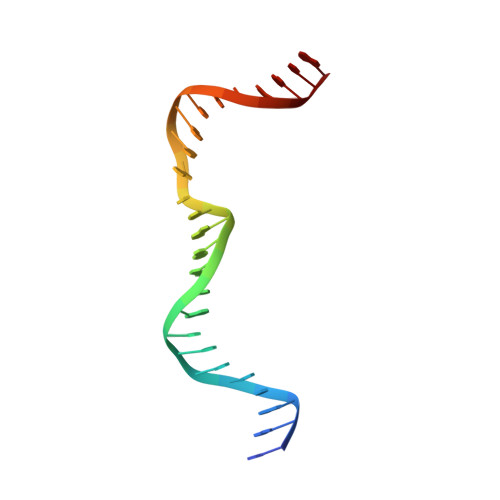
DNA (25-MER)25synthetic construct
Sequence Annotations
Expand
Reference Sequence
Find similar nucleic acids by:  Sequence
Entity ID: 3
MoleculeChains LengthOrganismImage
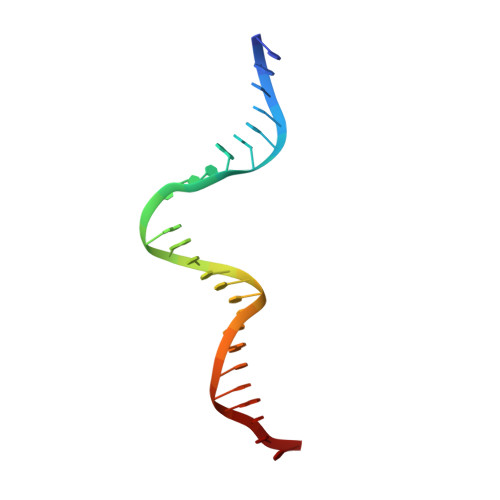
DNA (25-MER)25synthetic construct
Sequence Annotations
Expand
Reference Sequence

Small Molecules

Ligands 1 Unique
IDChains Name / Formula / InChI Key2D Diagram3D Interactions
ADP

Query on ADP


Download:Ideal Coordinates CCD File
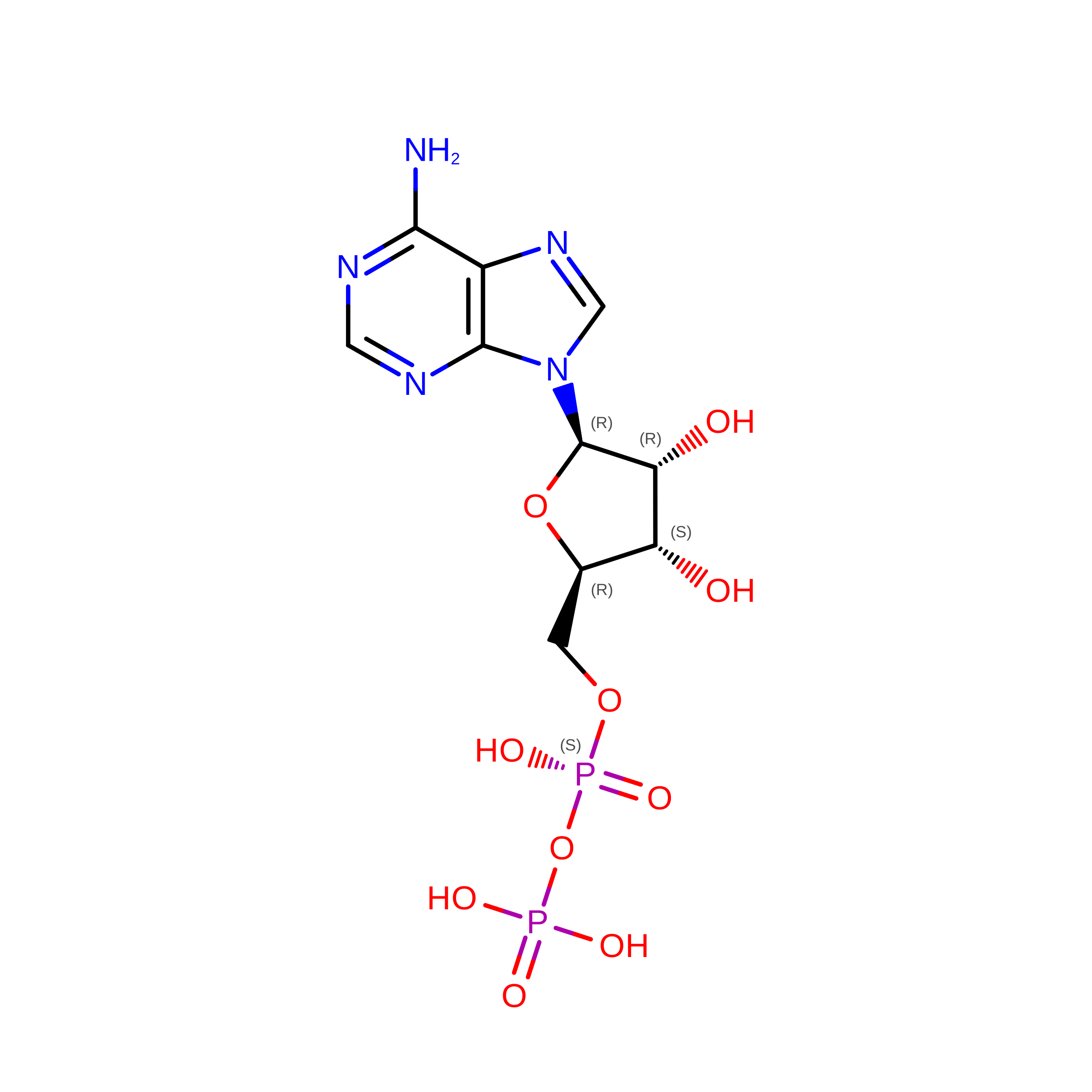
E [auth A]ADENOSINE-5'-DIPHOSPHATE
C10 H15 N5 O10 P2
XTWYTFMLZFPYCI-KQYNXXCUSA-N

Experimental Data & Validation

Experimental Data

  • Method: ELECTRON MICROSCOPY
  • Resolution: 6.90 Å
  • Aggregation State: PARTICLE 
  • Reconstruction Method: SINGLE PARTICLE 
EM Software:
TaskSoftware PackageVersion
MODEL REFINEMENTREFMAC5
RECONSTRUCTIONRELION3.1

Structure Validation

View Full Validation Report


Entry History 

& Funding Information

Deposition Data


Funding OrganizationLocationGrant Number
Medical Research Council (MRC, United Kingdom)United KingdomU105197143

Revision History  (Full details and data files)

  • Version 1.0: 2021-03-31
    Type: Initial release
  • Version 1.1: 2021-04-21
    Changes: Database references
  • Version 1.2: 2021-04-28
    Changes: Database references
  • Version 1.3: 2024-05-01
    Changes: Data collection, Database references, Refinement description