6XAB | pdb_00006xab

Structure of the acetate-bound form of ArrX from Chrysiogenes arsenatis


Experimental Data Snapshot

  • Method: X-RAY DIFFRACTION
  • Resolution: 1.78 Å
  • R-Value Free: 
    0.222 (Depositor), 0.237 (DCC) 
  • R-Value Work: 
    0.189 (Depositor) 

Starting Model: experimental
View more details

wwPDB Validation 3D Report Full Report

Validation slider image for 6XAB

This is version 1.2 of the entry. See complete history

Literature

Structural and Functional Investigation of the Periplasmic Arsenate-Binding Protein ArrX from Chrysiogenes arsenatis .

Poddar, N.Badilla, C.Maghool, S.Osborne, T.H.Santini, J.M.Maher, M.J.

(2021) Biochemistry 60: 465-476

  • DOI: https://doi.org/10.1021/acs.biochem.0c00555
  • Primary Citation Related Structures: 
    6X6B, 6X8W, 6X9G, 6XAB, 6XAD, 6XL2, 7L22

  • PubMed Abstract: 

    The anaerobic bacterium Chrysiogenes arsenatis respires using the oxyanion arsenate (AsO 4 3- ) as the terminal electron acceptor, where it is reduced to arsenite (AsO 3 3- ) while concomitantly oxidizing various organic (e.g., acetate) electron donors. This respiratory activity is catalyzed in the periplasm of the bacterium by the enzyme arsenate reductase (Arr), with expression of the enzyme controlled by a sensor histidine kinase (ArrS) and a periplasmic-binding protein (PBP), ArrX. Here, we report for the first time, the molecular structure of ArrX in the absence and presence of bound ligand arsenate. Comparison of the ligand-bound structure of ArrX with other PBPs shows a high level of conservation of critical residues for ligand binding by these proteins; however, this suite of PBPs shows different structural alterations upon ligand binding. For ArrX and its homologue AioX (from Rhizobium sp. str. NT-26), which specifically binds arsenite, the structures of the substrate-binding sites in the vicinity of a conserved and critical cysteine residue contribute to the discrimination of binding for these chemically similar ligands.


  • Organizational Affiliation
    • School of Chemistry and The Bio21 Molecular Science and Biotechnology Institute, The University of Melbourne, Parkville 3052, Australia.

Macromolecule Content 

  • Total Structure Weight: 34.4 kDa 
  • Atom Count: 2,173 
  • Modeled Residue Count: 254 
  • Deposited Residue Count: 305 
  • Unique protein chains: 1

Macromolecules

Find similar proteins by:|  3D Structure
Entity ID: 1
MoleculeChains  Sequence LengthOrganismDetailsImage
ArrX305Chrysiogenes arsenatisMutation(s): 0 
UniProt
Find proteins for A0A8I3B048 (Chrysiogenes arsenatis)
Explore A0A8I3B048 
Go to UniProtKB:  A0A8I3B048
Entity Groups
Sequence Clusters30% Identity50% Identity70% Identity90% Identity95% Identity100% Identity
UniProt GroupA0A8I3B048
Sequence Annotations
Expand
Reference Sequence

Small Molecules

Ligands 1 Unique
IDChains Name / Formula / InChI Key2D Diagram3D Interactions
ACT

Query on ACT


Download:Ideal Coordinates CCD File
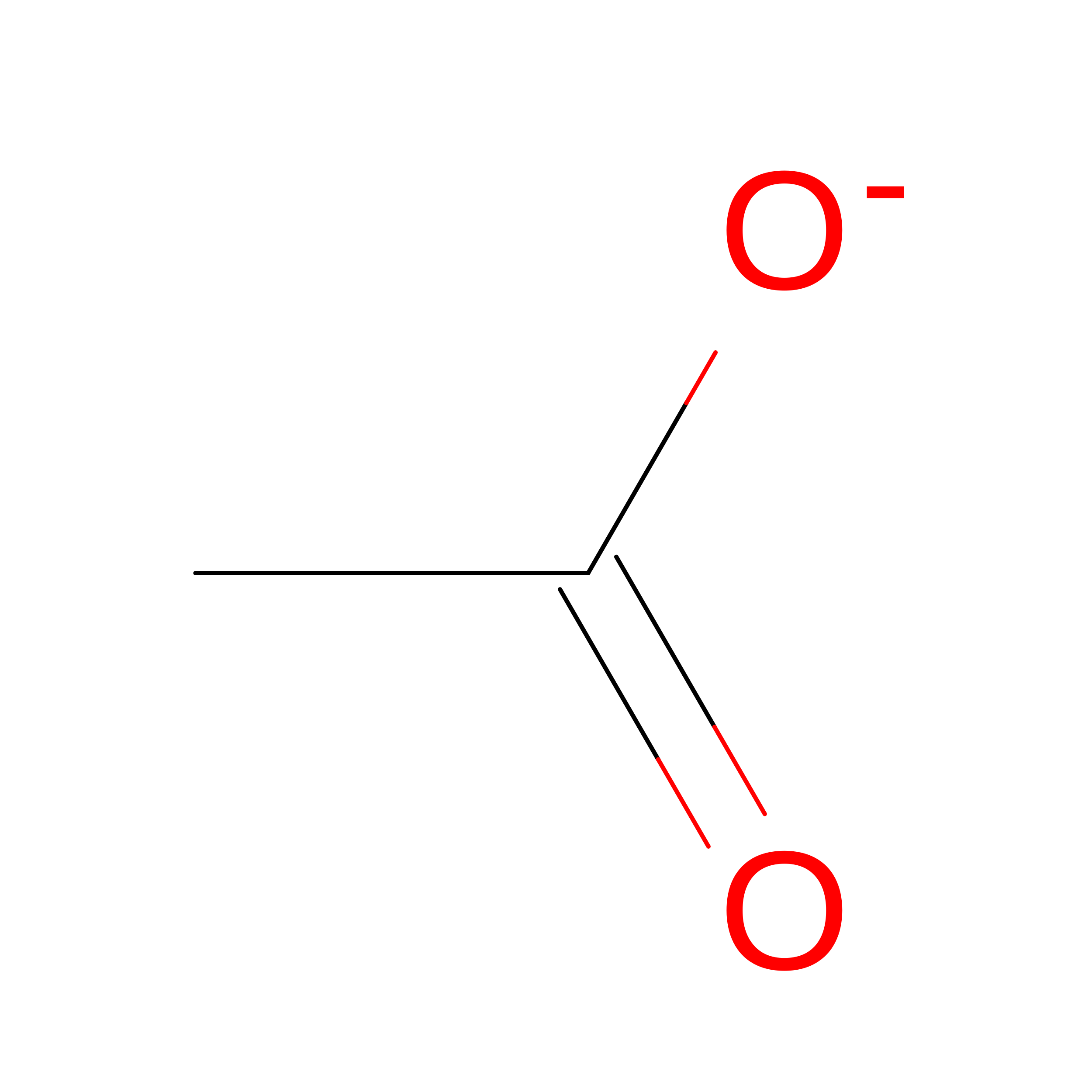
B [auth A]ACETATE ION
C2 H3 O2
QTBSBXVTEAMEQO-UHFFFAOYSA-M

Experimental Data & Validation

Experimental Data

  • Method: X-RAY DIFFRACTION
  • Resolution: 1.78 Å
  • R-Value Free:  0.222 (Depositor), 0.237 (DCC) 
  • R-Value Work:  0.189 (Depositor) 
Space Group: P 1 21 1
Unit Cell:
Length ( Å )Angle ( ˚ )
a = 46.663α = 90
b = 52.927β = 108.361
c = 54.967γ = 90
Software Package:
Software NamePurpose
REFMACrefinement
XDSdata reduction
Aimlessdata scaling
PHASERphasing

Structure Validation

View Full Validation Report


Entry History 

Deposition Data

Revision History  (Full details and data files)

  • Version 1.0: 2021-02-17
    Type: Initial release
  • Version 1.1: 2021-02-24
    Changes: Database references
  • Version 1.2: 2023-10-18
    Changes: Data collection, Database references, Refinement description