6VHO | pdb_00006vho

Glycoside hydrolase family 16 endo-glucanase from Bacteroides ovatus in complex with G4G4G3G-NHCOCH2Br


Experimental Data Snapshot

  • Method: X-RAY DIFFRACTION
  • Resolution: 2.15 Å
  • R-Value Free: 
    0.207 (Depositor), 0.207 (DCC) 
  • R-Value Work: 
    0.186 (Depositor), 0.186 (DCC) 

Starting Model: experimental
View more details

wwPDB Validation 3D Report Full Report

Validation slider image for 6VHO

This is version 1.4 of the entry. See complete history

Literature

Orthogonal Active-Site Labels for Mixed-Linkage endo-beta-Glucanases.

Jain, N.Tamura, K.Dejean, G.Van Petegem, F.Brumer, H.

(2021) ACS Chem Biol 16: 1968-1984

  • DOI: https://doi.org/10.1021/acschembio.1c00063
  • Primary Citation Related Structures: 
    6VHO, 7KR6

  • PubMed Abstract: 

    Small molecule irreversible inhibitors are valuable tools for determining catalytically important active-site residues and revealing key details of the specificity, structure, and function of glycoside hydrolases (GHs). β-glucans that contain backbone β(1,3) linkages are widespread in nature, e.g., mixed-linkage β(1,3)/β(1,4)-glucans in the cell walls of higher plants and β(1,3)glucans in yeasts and algae. Commensurate with this ubiquity, a large diversity of mixed-linkage endoglucanases (MLGases, EC 3.2.1.73) and endo-β(1,3)-glucanases (laminarinases, EC 3.2.1.39 and EC 3.2.1.6) have evolved to specifically hydrolyze these polysaccharides, respectively, in environmental niches including the human gut. To facilitate biochemical and structural analysis of these GHs, with a focus on MLGases, we present here the facile chemo-enzymatic synthesis of a library of active-site-directed enzyme inhibitors based on mixed-linkage oligosaccharide scaffolds and N -bromoacetylglycosylamine or 2-fluoro-2-deoxyglycoside warheads. The effectiveness and irreversibility of these inhibitors were tested with exemplar MLGases and an endo-β(1,3)-glucanase. Notably, determination of inhibitor-bound crystal structures of a human-gut microbial MLGase from Glycoside Hydrolase Family 16 revealed the orthogonal labeling of the nucleophile and catalytic acid/base residues with homologous 2-fluoro-2-deoxyglycoside and N -bromoacetylglycosylamine inhibitors, respectively. We anticipate that the selectivity of these inhibitors will continue to enable the structural and mechanistic analyses of β-glucanases from diverse sources and protein families.


  • Organizational Affiliation
    • Michael Smith Laboratories, University of British Columbia, 2185 East Mall, Vancouver, British Columbia V6T 1Z4, Canada.

Macromolecule Content 

  • Total Structure Weight: 61.85 kDa 
  • Atom Count: 4,030 
  • Modeled Residue Count: 474 
  • Deposited Residue Count: 544 
  • Unique protein chains: 1

Macromolecules

Find similar proteins by:|  3D Structure
Entity ID: 1
MoleculeChains  Sequence LengthOrganismDetailsImage
Glycosyl hydrolase family 16A [auth AAA],
B [auth BBB]
272Bacteroides ovatus ATCC 8483Mutation(s): 0 
Gene Names: BACOVA_02741

Oligosaccharides

Help  
Entity ID: 2
MoleculeChains Length2D Diagram GlycosylationD Interactions
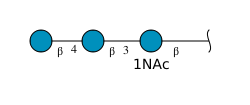
beta-D-glucopyranose-(1-4)-beta-D-glucopyranose-(1-3)-N-acetyl-beta-D-glucopyranosylamineC [auth A]3N/A
Glycosylation Resources
GlyTouCan: G49434ZI
GlyCosmos: G49434ZI

Experimental Data & Validation

Experimental Data

  • Method: X-RAY DIFFRACTION
  • Resolution: 2.15 Å
  • R-Value Free:  0.207 (Depositor), 0.207 (DCC) 
  • R-Value Work:  0.186 (Depositor), 0.186 (DCC) 
Space Group: C 1 2 1
Unit Cell:
Length ( Å )Angle ( ˚ )
a = 168.58α = 90
b = 61.15β = 93.608
c = 49.411γ = 90
Software Package:
Software NamePurpose
REFMACrefinement
XDSdata reduction
Cootmodel building
PHASERphasing
XSCALEdata scaling

Structure Validation

View Full Validation Report


Entry History 

& Funding Information

Deposition Data


Funding OrganizationLocationGrant Number
Canadian Institutes of Health Research (CIHR)Canada--

Revision History  (Full details and data files)

  • Version 1.0: 2021-01-13
    Type: Initial release
  • Version 1.1: 2021-05-19
    Changes: Advisory, Database references, Derived calculations
  • Version 1.2: 2021-05-26
    Changes: Database references
  • Version 1.3: 2021-10-27
    Changes: Database references
  • Version 1.4: 2023-10-11
    Changes: Data collection, Derived calculations, Refinement description