6HM5 | pdb_00006hm5

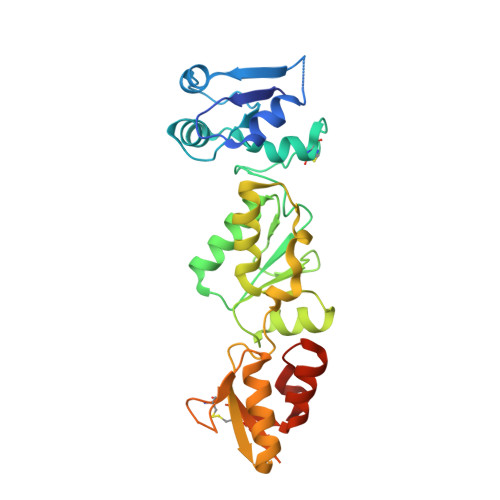
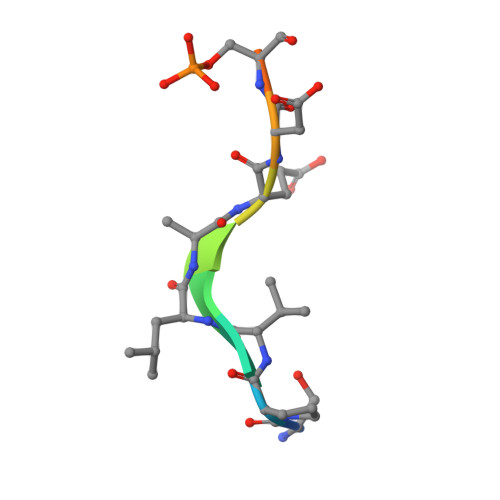
Crystal structure of TOPBP1 BRCT0,1,2 in complex with a RAD9 phosphopeptide


Experimental Data Snapshot

  • Method: X-RAY DIFFRACTION
  • Resolution: 2.33 Å
  • R-Value Free: 
    0.241 (Depositor), 0.247 (DCC) 
  • R-Value Work: 
    0.201 (Depositor), 0.207 (DCC) 
  • R-Value Observed: 
    0.205 (Depositor) 

wwPDB Validation 3D Report Full Report

Validation slider image for 6HM5

This is version 1.1 of the entry. See complete history

Literature

BRCT domains of the DNA damage checkpoint proteins TOPBP1/Rad4 display distinct specificities for phosphopeptide ligands.

Day, M.Rappas, M.Ptasinska, K.Boos, D.Oliver, A.W.Pearl, L.H.

(2018) Elife 7

  • DOI: https://doi.org/10.7554/eLife.39979
  • Primary Citation Related Structures: 
    6HM3, 6HM4, 6HM5

  • PubMed Abstract: 

    TOPBP1 and its fission yeast homologueRad4, are critical players in a range of DNA replication, repair and damage signalling processes. They are composed of multiple BRCT domains, some of which bind phosphorylated motifs in other proteins. They thus act as multi-point adaptors bringing proteins together into functional combinations, dependent on post-translational modifications downstream of cell cycle and DNA damage signals. We have now structurally and/or biochemically characterised a sufficient number of high-affinity complexes for the conserved N-terminal region of TOPBP1 and Rad4 with diverse phospho-ligands, including human RAD9 and Treslin, and Schizosaccharomyces pombe Crb2 and Sld3, to define the determinants of BRCT domain specificity. We use this to identify and characterise previously unknown phosphorylation-dependent TOPBP1/Rad4-binding motifs in human RHNO1 and the fission yeast homologue of MDC1, Mdb1. These results provide important insights into how multiple BRCT domains within TOPBP1/Rad4 achieve selective and combinatorial binding of their multiple partner proteins.


  • Organizational Affiliation
    • Cancer Research UK DNA Repair Enzymes Group, Genome Damage and Stability Centre, School of Life Sciences, University of Sussex, Falmer, United Kingdom.

Macromolecule Content 

  • Total Structure Weight: 34.37 kDa 
  • Atom Count: 2,114 
  • Modeled Residue Count: 259 
  • Deposited Residue Count: 301 
  • Unique protein chains: 2

Macromolecules

Find similar proteins by:|  3D Structure
Entity ID: 1
MoleculeChains  Sequence LengthOrganismDetailsImage
DNA topoisomerase II binding protein 1290Gallus gallusMutation(s): 0 
Gene Names: TOPBP1
UniProt
Find proteins for A0A1D5P3M9 (Gallus gallus)
Explore A0A1D5P3M9 
Go to UniProtKB:  A0A1D5P3M9
Entity Groups
Sequence Clusters30% Identity50% Identity70% Identity90% Identity95% Identity100% Identity
UniProt GroupA0A1D5P3M9
Sequence Annotations
Expand
Reference Sequence
Find similar proteins by:  Sequence   |   3D Structure  
Entity ID: 2
MoleculeChains  Sequence LengthOrganismDetailsImage
Cell cycle checkpoint control protein RAD9A11Homo sapiensMutation(s): 0 
EC: 3.1.11.2
UniProt & NIH Common Fund Data Resources
Find proteins for Q99638 (Homo sapiens)
Explore Q99638 
Go to UniProtKB:  Q99638
PHAROS:  Q99638
GTEx:  ENSG00000172613 
Entity Groups
Sequence Clusters30% Identity50% Identity70% Identity90% Identity95% Identity100% Identity
UniProt GroupQ99638
Sequence Annotations
Expand
Reference Sequence

Small Molecules

Modified Residues  1 Unique
IDChains TypeFormula2D DiagramParent
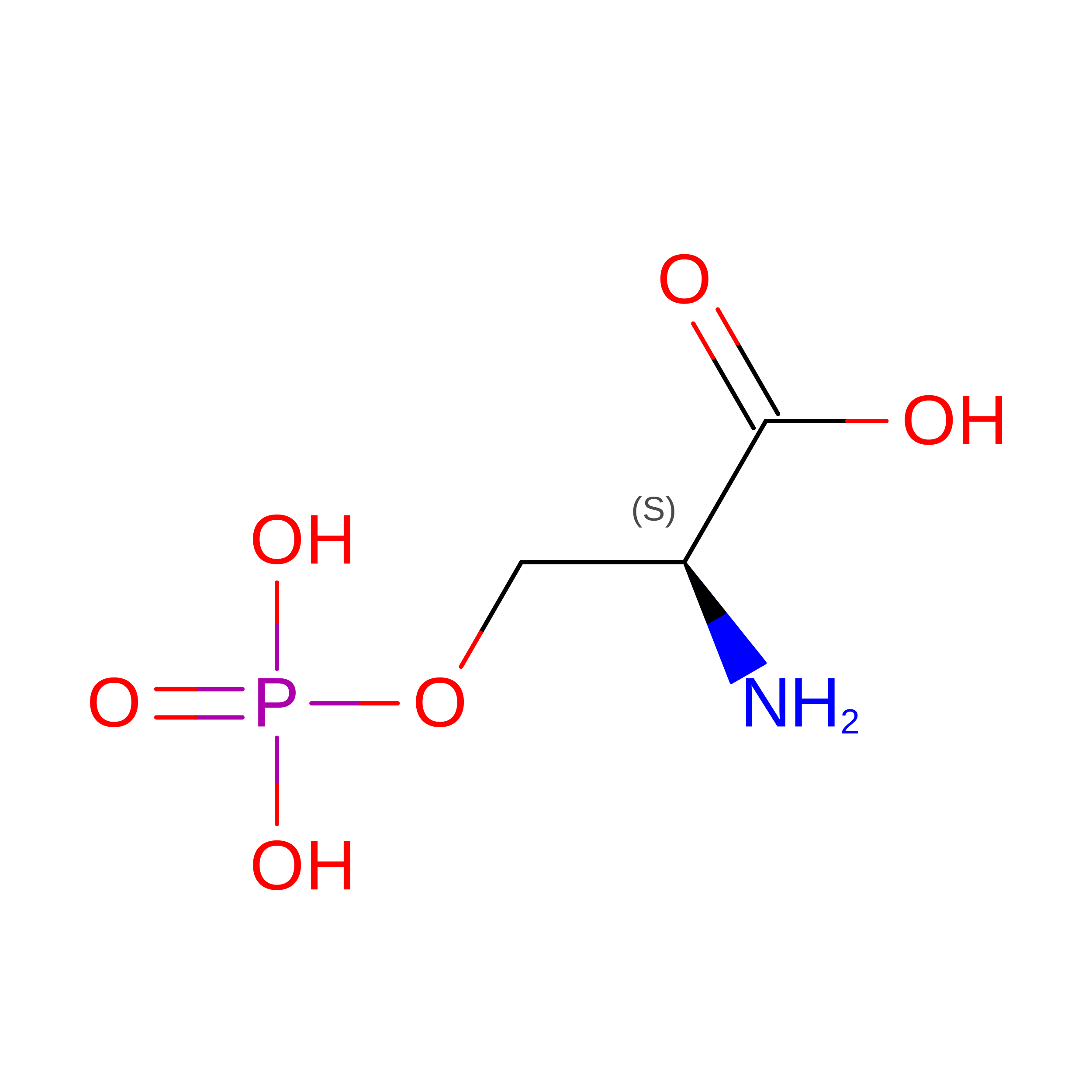
SEP
Query on SEP
B
L-PEPTIDE LINKINGC3 H8 N O6 PSER

Experimental Data & Validation

Experimental Data

  • Method: X-RAY DIFFRACTION
  • Resolution: 2.33 Å
  • R-Value Free:  0.241 (Depositor), 0.247 (DCC) 
  • R-Value Work:  0.201 (Depositor), 0.207 (DCC) 
  • R-Value Observed: 0.205 (Depositor) 
Space Group: P 1 21 1
Unit Cell:
Length ( Å )Angle ( ˚ )
a = 59.05α = 90
b = 34.07β = 103.57
c = 66.67γ = 90
Software Package:
Software NamePurpose
REFMACrefinement
PHENIXrefinement
xia2data reduction
Aimlessdata scaling
PHASERphasing

Structure Validation

View Full Validation Report


Entry History 

& Funding Information

Deposition Data


Funding OrganizationLocationGrant Number
Cancer Research UKUnited KingdomC302/A14532

Revision History  (Full details and data files)

  • Version 1.0: 2018-10-17
    Type: Initial release
  • Version 1.1: 2024-11-13
    Changes: Data collection, Database references, Structure summary