6HKU | pdb_00006hku

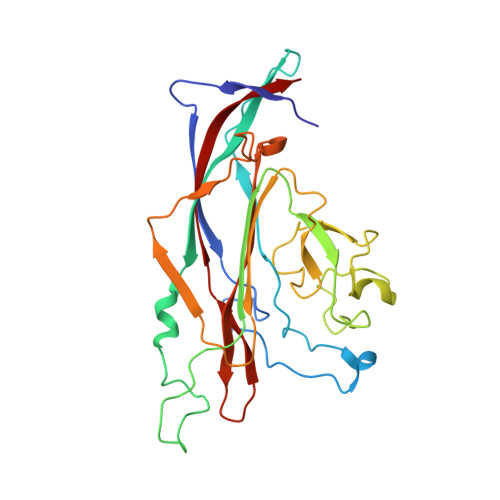
Trichodysplasia spinulosa-associated polyomavirus (TSPyV) VP1 in complex with sialylated precision glycooligomers


Experimental Data Snapshot

  • Method: X-RAY DIFFRACTION
  • Resolution: 1.98 Å
  • R-Value Free: 
    0.230 (Depositor), 0.206 (DCC) 
  • R-Value Work: 
    0.185 (Depositor) 
  • R-Value Observed: 
    0.185 (Depositor) 

Starting Model: experimental
View more details

wwPDB Validation 3D Report Full Report

Validation slider image for 6HKU

Ligand Structure Quality Assessment 


This is version 2.1 of the entry. See complete history

Literature

Divalent Sialylated Precision Glycooligomers Binding to Polyomaviruses and the Effect of Different Linkers.

Baier, M.Rustmeier, N.H.Harr, J.Cyrus, N.Reiss, G.J.Grafmuller, A.Blaum, B.S.Stehle, T.Hartmann, L.

(2019) Macromol Biosci 19: e1800426-e1800426

  • DOI: https://doi.org/10.1002/mabi.201800426
  • Primary Citation Related Structures: 
    6HKU, 6HKV

  • PubMed Abstract: 

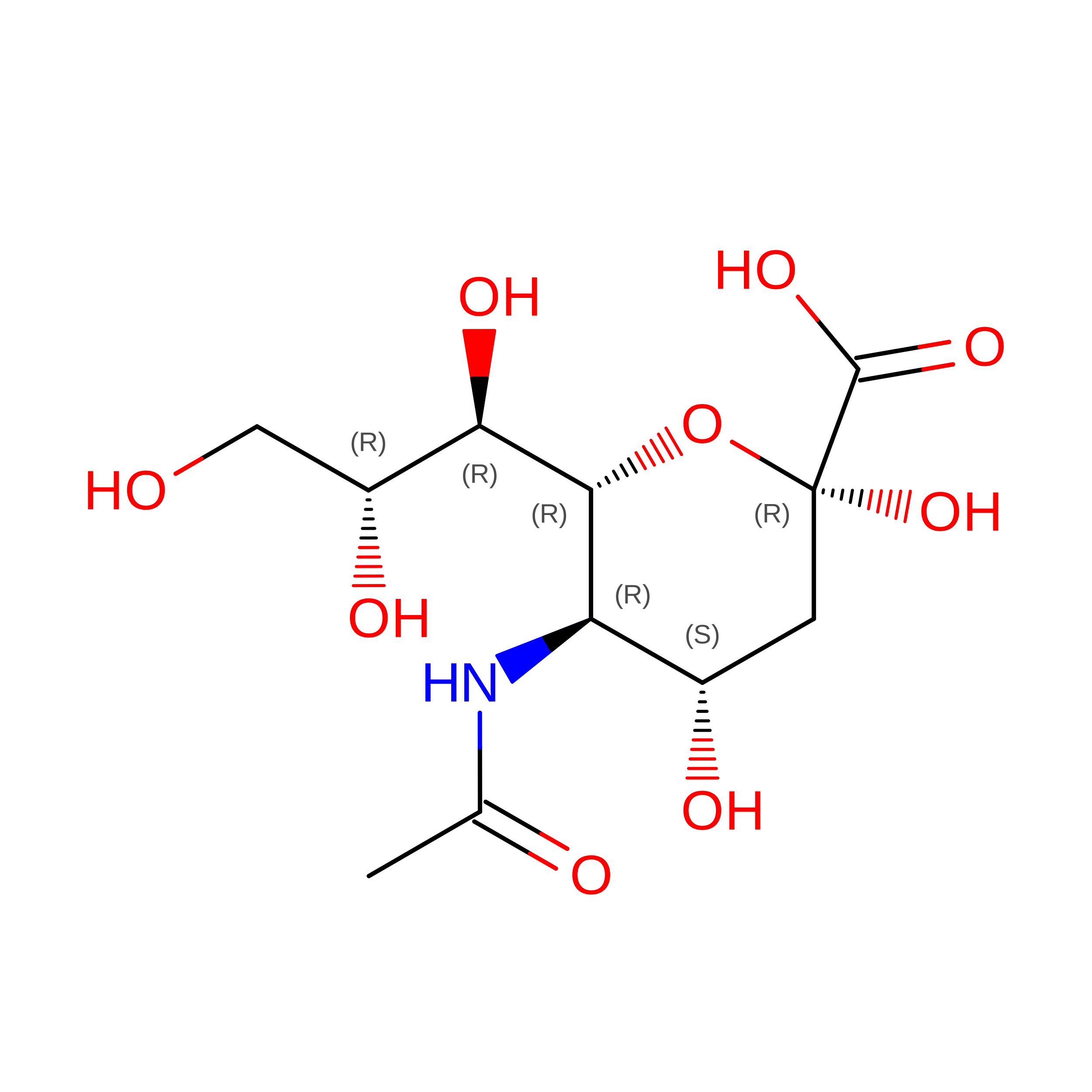
    Divalent precision glycooligomers terminating in N-acetylneuraminic acid (Neu5Ac) or 3'-sialyllactose (3'-SL) with varying linkers between scaffold and the glycan portions are synthesized via solid phase synthesis for co-crystallization studies with the sialic acid-binding major capsid protein VP1 of human Trichodysplasia spinulosa-associated Polyomavirus. High-resolution crystal structures of complexes demonstrate that the compounds bind to VP1 depending on the favorable combination of carbohydrate ligand and linker. It is found that artificial linkers can replace portions of natural carbohydrate linkers as long as they meet certain requirements such as size or flexibility to optimize contact area between ligand and receptor binding sites. The obtained results will influence the design of future high affinity ligands based on the structures presented here, and they can serve as a blueprint to develop multivalent glycooligomers as inhibitors of viral adhesion.


  • Organizational Affiliation
    • Institute of Organic and Macromolecular Chemistry, Heinrich-Heine-University Duesseldorf, Universitaetsstrasse 1, 40225, Duesseldorf, Germany.

Macromolecule Content 

  • Total Structure Weight: 305.38 kDa 
  • Atom Count: 23,268 
  • Modeled Residue Count: 2,696 
  • Deposited Residue Count: 2,720 
  • Unique protein chains: 1

Macromolecules

Find similar proteins by:|  3D Structure
Entity ID: 1
MoleculeChains  Sequence LengthOrganismDetailsImage
Capsid protein VP1
A, B, C, D, E
A, B, C, D, E, F, G, H, I, J
272Trichodysplasia spinulosa-associated polyomavirusMutation(s): 0 
Gene Names: VP1
UniProt
Find proteins for E2ESL7 (Trichodysplasia spinulosa-associated polyomavirus)
Explore E2ESL7 
Go to UniProtKB:  E2ESL7
Entity Groups
Sequence Clusters30% Identity50% Identity70% Identity90% Identity95% Identity100% Identity
UniProt GroupE2ESL7
Sequence Annotations
Expand
Reference Sequence

Oligosaccharides

Help  
Entity ID: 2
MoleculeChains Length2D Diagram GlycosylationD Interactions
N-acetyl-alpha-neuraminic acid-(2-3)-beta-D-galactopyranose
K, L, M
2N/A
Glycosylation Resources
GlyTouCan: G30207PZ
GlyCosmos: G30207PZ
GlyGen: G30207PZ
Entity ID: 3
MoleculeChains Length2D Diagram GlycosylationD Interactions
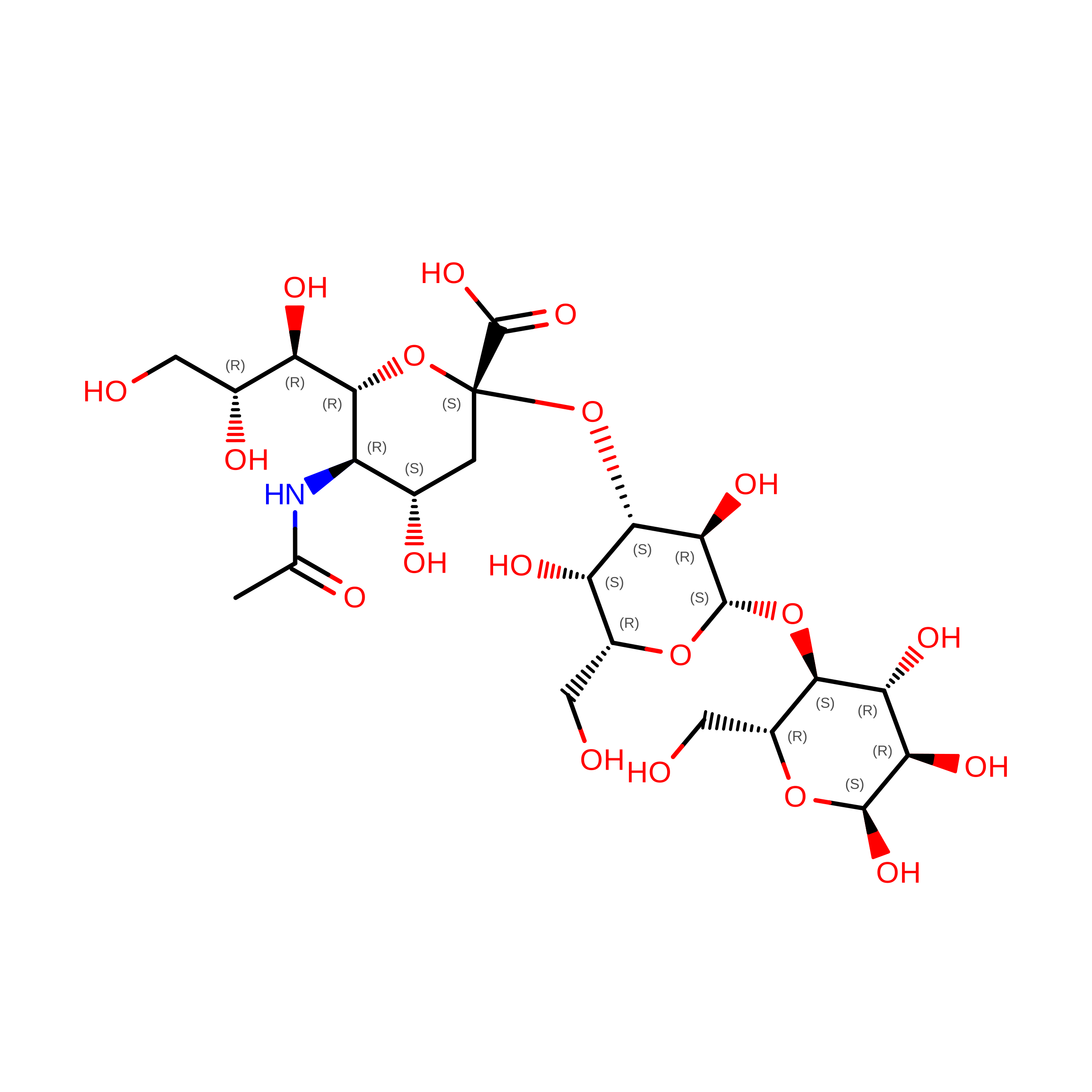
N-acetyl-alpha-neuraminic acid-(2-3)-beta-D-galactopyranose-(1-4)-alpha-D-glucopyranose
N, O
3N/A
Glycosylation Resources
GlyTouCan: G92323ZH
GlyCosmos: G92323ZH
GlyGen: G92323ZH

Biologically Interesting Molecules (External Reference) 

1 Unique

Experimental Data & Validation

Experimental Data

  • Method: X-RAY DIFFRACTION
  • Resolution: 1.98 Å
  • R-Value Free:  0.230 (Depositor), 0.206 (DCC) 
  • R-Value Work:  0.185 (Depositor) 
  • R-Value Observed: 0.185 (Depositor) 
Space Group: P 21 21 21
Unit Cell:
Length ( Å )Angle ( ˚ )
a = 139.277α = 90
b = 146.16β = 90
c = 150.413γ = 90
Software Package:
Software NamePurpose
REFMACrefinement
XDSdata reduction
PHASERphasing
PDB_EXTRACTdata extraction
XDSdata scaling

Structure Validation

View Full Validation Report


Ligand Structure Quality Assessment 


Entry History 

& Funding Information

Deposition Data


Funding OrganizationLocationGrant Number
GermanyFOR2327

Revision History  (Full details and data files)

  • Version 1.0: 2019-03-27
    Type: Initial release
  • Version 1.1: 2019-05-22
    Changes: Data collection, Database references
  • Version 2.0: 2020-07-29
    Type: Remediation
    Reason: Carbohydrate remediation
    Changes: Atomic model, Data collection, Derived calculations, Structure summary
  • Version 2.1: 2024-01-17
    Changes: Data collection, Database references, Derived calculations, Refinement description, Structure summary