Download Mendeley
Ligand Binding Remodels the Oligomeric State and Active Site of Klebsiella pneumoniae Azoreductase.
Hitchings, R., Ghosh, A., Arcinas, A.J., Almo, S.C., Kelly, L., Ryan, A.(2026) Biochemistry 65: 3236-3246
- PubMed: 42899598 Search on PubMed
- DOI: https://doi.org/10.1021/acs.biochem.6c00568
- Primary Citation Related Structures:
6DXP, 7N2W, 7N2X - PubMed Abstract:
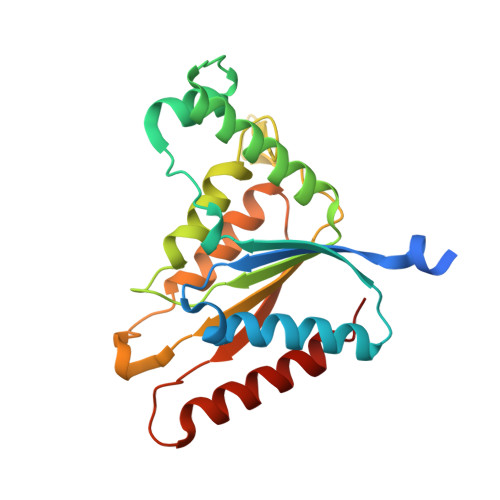
Azo dyes are widespread in the environment, and humans ingest a range of these dyes present in food and drugs. The human gut microbiome significantly impacts the fate of ingested azo dyes primarily through the reduction of the azo bond (R-N = N-R'). Flavin-dependent azoreductases have been considered the key enzymatic drivers of this process. To challenge this paradigm, we constructed a sequence similarity network of known azoreductases and focused on AzoA of Klebsiella pneumoniae, a central representative within the gut microbiome cluster. Unexpectedly, K. pneumoniae AzoA displayed relatively low in vitro activity against a range of azo compounds. While the physiological implications remain unclear, these findings are consistent with the possibility that nonenzymatic mechanisms contribute substantially to azo compound reduction in the gut. Furthermore, structural characterization of AzoA, as a holoenzyme and in its ligand-bound state, revealed a previously unrecognized ligand-coupled mechanism involving remodeling of the active site and oligomeric state.
- Department of Systems and Computational Biology, Albert Einstein College of Medicine, Bronx, New York10461, United States.
Organizational Affiliation: