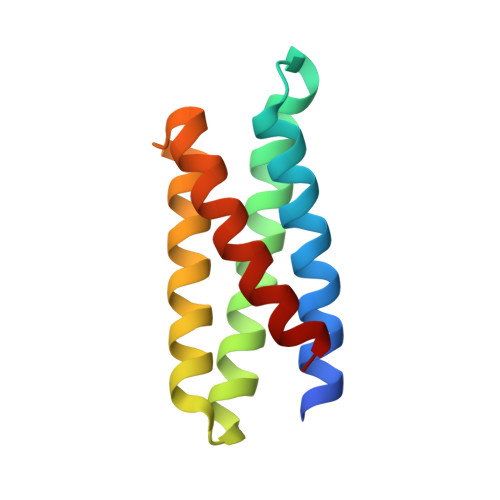
6DG6 | pdb_00006dg6

Structure of a de novo designed Interleukin-2/Interleukin-15 mimetic


Experimental Data Snapshot

  • Method: X-RAY DIFFRACTION
  • Resolution: 2.00 Å
  • R-Value Free: 
    0.226 (Depositor), 0.222 (DCC) 
  • R-Value Work: 
    0.204 (Depositor), 0.203 (DCC) 
  • R-Value Observed: 
    0.205 (Depositor) 

Starting Model: in silico
View more details

wwPDB Validation 3D Report Full Report

Validation slider image for 6DG6

This is version 1.4 of the entry. See complete history

Literature

De novo design of potent and selective mimics of IL-2 and IL-15.

Silva, D.A.Yu, S.Ulge, U.Y.Spangler, J.B.Jude, K.M.Labao-Almeida, C.Ali, L.R.Quijano-Rubio, A.Ruterbusch, M.Leung, I.Biary, T.Crowley, S.J.Marcos, E.Walkey, C.D.Weitzner, B.D.Pardo-Avila, F.Castellanos, J.Carter, L.Stewart, L.Riddell, S.R.Pepper, M.Bernardes, G.J.L.Dougan, M.Garcia, K.C.Baker, D.

(2019) Nature 565: 186-191

  • DOI: https://doi.org/10.1038/s41586-018-0830-7
  • Primary Citation Related Structures: 
    6DG5, 6DG6

  • PubMed Abstract: 

    We describe a de novo computational approach for designing proteins that recapitulate the binding sites of natural cytokines, but are otherwise unrelated in topology or amino acid sequence. We use this strategy to design mimics of the central immune cytokine interleukin-2 (IL-2) that bind to the IL-2 receptor βγ c heterodimer (IL-2Rβγ c ) but have no binding site for IL-2Rα (also called CD25) or IL-15Rα (also known as CD215). The designs are hyper-stable, bind human and mouse IL-2Rβγ c with higher affinity than the natural cytokines, and elicit downstream cell signalling independently of IL-2Rα and IL-15Rα. Crystal structures of the optimized design neoleukin-2/15 (Neo-2/15), both alone and in complex with IL-2Rβγ c , are very similar to the designed model. Neo-2/15 has superior therapeutic activity to IL-2 in mouse models of melanoma and colon cancer, with reduced toxicity and undetectable immunogenicity. Our strategy for building hyper-stable de novo mimetics could be applied generally to signalling proteins, enabling the creation of superior therapeutic candidates.


  • Organizational Affiliation
    • Institute for Protein Design, University of Washington, Seattle, WA, USA. dadriano@uw.edu.

Macromolecule Content 

  • Total Structure Weight: 72.68 kDa 
  • Atom Count: 4,791 
  • Modeled Residue Count: 597 
  • Deposited Residue Count: 624 
  • Unique protein chains: 1

Macromolecules

Find similar proteins by:|  3D Structure
Entity ID: 1
MoleculeChains  Sequence LengthOrganismDetailsImage
Neoleukin-2/15
A, B, C, D, E
A, B, C, D, E, F
104synthetic constructMutation(s): 0 

Experimental Data & Validation

Experimental Data

  • Method: X-RAY DIFFRACTION
  • Resolution: 2.00 Å
  • R-Value Free:  0.226 (Depositor), 0.222 (DCC) 
  • R-Value Work:  0.204 (Depositor), 0.203 (DCC) 
  • R-Value Observed: 0.205 (Depositor) 
Space Group: P 21 21 21
Unit Cell:
Length ( Å )Angle ( ˚ )
a = 73.73α = 90
b = 86.8β = 90
c = 92.31γ = 90
Software Package:
Software NamePurpose
XDSdata reduction
XSCALEdata scaling
PHASERphasing
PHENIXrefinement
PDB_EXTRACTdata extraction

Structure Validation

View Full Validation Report


Entry History 

& Funding Information

Deposition Data


Funding OrganizationLocationGrant Number
National Institutes of Health/National Institute Of Allergy and Infectious Diseases (NIH/NIAID)United StatesRO1-AI51321

Revision History  (Full details and data files)

  • Version 1.0: 2019-01-16
    Type: Initial release
  • Version 1.1: 2019-01-23
    Changes: Data collection, Database references
  • Version 1.2: 2019-12-18
    Changes: Author supporting evidence
  • Version 1.3: 2024-03-13
    Changes: Data collection, Database references
  • Version 1.4: 2024-04-03
    Changes: Refinement description