6ZQO | pdb_00006zqo

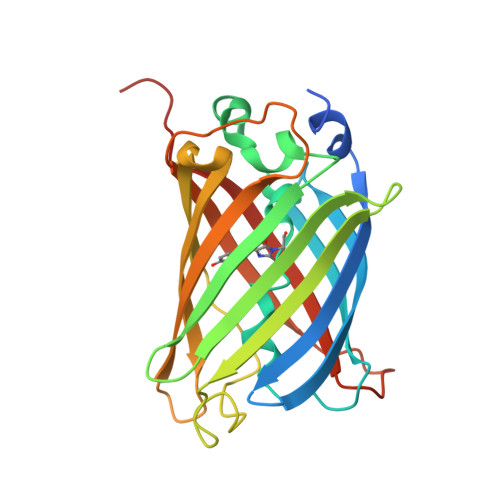
EYFP mutant - F165G


Experimental Data Snapshot

  • Method: X-RAY DIFFRACTION
  • Resolution: 2.20 Å
  • R-Value Free: 
    0.340 (Depositor), 0.347 (DCC) 
  • R-Value Work: 
    0.254 (Depositor), 0.269 (DCC) 
  • R-Value Observed: 
    0.259 (Depositor) 

Starting Model: experimental
View more details

wwPDB Validation 3D Report Full Report

Validation slider image for 6ZQO

This is version 1.3 of the entry. See complete history

Literature

Amino acid residue at the 165th position tunes EYFP chromophore maturation. A structure-based design.

Pletneva, N.V.Maksimov, E.G.Protasova, E.A.Mamontova, A.V.Simonyan, T.R.Ziganshin, R.H.Lukyanov, K.A.Muslinkina, L.Pletnev, S.Bogdanov, A.M.Pletnev, V.Z.

(2021) Comput Struct Biotechnol J 19: 2950-2959

  • DOI: https://doi.org/10.1016/j.csbj.2021.05.017
  • Primary Citation Related Structures: 
    6ZQO

  • PubMed Abstract: 

    For the whole GFP family, a few cases, when a single mutation in the chromophore environment strongly inhibits maturation, were described. Here we study EYFP-F165G - a variant of the enhanced yellow fluorescent protein - obtained by a single F165G replacement, and demonstrated multiple fluorescent states represented by the minor emission peaks in blue and yellow ranges (~470 and ~530 nm), and the major peak at ~330 nm. The latter has been assigned to tryptophan fluorescence, quenched due to excitation energy transfer to the mature chromophore in the parental EYFP protein. EYFP-F165G crystal structure revealed two general independent routes of post-translational chemistry, resulting in two main states of the polypeptide chain with the intact chromophore forming triad (~85%) and mature chromophore (~15%). Our experiments thus highlighted important stereochemical role of the 165th position strongly affecting spectral characteristics of the protein. On the basis of the determined EYFP-F165G three-dimensional structure, new variants with ~ 2-fold improved brightness were engineered.


  • Organizational Affiliation
    • Shemyakin-Ovchinnikov Institute of Bioorganic Chemistry, Moscow 117997, Russia.

Macromolecule Content 

  • Total Structure Weight: 28.42 kDa 
  • Atom Count: 1,887 
  • Modeled Residue Count: 230 
  • Deposited Residue Count: 249 
  • Unique protein chains: 1

Macromolecules

Find similar proteins by:|  3D Structure
Entity ID: 1
MoleculeChains  Sequence LengthOrganismDetailsImage
G protein/GFP fusion protein249Recombinant vesicular stomatitis Indiana virus rVSV-G/GFPMutation(s): 6 
Gene Names: GGFP
UniProt
Find proteins for B7UCZ6 (Recombinant vesicular stomatitis Indiana virus rVSV-G/GFP)
Explore B7UCZ6 
Go to UniProtKB:  B7UCZ6
Entity Groups
Sequence Clusters30% Identity50% Identity70% Identity90% Identity95% Identity100% Identity
UniProt GroupB7UCZ6
Sequence Annotations
Expand
Reference Sequence

Small Molecules

Ligands 1 Unique
IDChains Name / Formula / InChI Key2D Diagram3D Interactions
SO4

Query on SO4


Download:Ideal Coordinates CCD File
B [auth A]SULFATE ION
O4 S
QAOWNCQODCNURD-UHFFFAOYSA-L
Modified Residues  1 Unique
IDChains TypeFormula2D DiagramParent
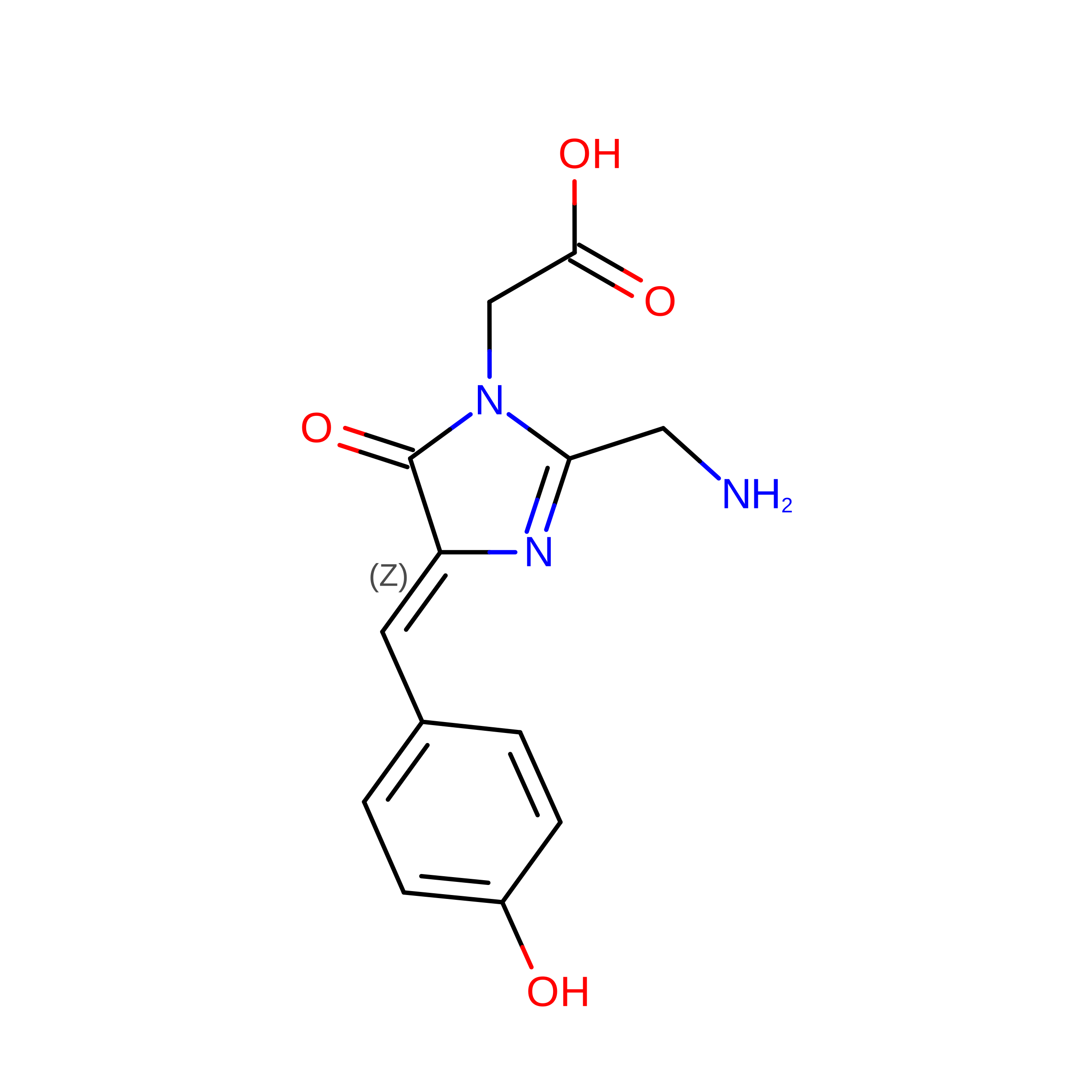
CR2
Query on CR2
A
L-PEPTIDE LINKINGC13 H13 N3 O4GLY, TYR, GLY

Experimental Data & Validation

Experimental Data

  • Method: X-RAY DIFFRACTION
  • Resolution: 2.20 Å
  • R-Value Free:  0.340 (Depositor), 0.347 (DCC) 
  • R-Value Work:  0.254 (Depositor), 0.269 (DCC) 
  • R-Value Observed: 0.259 (Depositor) 
Space Group: P 41 21 2
Unit Cell:
Length ( Å )Angle ( ˚ )
a = 57.888α = 90
b = 57.888β = 90
c = 168.838γ = 90
Software Package:
Software NamePurpose
REFMACrefinement
HKL-2000data reduction
HKL-2000data scaling
PDB_EXTRACTdata extraction
REFMACphasing

Structure Validation

View Full Validation Report


Entry History 

& Funding Information

Deposition Data


Funding OrganizationLocationGrant Number
Russian Foundation for Basic ResearchRussian Federation19-04-00107

Revision History  (Full details and data files)

  • Version 1.0: 2021-06-16
    Type: Initial release
  • Version 1.1: 2021-06-30
    Changes: Database references
  • Version 1.2: 2024-01-31
    Changes: Data collection, Database references, Refinement description
  • Version 1.3: 2024-10-16
    Changes: Structure summary