6ZMJ | pdb_00006zmj

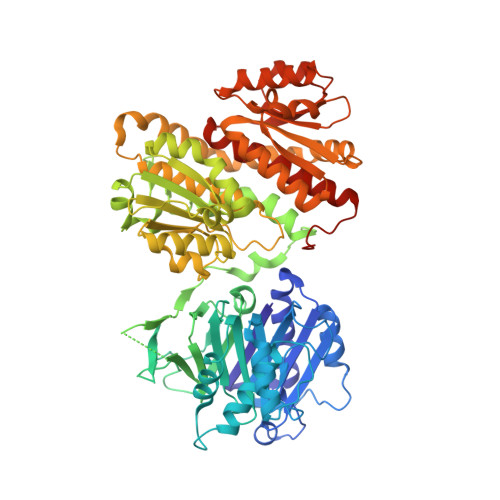
Crystal structure of human GFAT-1 R203H


Experimental Data Snapshot

  • Method: X-RAY DIFFRACTION
  • Resolution: 2.77 Å
  • R-Value Free: 
    0.239 (Depositor), 0.241 (DCC) 
  • R-Value Work: 
    0.201 (Depositor), 0.207 (DCC) 
  • R-Value Observed: 
    0.202 (Depositor) 

Starting Model: experimental
View more details

wwPDB Validation 3D Report Full Report

Validation slider image for 6ZMJ

Ligand Structure Quality Assessment 


This is version 1.2 of the entry. See complete history

Literature

Protein kinase A controls the hexosamine pathway by tuning the feedback inhibition of GFAT-1.

Ruegenberg, S.Mayr, F.A.M.C.Atanassov, I.Baumann, U.Denzel, M.S.

(2021) Nat Commun 12: 2176-2176

  • DOI: https://doi.org/10.1038/s41467-021-22320-y
  • Primary Citation Related Structures: 
    6ZMJ, 6ZMK, 7NDL

  • PubMed Abstract: 

    The hexosamine pathway (HP) is a key anabolic pathway whose product uridine 5'-diphospho-N-acetyl-D-glucosamine (UDP-GlcNAc) is an essential precursor for glycosylation processes in mammals. It modulates the ER stress response and HP activation extends lifespan in Caenorhabditis elegans. The highly conserved glutamine fructose-6-phosphate amidotransferase 1 (GFAT-1) is the rate-limiting HP enzyme. GFAT-1 activity is modulated by UDP-GlcNAc feedback inhibition and via phosphorylation by protein kinase A (PKA). Molecular consequences of GFAT-1 phosphorylation, however, remain poorly understood. Here, we identify the GFAT-1 R203H substitution that elevates UDP-GlcNAc levels in C. elegans. In human GFAT-1, the R203H substitution interferes with UDP-GlcNAc inhibition and with PKA-mediated Ser205 phosphorylation. Our data indicate that phosphorylation affects the interactions of the two GFAT-1 domains to control catalytic activity. Notably, Ser205 phosphorylation has two discernible effects: it lowers baseline GFAT-1 activity and abolishes UDP-GlcNAc feedback inhibition. PKA controls the HP by uncoupling the metabolic feedback loop of GFAT-1.


  • Organizational Affiliation
    • Max Planck Institute for Biology of Ageing, Cologne, Germany.

Macromolecule Content 

  • Total Structure Weight: 156.02 kDa 
  • Atom Count: 10,329 
  • Modeled Residue Count: 1,298 
  • Deposited Residue Count: 1,374 
  • Unique protein chains: 1

Macromolecules

Find similar proteins by:|  3D Structure
Entity ID: 1
MoleculeChains  Sequence LengthOrganismDetailsImage
Glutamine--fructose-6-phosphate aminotransferase [isomerizing] 1
A, B
687Homo sapiensMutation(s): 1 
Gene Names: GFPT1GFATGFPT
EC: 2.6.1.16
UniProt & NIH Common Fund Data Resources
Find proteins for Q06210 (Homo sapiens)
Explore Q06210 
Go to UniProtKB:  Q06210
PHAROS:  Q06210
GTEx:  ENSG00000198380 
Entity Groups
Sequence Clusters30% Identity50% Identity70% Identity90% Identity95% Identity100% Identity
UniProt GroupQ06210
Sequence Annotations
Expand
Reference Sequence

Experimental Data & Validation

Experimental Data

  • Method: X-RAY DIFFRACTION
  • Resolution: 2.77 Å
  • R-Value Free:  0.239 (Depositor), 0.241 (DCC) 
  • R-Value Work:  0.201 (Depositor), 0.207 (DCC) 
  • R-Value Observed: 0.202 (Depositor) 
Space Group: P 41 21 2
Unit Cell:
Length ( Å )Angle ( ˚ )
a = 152.766α = 90
b = 152.766β = 90
c = 164.81γ = 90
Software Package:
Software NamePurpose
PHENIXrefinement
PDB_EXTRACTdata extraction
XDSdata reduction
XDSdata scaling
PHENIXphasing

Structure Validation

View Full Validation Report


Ligand Structure Quality Assessment 


Entry History 

& Funding Information

Deposition Data


Funding OrganizationLocationGrant Number
German Federal Ministry for Education and ResearchGermany01GQ1423A
European CommissionGermanyERC-2014-StG-640254-MetAGEn
German Research Foundation (DFG)GermanyINST 216/949-1 FUGG

Revision History  (Full details and data files)

  • Version 1.0: 2020-08-05
    Type: Initial release
  • Version 1.1: 2021-04-28
    Changes: Database references
  • Version 1.2: 2024-01-31
    Changes: Data collection, Database references, Refinement description