6YME | pdb_00006yme

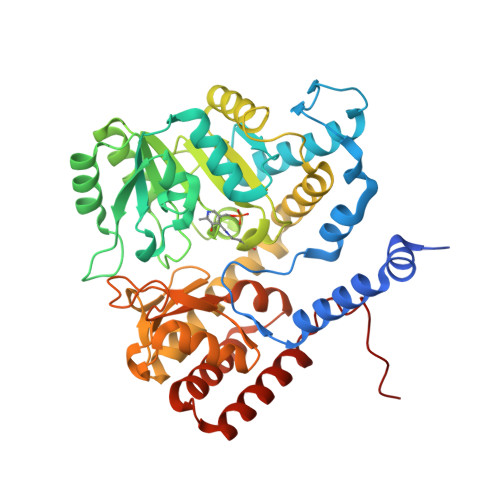
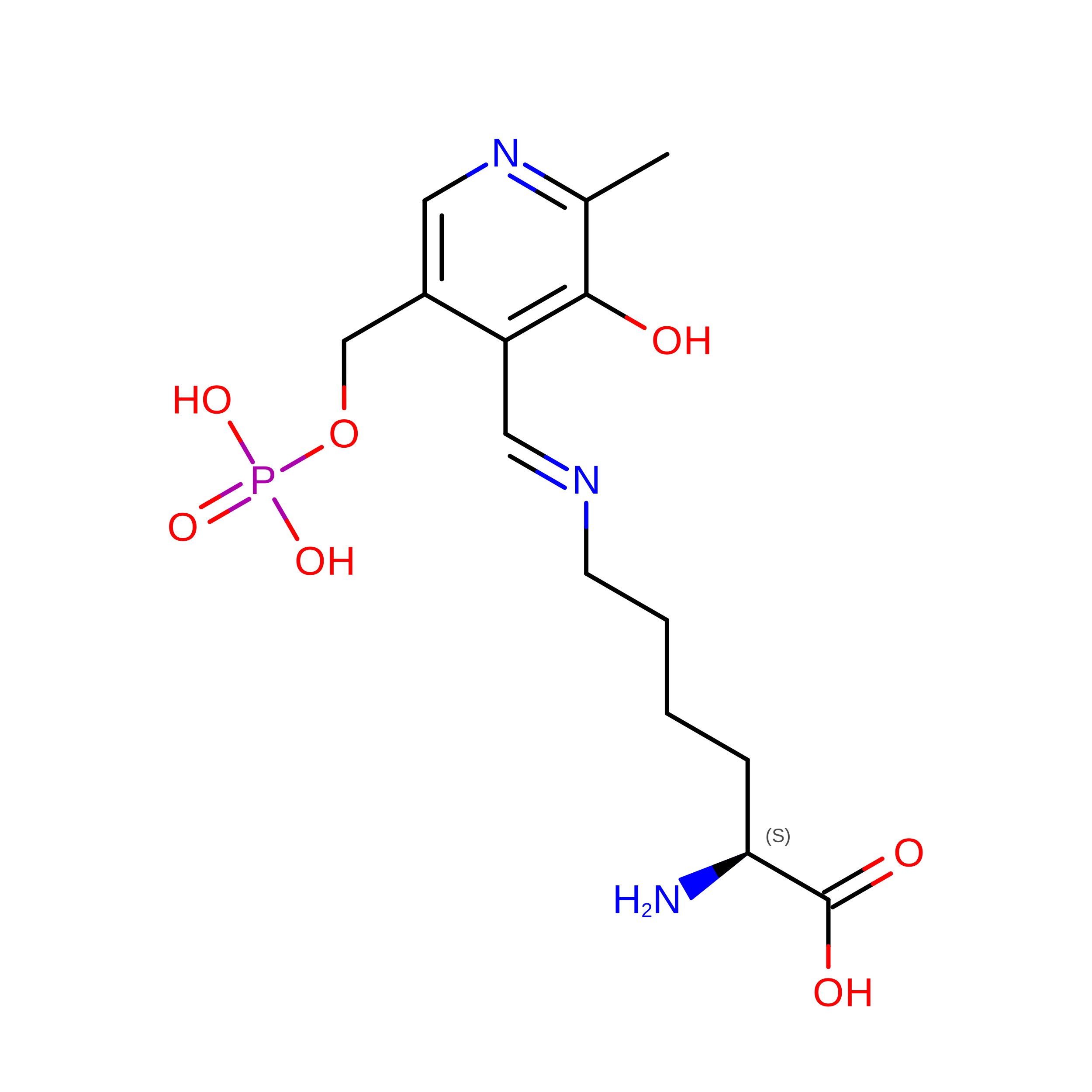
Crystal structure of serine hydroxymethyltransferase from Aphanothece halophytica in the PLP-internal aldimine state


Experimental Data Snapshot

  • Method: X-RAY DIFFRACTION
  • Resolution: 1.77 Å
  • R-Value Free: 
    0.175 (Depositor), 0.178 (DCC) 
  • R-Value Work: 
    0.141 (Depositor), 0.154 (DCC) 
  • R-Value Observed: 
    0.142 (Depositor) 

Starting Model: experimental
View more details

wwPDB Validation 3D Report Full Report

Validation slider image for 6YME

This is version 1.3 of the entry. See complete history

Literature

Structural and kinetic properties of serine hydroxymethyltransferase from the halophytic cyanobacterium Aphanothece halophytica provide a rationale for salt tolerance.

Nogues, I.Tramonti, A.Angelaccio, S.Ruszkowski, M.Sekula, B.Contestabile, R.

(2020) Int J Biol Macromol 159: 517-529

  • DOI: https://doi.org/10.1016/j.ijbiomac.2020.05.081
  • Primary Citation Related Structures: 
    6YMD, 6YME, 6YMF

  • PubMed Abstract: 

    Serine hydroxymethyltransferase (SHMT) is a pyridoxal 5'-phosphate-dependent enzyme that plays a pivotal role in cellular one‑carbon metabolism. In plants and cyanobacteria, this enzyme is also involved in photorespiration and confers salt tolerance, as in the case of SHMT from the halophilic cyanobacterium Aphanothece halophytica (AhSHMT). We have characterized the catalytic properties of AhSHMT in different salt and pH conditions. Although the kinetic properties of AhSHMT correlate with those of the mesophilic orthologue from Escherichia coli, AhSHMT appears more catalytically efficient, especially in presence of salt. Our studies also reveal substrate inhibition, previously unobserved in AhSHMT. Furthermore, addition of the osmoprotectant glycine betaine under salt conditions has a distinct positive effect on AhSHMT activity. The crystal structures of AhSHMT in three forms, as internal aldimine, as external aldimine with the l-serine substrate, and as a covalent complex with malonate, give structural insights on the possible role of specific amino acid residues implicated in the halophilic features of AhSHMT. Importantly, we observed that overexpression of the gene encoding SHMT, independently from its origin, increases the capability of E. coli to grow in high salt conditions, suggesting that the catalytic activity of this enzyme in itself plays a fundamental role in salt tolerance.


  • Organizational Affiliation
    • Istituto di Ricerca sugli Ecosistemi Terrestri, Consiglio Nazionale delle Ricerche, Monterotondo, Italy.

Macromolecule Content 

  • Total Structure Weight: 49.45 kDa 
  • Atom Count: 3,791 
  • Modeled Residue Count: 425 
  • Deposited Residue Count: 447 
  • Unique protein chains: 1

Macromolecules

Find similar proteins by:|  3D Structure
Entity ID: 1
MoleculeChains  Sequence LengthOrganismDetailsImage
Serine hydroxymethyltransferase447Aphanothece halophyticaMutation(s): 0 
Gene Names: glyrAglyA
EC: 2.1.2.1
UniProt
Find proteins for I7H6W6 (Aphanothece halophytica)
Explore I7H6W6 
Go to UniProtKB:  I7H6W6
Entity Groups
Sequence Clusters30% Identity50% Identity70% Identity90% Identity95% Identity100% Identity
UniProt GroupI7H6W6
Sequence Annotations
Expand
Reference Sequence

Experimental Data & Validation

Experimental Data

  • Method: X-RAY DIFFRACTION
  • Resolution: 1.77 Å
  • R-Value Free:  0.175 (Depositor), 0.178 (DCC) 
  • R-Value Work:  0.141 (Depositor), 0.154 (DCC) 
  • R-Value Observed: 0.142 (Depositor) 
Space Group: P 31 2 1
Unit Cell:
Length ( Å )Angle ( ˚ )
a = 94.383α = 90
b = 94.383β = 90
c = 134.466γ = 120
Software Package:
Software NamePurpose
REFMACrefinement
XDSdata reduction
XSCALEdata scaling
REFMACphasing

Structure Validation

View Full Validation Report


Entry History 

& Funding Information

Deposition Data


Funding OrganizationLocationGrant Number
National Institutes of Health/National Cancer Institute (NIH/NCI)United StatesIntramural Research Program

Revision History  (Full details and data files)

  • Version 1.0: 2020-06-03
    Type: Initial release
  • Version 1.1: 2020-06-10
    Changes: Database references
  • Version 1.2: 2020-06-17
    Changes: Data collection
  • Version 1.3: 2024-01-24
    Changes: Data collection, Database references, Refinement description