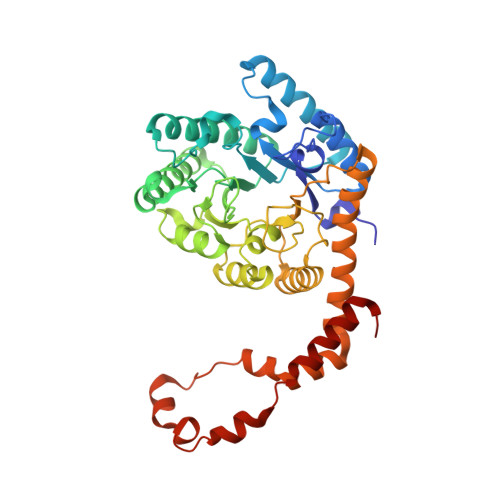
6YBR | pdb_00006ybr

RT structure of Glucose Isomerase obtained at 1.20 A resolution from crystal grown in a Mylar microchip.


Experimental Data Snapshot

  • Method: X-RAY DIFFRACTION
  • Resolution: 1.20 Å
  • R-Value Free: 
    0.131 (Depositor), 0.135 (DCC) 
  • R-Value Work: 
    0.121 (Depositor), 0.127 (DCC) 
  • R-Value Observed: 
    0.121 (Depositor) 

Starting Model: experimental
View more details

wwPDB Validation 3D Report Full Report

Validation slider image for 6YBR

This is version 1.2 of the entry. See complete history

Literature

Attaining atomic resolution from in situ data collection at room temperature using counter-diffusion-based low-cost microchips.

Gavira, J.A.Rodriguez-Ruiz, I.Martinez-Rodriguez, S.Basu, S.Teychene, S.McCarthy, A.A.Mueller-Dieckman, C.

(2020) Acta Crystallogr D Struct Biol 76: 751-758

  • DOI: https://doi.org/10.1107/S2059798320008475
  • Primary Citation Related Structures: 
    6YBF, 6YBI, 6YBO, 6YBR, 6YBX, 6YC5

  • PubMed Abstract: 

    Sample handling and manipulation for cryoprotection currently remain critical factors in X-ray structural determination. While several microchips for macromolecular crystallization have been proposed during the last two decades to partially overcome crystal-manipulation issues, increased background noise originating from the scattering of chip-fabrication materials has so far limited the attainable resolution of diffraction data. Here, the conception and use of low-cost, X-ray-transparent microchips for in situ crystallization and direct data collection, and structure determination at atomic resolution close to 1.0 Å, is presented. The chips are fabricated by a combination of either OSTEMER and Kapton or OSTEMER and Mylar materials for the implementation of counter-diffusion crystallization experiments. Both materials produce a sufficiently low scattering background to permit atomic resolution diffraction data collection at room temperature and the generation of 3D structural models of the tested model proteins lysozyme, thaumatin and glucose isomerase. Although the high symmetry of the three model protein crystals produced almost complete data sets at high resolution, the potential of in-line data merging and scaling of the multiple crystals grown along the microfluidic channels is also presented and discussed.


  • Organizational Affiliation
    • Laboratorio de Estudios Cristalográficos, IACT, CSIC-Universidad de Granada, Avenida Las Palmeras 4, 18100 Armilla, Spain.

Macromolecule Content 

  • Total Structure Weight: 43.38 kDa 
  • Atom Count: 3,703 
  • Modeled Residue Count: 385 
  • Deposited Residue Count: 388 
  • Unique protein chains: 1

Macromolecules

Find similar proteins by:|  3D Structure
Entity ID: 1
MoleculeChains  Sequence LengthOrganismDetailsImage
Xylose isomerase388Streptomyces pseudogriseolusMutation(s): 0 
EC: 5.3.1.5
UniProt
Find proteins for P24300 (Streptomyces pseudogriseolus)
Explore P24300 
Go to UniProtKB:  P24300
Entity Groups
Sequence Clusters30% Identity50% Identity70% Identity90% Identity95% Identity100% Identity
UniProt GroupP24300
Sequence Annotations
Expand
Reference Sequence

Experimental Data & Validation

Experimental Data

  • Method: X-RAY DIFFRACTION
  • Resolution: 1.20 Å
  • R-Value Free:  0.131 (Depositor), 0.135 (DCC) 
  • R-Value Work:  0.121 (Depositor), 0.127 (DCC) 
  • R-Value Observed: 0.121 (Depositor) 
Space Group: I 2 2 2
Unit Cell:
Length ( Å )Angle ( ˚ )
a = 93.99α = 90
b = 99.38β = 90
c = 103.1γ = 90
Software Package:
Software NamePurpose
MxCuBEdata collection
XDSdata reduction
PHASERphasing
PHENIXrefinement
Cootmodel building
Aimlessdata scaling

Structure Validation

View Full Validation Report


Entry History 

& Funding Information

Deposition Data


Funding OrganizationLocationGrant Number
Ministry of Economy and Competitiveness (MINECO)SpainBIO2016-74875-P

Revision History  (Full details and data files)

  • Version 1.0: 2020-08-12
    Type: Initial release
  • Version 1.1: 2020-08-19
    Changes: Database references
  • Version 1.2: 2024-01-24
    Changes: Data collection, Database references, Refinement description