6Y3J | pdb_00006y3j

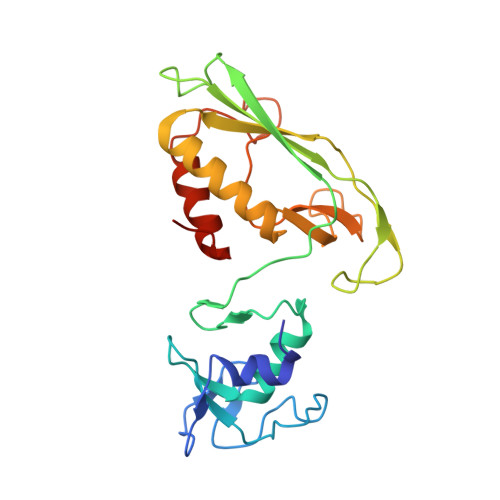
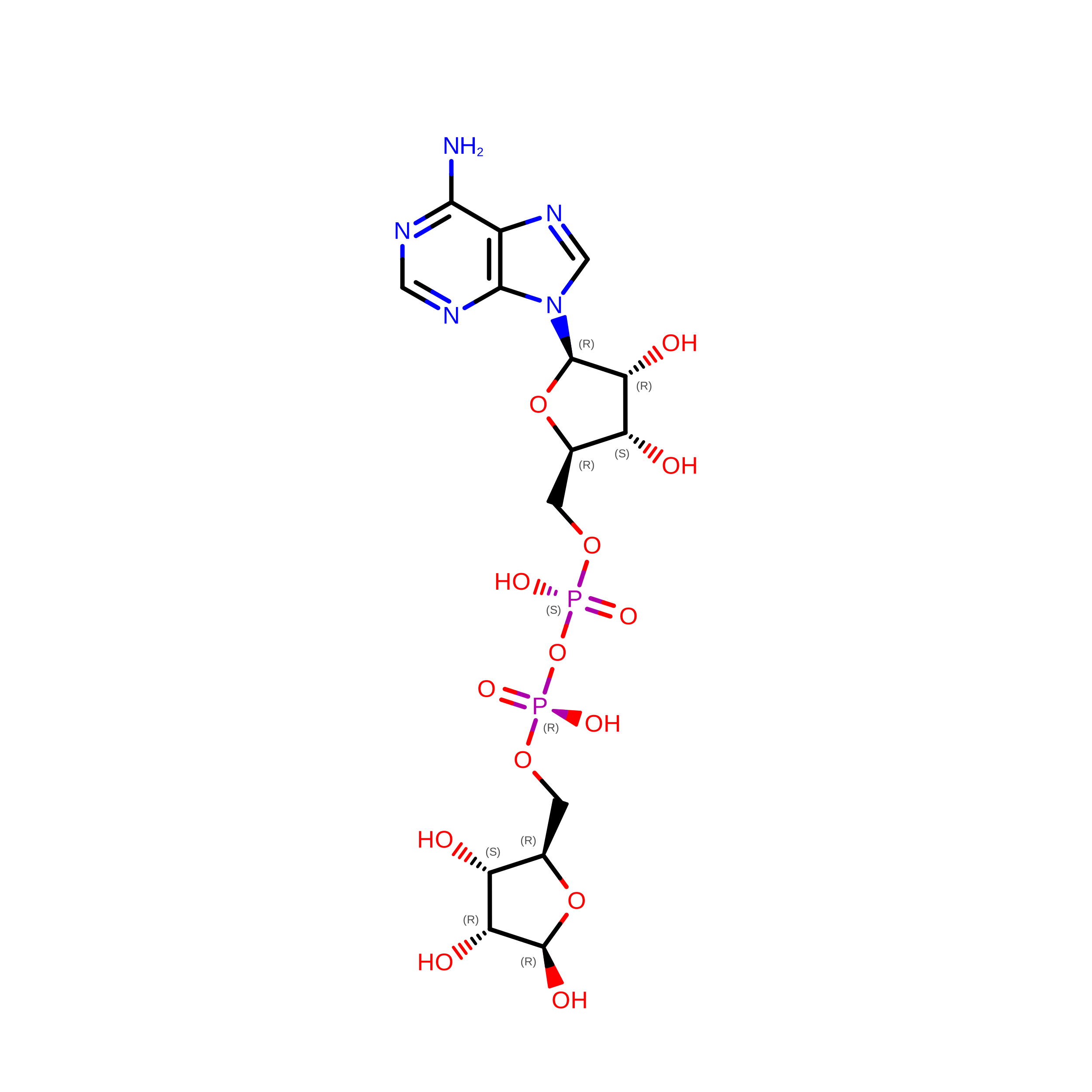
RING-DTC domains of Deltex 2, bound to ADP-ribose


Experimental Data Snapshot

  • Method: X-RAY DIFFRACTION
  • Resolution: 2.60 Å
  • R-Value Free: 
    0.282 (Depositor), 0.272 (DCC) 
  • R-Value Work: 
    0.238 (Depositor) 
  • R-Value Observed: 
    0.240 (Depositor) 

Starting Model: experimental
View more details

wwPDB Validation 3D Report Full Report

Validation slider image for 6Y3J

Ligand Structure Quality Assessment 


This is version 1.2 of the entry. See complete history

Literature

DELTEX2 C-terminal domain recognizes and recruits ADP-ribosylated proteins for ubiquitination.

Ahmed, S.F.Buetow, L.Gabrielsen, M.Lilla, S.Chatrin, C.Sibbet, G.J.Zanivan, S.Huang, D.T.

(2020) Sci Adv 6

  • DOI: https://doi.org/10.1126/sciadv.abc0629
  • Primary Citation Related Structures: 
    6Y22, 6Y2X, 6Y3J

  • PubMed Abstract: 

    Cross-talk between ubiquitination and ADP-ribosylation regulates spatiotemporal recruitment of key players in many signaling pathways. The DELTEX family ubiquitin ligases (DTX1 to DTX4 and DTX3L) are characterized by a RING domain followed by a C-terminal domain (DTC) of hitherto unknown function. Here, we use two label-free mass spectrometry techniques to investigate the interactome and ubiquitinated substrates of human DTX2 and identify a large proportion of proteins associated with the DNA damage repair pathway. We show that DTX2-catalyzed ubiquitination of these interacting proteins requires PARP1/2-mediated ADP-ribosylation and depends on the DTC domain. Using a combination of structural, biochemical, and cell-based techniques, we show that the DTX2 DTC domain harbors an ADP-ribose-binding pocket and recruits poly-ADP-ribose (PAR)-modified proteins for ubiquitination. This PAR-binding property of DTC domain is conserved across the DELTEX family E3s. These findings uncover a new ADP-ribose-binding domain that facilitates PAR-dependent ubiquitination.


  • Organizational Affiliation
    • Cancer Research UK Beatson Institute, Garscube Estate, Switchback Road, Glasgow G61 1BD, UK.

Macromolecule Content 

  • Total Structure Weight: 26.62 kDa 
  • Atom Count: 1,790 
  • Modeled Residue Count: 227 
  • Deposited Residue Count: 235 
  • Unique protein chains: 1

Macromolecules

Find similar proteins by:|  3D Structure
Entity ID: 1
MoleculeChains  Sequence LengthOrganismDetailsImage
Probable E3 ubiquitin-protein ligase DTX2235Homo sapiensMutation(s): 0 
Gene Names: DTX2KIAA1528RNF58
EC: 2.3.2.27
UniProt & NIH Common Fund Data Resources
Find proteins for Q86UW9 (Homo sapiens)
Explore Q86UW9 
Go to UniProtKB:  Q86UW9
PHAROS:  Q86UW9
GTEx:  ENSG00000091073 
Entity Groups
Sequence Clusters30% Identity50% Identity70% Identity90% Identity95% Identity100% Identity
UniProt GroupQ86UW9
Sequence Annotations
Expand
Reference Sequence

Experimental Data & Validation

Experimental Data

  • Method: X-RAY DIFFRACTION
  • Resolution: 2.60 Å
  • R-Value Free:  0.282 (Depositor), 0.272 (DCC) 
  • R-Value Work:  0.238 (Depositor) 
  • R-Value Observed: 0.240 (Depositor) 
Space Group: P 32 2 1
Unit Cell:
Length ( Å )Angle ( ˚ )
a = 104.933α = 90
b = 104.933β = 90
c = 74.544γ = 120
Software Package:
Software NamePurpose
PHENIXrefinement
DIALSdata collection
DIALSdata reduction
Aimlessdata scaling
PHASERphasing

Structure Validation

View Full Validation Report


Ligand Structure Quality Assessment 


Entry History 

& Funding Information

Deposition Data


Funding OrganizationLocationGrant Number
Cancer Research UKUnited KingdomA23278
European Research Council (ERC)United Kingdom647849

Revision History  (Full details and data files)

  • Version 1.0: 2020-09-02
    Type: Initial release
  • Version 1.1: 2020-09-30
    Changes: Database references
  • Version 1.2: 2024-01-24
    Changes: Data collection, Database references, Refinement description