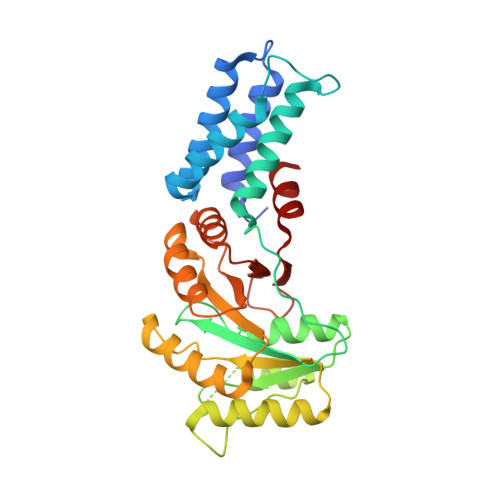
6Y31 | pdb_00006y31

NG domain of human SRP54 T117 deletion mutant


Experimental Data Snapshot

  • Method: X-RAY DIFFRACTION
  • Resolution: 4.00 Å
  • R-Value Free: 
    0.331 (Depositor), 0.295 (DCC) 
  • R-Value Work: 
    0.311 (Depositor), 0.311 (DCC) 
  • R-Value Observed: 
    0.312 (Depositor) 

Starting Model: experimental
View more details

wwPDB Validation 3D Report Full Report

Validation slider image for 6Y31

This is version 1.3 of the entry. See complete history

Literature

Structural and Functional Impact of SRP54 Mutations Causing Severe Congenital Neutropenia.

Juaire, K.D.Lapouge, K.Becker, M.M.M.Kotova, I.Michelhans, M.Carapito, R.Wild, K.Bahram, S.Sinning, I.

(2021) Structure 29: 15

  • DOI: https://doi.org/10.1016/j.str.2020.09.008
  • Primary Citation Related Structures: 
    6Y2Z, 6Y30, 6Y31, 6Y32

  • PubMed Abstract: 

    The SRP54 GTPase is a key component of co-translational protein targeting by the signal recognition particle (SRP). Point mutations in SRP54 have been recently shown to lead to a form of severe congenital neutropenia displaying symptoms overlapping with those of Shwachman-Diamond syndrome. The phenotype includes severe neutropenia, exocrine pancreatic deficiency, and neurodevelopmental as well as skeletal disorders. Using a combination of X-ray crystallography, hydrogen-deuterium exchange coupled to mass spectrometry and complementary biochemical and biophysical methods, we reveal extensive structural defects in three disease-causing SRP54 variants resulting in critical protein destabilization. GTP binding is mostly abolished as a consequence of an altered GTPase core. The mutations located in conserved sequence fingerprints of SRP54 eliminate targeting complex formation with the SRP receptor as demonstrated in yeast and human cells. These specific defects critically influence the entire SRP pathway, thereby causing this life-threatening disease.


  • Organizational Affiliation
    • Heidelberg University Biochemistry Center (BZH), Im Neuenheimer Feld 328, D-69120 Heidelberg, Germany.

Macromolecule Content 

  • Total Structure Weight: 133.64 kDa 
  • Atom Count: 9,043 
  • Modeled Residue Count: 1,175 
  • Deposited Residue Count: 1,212 
  • Unique protein chains: 1

Macromolecules

Find similar proteins by:|  3D Structure
Entity ID: 1
MoleculeChains  Sequence LengthOrganismDetailsImage
Signal recognition particle 54 kDa protein
A, B, C, D
303Homo sapiensMutation(s): 0 
Gene Names: SRP54
EC: 3.6.5.4
UniProt & NIH Common Fund Data Resources
Find proteins for P61011 (Homo sapiens)
Explore P61011 
Go to UniProtKB:  P61011
PHAROS:  P61011
GTEx:  ENSG00000100883 
Entity Groups
Sequence Clusters30% Identity50% Identity70% Identity90% Identity95% Identity100% Identity
UniProt GroupP61011
Sequence Annotations
Expand
Reference Sequence

Experimental Data & Validation

Experimental Data

  • Method: X-RAY DIFFRACTION
  • Resolution: 4.00 Å
  • R-Value Free:  0.331 (Depositor), 0.295 (DCC) 
  • R-Value Work:  0.311 (Depositor), 0.311 (DCC) 
  • R-Value Observed: 0.312 (Depositor) 
Space Group: P 1 21 1
Unit Cell:
Length ( Å )Angle ( ˚ )
a = 87.356α = 90
b = 50.607β = 99.39
c = 181.629γ = 90
Software Package:
Software NamePurpose
PHENIXrefinement
PDB_EXTRACTdata extraction
Aimlessdata reduction
Aimlessdata scaling
PHENIXphasing

Structure Validation

View Full Validation Report


Entry History 

& Funding Information

Deposition Data


Funding OrganizationLocationGrant Number
German Research Foundation (DFG)GermanySI 586/6-1

Revision History  (Full details and data files)

  • Version 1.0: 2020-09-23
    Type: Initial release
  • Version 1.1: 2020-12-16
    Changes: Database references
  • Version 1.2: 2021-01-20
    Changes: Database references
  • Version 1.3: 2024-01-24
    Changes: Data collection, Database references, Refinement description