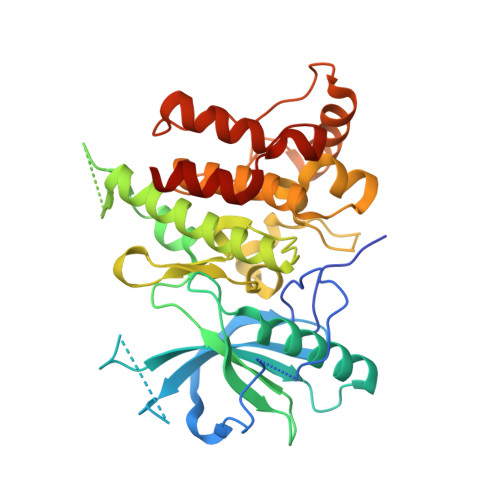
6Y23 | pdb_00006y23

DDR1 kinase autoinhibited by its juxtamembrane region


Experimental Data Snapshot

  • Method: X-RAY DIFFRACTION
  • Resolution: 2.58 Å
  • R-Value Free: 
    0.270 (Depositor), 0.269 (DCC) 
  • R-Value Work: 
    0.225 (Depositor), 0.225 (DCC) 
  • R-Value Observed: 
    0.228 (Depositor) 

Starting Model: experimental
View more details

wwPDB Validation 3D Report Full Report

Validation slider image for 6Y23

This is version 1.2 of the entry. See complete history

Literature

Two-step release of kinase autoinhibition in discoidin domain receptor 1.

Sammon, D.Hohenester, E.Leitinger, B.

(2020) Proc Natl Acad Sci U S A 117: 22051-22060

  • DOI: https://doi.org/10.1073/pnas.2007271117
  • Primary Citation Related Structures: 
    6Y23

  • PubMed Abstract: 

    Discoidin domain receptor 1 (DDR1) is a collagen-activated receptor tyrosine kinase with important functions in organogenesis and tissue homeostasis. Aberrant DDR1 activity contributes to the progression of human diseases, including fibrosis and cancer. How DDR1 activity is regulated is poorly understood. We investigated the function of the long intracellular juxtamembrane (JM) region of human DDR1 and found that the kinase-proximal segment, JM4, is an important regulator of kinase activity. Crystal structure analysis revealed that JM4 forms a hairpin that penetrates the kinase active site, reinforcing autoinhibition by the activation loop. Using in vitro enzymology with soluble kinase constructs, we established that release from autoinhibition occurs in two distinct steps: rapid autophosphorylation of the JM4 tyrosines, Tyr569 and Tyr586, followed by slower autophosphorylation of activation loop tyrosines. Mutation of JM4 tyrosines abolished collagen-induced DDR1 activation in cells. The insights may be used to develop allosteric, DDR1-specific, kinase inhibitors.


  • Organizational Affiliation
    • National Heart and Lung Institute, Imperial College London, SW7 2AZ London, United Kingdom.

Macromolecule Content 

  • Total Structure Weight: 117.91 kDa 
  • Atom Count: 7,259 
  • Modeled Residue Count: 911 
  • Deposited Residue Count: 1,050 
  • Unique protein chains: 1

Macromolecules

Find similar proteins by:|  3D Structure
Entity ID: 1
MoleculeChains  Sequence LengthOrganismDetailsImage
Epithelial discoidin domain-containing receptor 1
A, B, C
350Homo sapiensMutation(s): 2 
Gene Names: DDR1CAKEDDR1NEPNTRK4PTK3ARTK6TRKE
EC: 2.7.10.1
UniProt & NIH Common Fund Data Resources
Find proteins for Q08345 (Homo sapiens)
Explore Q08345 
Go to UniProtKB:  Q08345
PHAROS:  Q08345
GTEx:  ENSG00000204580 
Entity Groups
Sequence Clusters30% Identity50% Identity70% Identity90% Identity95% Identity100% Identity
UniProt GroupQ08345
Sequence Annotations
Expand
Reference Sequence

Experimental Data & Validation

Experimental Data

  • Method: X-RAY DIFFRACTION
  • Resolution: 2.58 Å
  • R-Value Free:  0.270 (Depositor), 0.269 (DCC) 
  • R-Value Work:  0.225 (Depositor), 0.225 (DCC) 
  • R-Value Observed: 0.228 (Depositor) 
Space Group: P 63 2 2
Unit Cell:
Length ( Å )Angle ( ˚ )
a = 105.307α = 90
b = 105.307β = 90
c = 406.939γ = 120
Software Package:
Software NamePurpose
PHENIXrefinement
PHENIXrefinement
xia2data reduction
xia2data scaling
PHASERphasing

Structure Validation

View Full Validation Report


Entry History 

& Funding Information

Deposition Data


Funding OrganizationLocationGrant Number
Biotechnology and Biological Sciences Research Council (BBSRC)United Kingdom--

Revision History  (Full details and data files)

  • Version 1.0: 2020-09-02
    Type: Initial release
  • Version 1.1: 2020-09-16
    Changes: Database references
  • Version 1.2: 2024-01-24
    Changes: Data collection, Database references, Refinement description