6XW7 | pdb_00006xw7

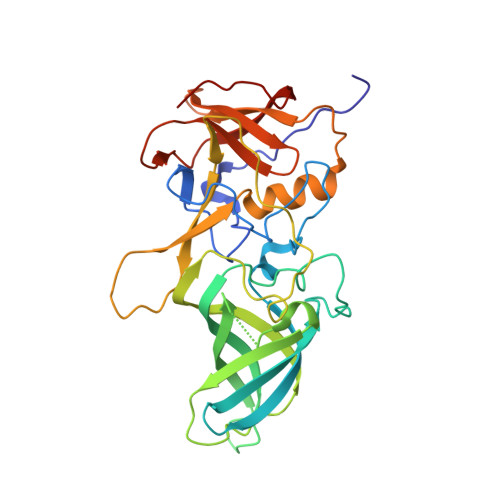
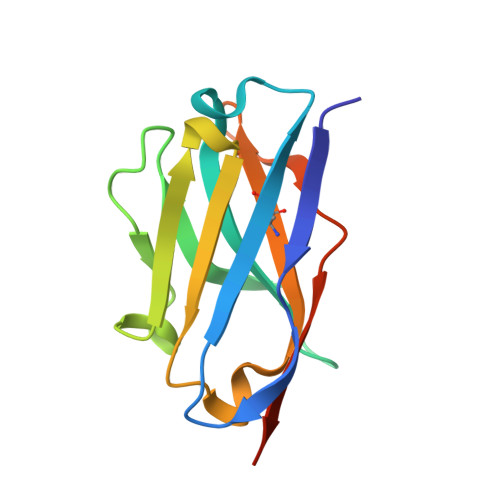
Crystal structure of murine norovirus P domain in complex with Nanobody NB-5829 and glycochenodeoxycholate (GCDCA)


Experimental Data Snapshot

  • Method: X-RAY DIFFRACTION
  • Resolution: 2.15 Å
  • R-Value Free: 
    0.215 (Depositor), 0.198 (DCC) 
  • R-Value Work: 
    0.171 (Depositor) 
  • R-Value Observed: 
    0.174 (Depositor) 

Starting Model: experimental
View more details

wwPDB Validation 3D Report Full Report

Validation slider image for 6XW7

Ligand Structure Quality Assessment 


This is version 1.4 of the entry. See complete history

Literature

Nanobody-Mediated Neutralization Reveals an Achilles Heel for Norovirus.

Koromyslova, A.D.Devant, J.M.Kilic, T.Sabin, C.D.Malak, V.Hansman, G.S.

(2020) J Virol 94

  • DOI: https://doi.org/10.1128/JVI.00660-20
  • Primary Citation Related Structures: 
    6XW4, 6XW5, 6XW6, 6XW7

  • PubMed Abstract: 

    Human norovirus frequently causes outbreaks of acute gastroenteritis. Although discovered more than five decades ago, antiviral development has, until recently, been hampered by the lack of a reliable human norovirus cell culture system. Nevertheless, a lot of pathogenesis studies were accomplished using murine norovirus (MNV), which can be grown routinely in cell culture. In this study, we analyzed a sizeable library of nanobodies that were raised against the murine norovirus virion with the main purpose of developing nanobody-based inhibitors. We discovered two types of neutralizing nanobodies and analyzed the inhibition mechanisms using X-ray crystallography, cryo-electron microscopy (cryo-EM), and cell culture techniques. The first type bound on the top region of the protruding (P) domain. Interestingly, this nanobody binding region closely overlapped the MNV receptor-binding site and collectively shared numerous P domain-binding residues. In addition, we showed that these nanobodies competed with the soluble receptor, and this action blocked virion attachment to cultured cells. The second type bound at a dimeric interface on the lower side of the P dimer. We discovered that these nanobodies disrupted a structural change in the capsid associated with binding cofactors (i.e., metal cations/bile acid). Indeed, we found that capsids underwent major conformational changes following addition of Mg 2+ or Ca 2+ Ultimately, these nanobodies directly obstructed a structural modification reserved for a postreceptor attachment stage. Altogether, our new data show that nanobody-based inhibition could occur by blocking functional and structural capsid properties. IMPORTANCE This research discovered and analyzed two different types of MNV-neutralizing nanobodies. The top-binding nanobodies sterically inhibited the receptor-binding site, whereas the dimeric-binding nanobodies interfered with a structural modification associated with cofactor binding. Moreover, we found that the capsid contained a number of vulnerable regions that were essential for viral replication. In fact, the capsid appeared to be organized in a state of flux, which could be important for cofactor/receptor-binding functions. Blocking these capsid-binding events with nanobodies directly inhibited essential capsid functions. Moreover, a number of MNV-specific nanobody binding epitopes were comparable to human norovirus-specific nanobody inhibitors. Therefore, this additional structural and inhibition information could be further exploited in the development of human norovirus antivirals.


  • Organizational Affiliation
    • Schaller Research Group at the University of Heidelberg and DKFZ, Heidelberg, Germany anna.koromyslova@gmail.com g.hansman@dkfz.de.

Macromolecule Content 

  • Total Structure Weight: 190.85 kDa 
  • Atom Count: 13,940 
  • Modeled Residue Count: 1,677 
  • Deposited Residue Count: 1,728 
  • Unique protein chains: 2

Macromolecules

Find similar proteins by:|  3D Structure
Entity ID: 1
MoleculeChains  Sequence LengthOrganismDetailsImage
Capsid proteinA,
B,
C [auth E],
D [auth F]
309Murine norovirus 1Mutation(s): 0 
UniProt
Find proteins for Q80J94 (Norovirus (isolate Mouse/NoV/United States/MNV1/2002/GV))
Explore Q80J94 
Go to UniProtKB:  Q80J94
Entity Groups
Sequence Clusters30% Identity50% Identity70% Identity90% Identity95% Identity100% Identity
UniProt GroupQ80J94
Sequence Annotations
Expand
Reference Sequence
Find similar proteins by:|  3D Structure
Entity ID: 2
MoleculeChains  Sequence LengthOrganismDetailsImage
Nanobody NB-5829E [auth C],
F [auth D],
G,
H
123Vicugna pacosMutation(s): 0 

Small Molecules

Ligands 3 Unique
IDChains Name / Formula / InChI Key2D Diagram3D Interactions
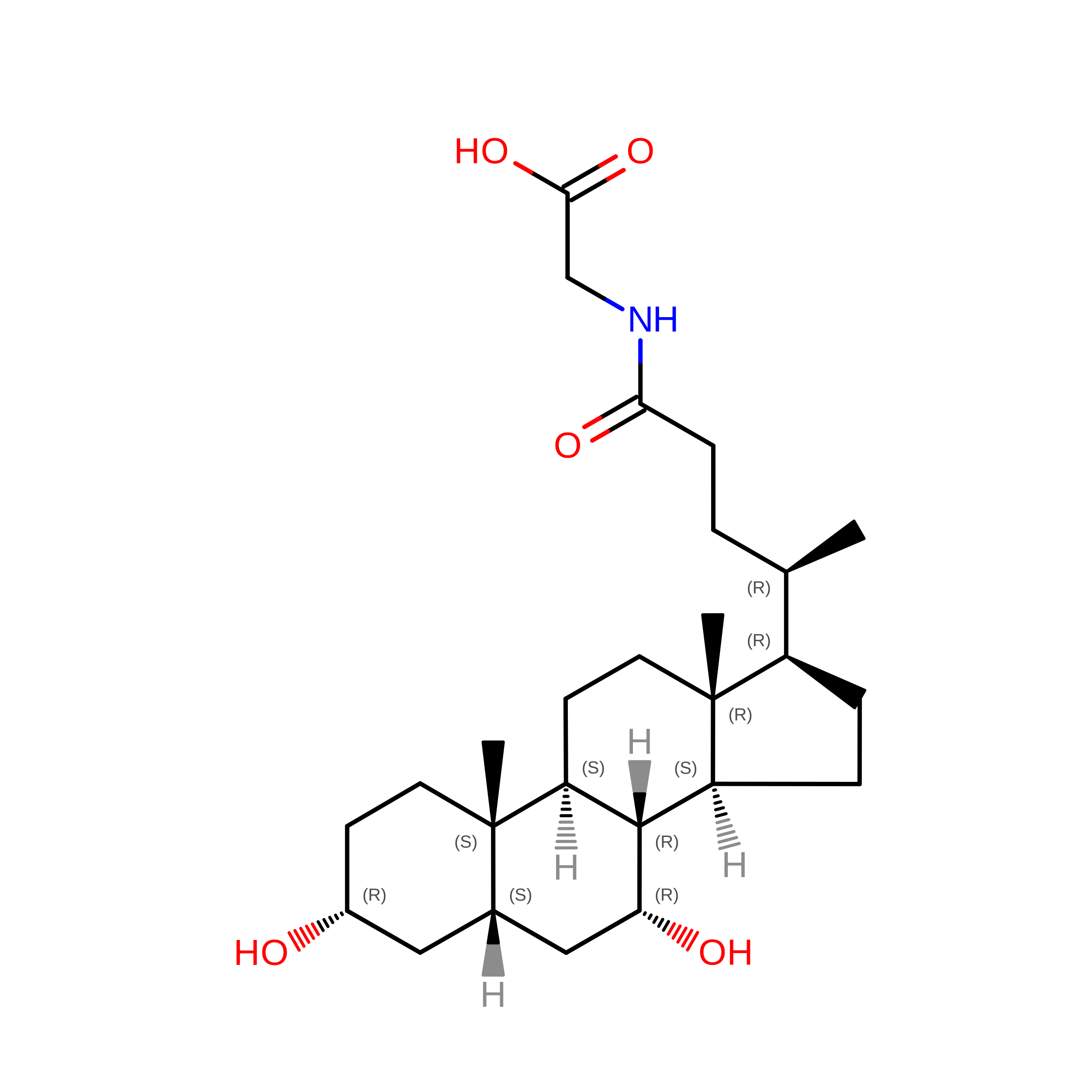
CHO
(Subject of Investigation/LOI)

Query on CHO


Download:Ideal Coordinates CCD File
K [auth A],
L [auth B],
P [auth E],
Q [auth F]
GLYCOCHENODEOXYCHOLIC ACID
C26 H43 N O5
GHCZAUBVMUEKKP-GYPHWSFCSA-N
EDO

Query on EDO


Download:Ideal Coordinates CCD File
I [auth A]
J [auth A]
N [auth E]
O [auth E]
R [auth C]
I [auth A],
J [auth A],
N [auth E],
O [auth E],
R [auth C],
S [auth D],
T [auth G],
U [auth H]
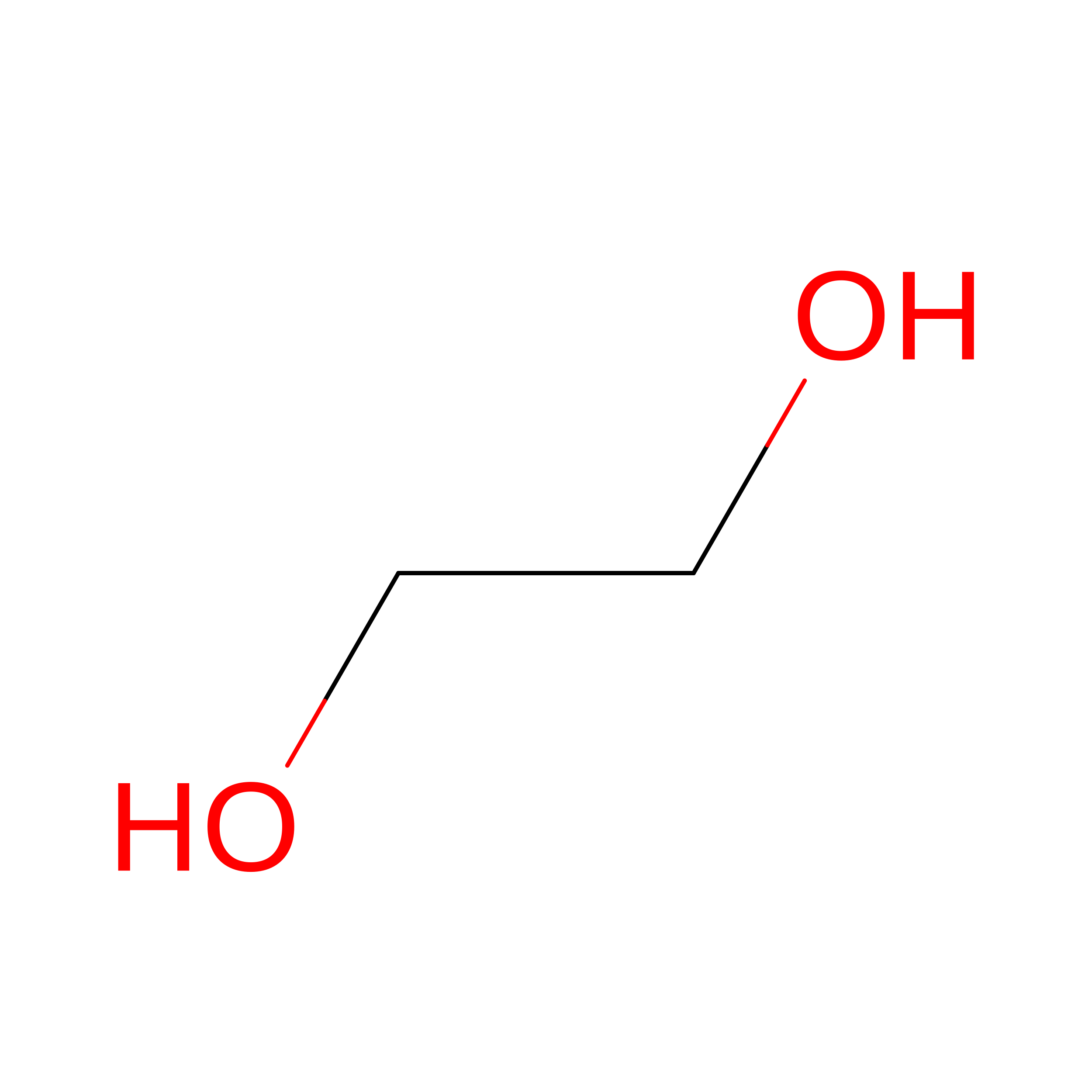
1,2-ETHANEDIOL
C2 H6 O2
LYCAIKOWRPUZTN-UHFFFAOYSA-N
MG

Query on MG


Download:Ideal Coordinates CCD File
M [auth B]MAGNESIUM ION
Mg
JLVVSXFLKOJNIY-UHFFFAOYSA-N

Experimental Data & Validation

Experimental Data

  • Method: X-RAY DIFFRACTION
  • Resolution: 2.15 Å
  • R-Value Free:  0.215 (Depositor), 0.198 (DCC) 
  • R-Value Work:  0.171 (Depositor) 
  • R-Value Observed: 0.174 (Depositor) 
Space Group: C 1 2 1
Unit Cell:
Length ( Å )Angle ( ˚ )
a = 190.73α = 90
b = 124.93β = 125.3
c = 113.13γ = 90
Software Package:
Software NamePurpose
XSCALEdata scaling
REFMACrefinement
PDB_EXTRACTdata extraction
PHASERphasing
XDSdata reduction

Structure Validation

View Full Validation Report


Ligand Structure Quality Assessment 


Entry History 

& Funding Information

Deposition Data


Funding OrganizationLocationGrant Number
German Federal Ministry for Education and ResearchGermanyNATION, 03VP00912

Revision History  (Full details and data files)

  • Version 1.0: 2020-04-22
    Type: Initial release
  • Version 1.1: 2020-05-06
    Changes: Database references
  • Version 1.2: 2020-07-01
    Changes: Database references
  • Version 1.3: 2024-01-24
    Changes: Data collection, Database references, Derived calculations, Refinement description
  • Version 1.4: 2024-10-23
    Changes: Structure summary