6XV0 | pdb_00006xv0

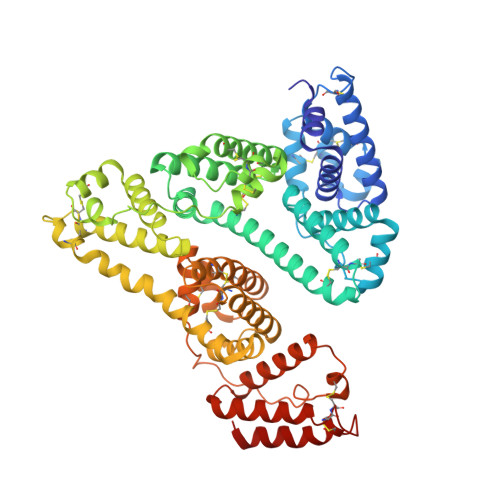
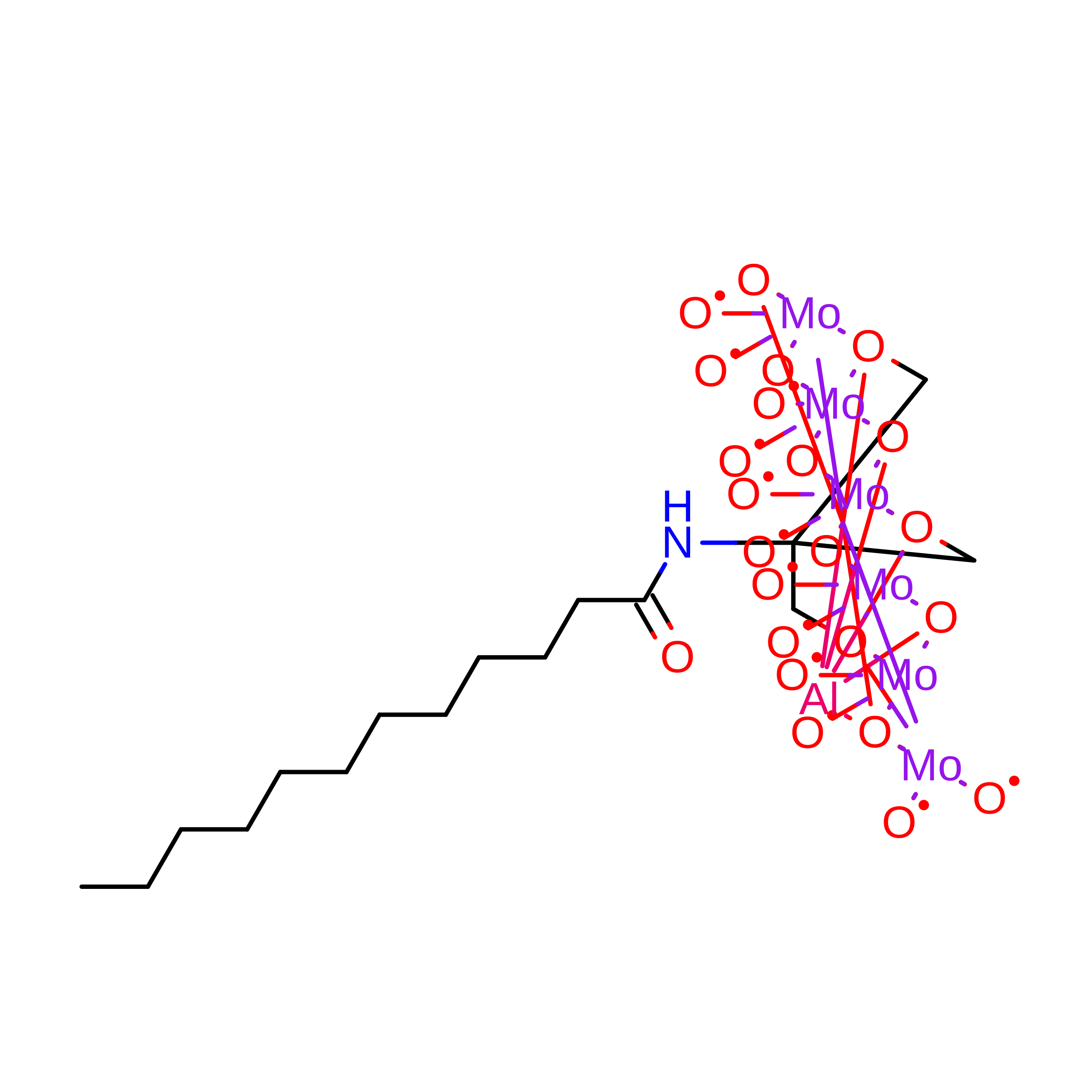
lauric acid functionalized hexamolybdoaluminate bound to human serum albumin


Experimental Data Snapshot

  • Method: X-RAY DIFFRACTION
  • Resolution: 3.00 Å
  • R-Value Free: 
    0.311 (Depositor), 0.310 (DCC) 
  • R-Value Work: 
    0.269 (Depositor), 0.272 (DCC) 

Starting Model: experimental
View more details

wwPDB Validation 3D Report Full Report

Validation slider image for 6XV0

Ligand Structure Quality Assessment 


This is version 1.4 of the entry. See complete history

Literature

Binding of a Fatty Acid-Functionalized Anderson-Type Polyoxometalate to Human Serum Albumin.

Bijelic, A.Dobrov, A.Roller, A.Rompel, A.

(2020) Inorg Chem 59: 5243-5246

  • DOI: https://doi.org/10.1021/acs.inorgchem.9b03407
  • Primary Citation Related Structures: 
    6XV0

  • PubMed Abstract: 

    The Anderson-type hexamolybdoaluminate functionalized with lauric acid (LA), (TBA) 3 [Al(OH) 3 Mo 6 O 18 {(OCH 2 ) 3 CNHCOC 11 H 23 }]·9H 2 O (TBA-AlMo 6 -LA, where TBA = tetrabutylammonium), was prepared via two synthetic routes and characterized by thermogravimetric and elemental analyses, mass spectrometry, IR and 1 H NMR spectroscopy, and powder and single-crystal X-ray diffraction. The interaction of TBA-AlMo 6 -LA with human serum albumin (HSA) was investigated via fluorescence and circular dichroism spectroscopy. The results revealed that TBA-AlMo 6 -LA binds strongly to HSA (63% quenching at an HSA/TBA-AlMo 6 -LA ratio of 1:1), exhibiting static quenching. In contrast to TBA-AlMo 6 -LA, the nonfunctionalized polyoxometalate, Na 3 (H 2 O) 6 [Al(OH) 6 Mo 6 O 18 ]·2H 2 O (AlMo 6 ), showed weak binding toward HSA (22% quenching at a HSA/AlMo 6 ratio of 1:25). HSA binding was confirmed by X-ray structure analysis of the HSA-Myr-AlMo 6 -LA complex (Myr = myristate). These results provide a promising lead for the design of novel polyoxometalate-based hybrids that are able to exploit HSA as a delivery vehicle to improve their pharmacokinetics and bioactivity.


  • Organizational Affiliation
    • Fakultät für Chemie, Institut für Biophysikalische Chemie, Universität Wien, Althanstraße 14, 1090 Wien, Austria.

Macromolecule Content 

  • Total Structure Weight: 70.42 kDa 
  • Atom Count: 4,679 
  • Modeled Residue Count: 581 
  • Deposited Residue Count: 585 
  • Unique protein chains: 1

Macromolecules

Find similar proteins by:|  3D Structure
Entity ID: 1
MoleculeChains  Sequence LengthOrganismDetailsImage
Serum albumin585Homo sapiensMutation(s): 0 
UniProt & NIH Common Fund Data Resources
Find proteins for P02768 (Homo sapiens)
Explore P02768 
Go to UniProtKB:  P02768
PHAROS:  P02768
GTEx:  ENSG00000163631 
Entity Groups
Sequence Clusters30% Identity50% Identity70% Identity90% Identity95% Identity100% Identity
UniProt GroupP02768
Sequence Annotations
Expand
Reference Sequence

Small Molecules

Ligands 2 Unique
IDChains Name / Formula / InChI Key2D Diagram3D Interactions
M6O
(Subject of Investigation/LOI)

Query on M6O


Download:Ideal Coordinates CCD File
H [auth A],
I [auth A]
lauric acid functionalized hexamolybdoaluminate
C16 H30 Al Mo6 N O25
DDMPEGDABTWEPM-UHFFFAOYSA-B
MYR

Query on MYR


Download:Ideal Coordinates CCD File
B [auth A]
C [auth A]
D [auth A]
E [auth A]
F [auth A]
B [auth A],
C [auth A],
D [auth A],
E [auth A],
F [auth A],
G [auth A]
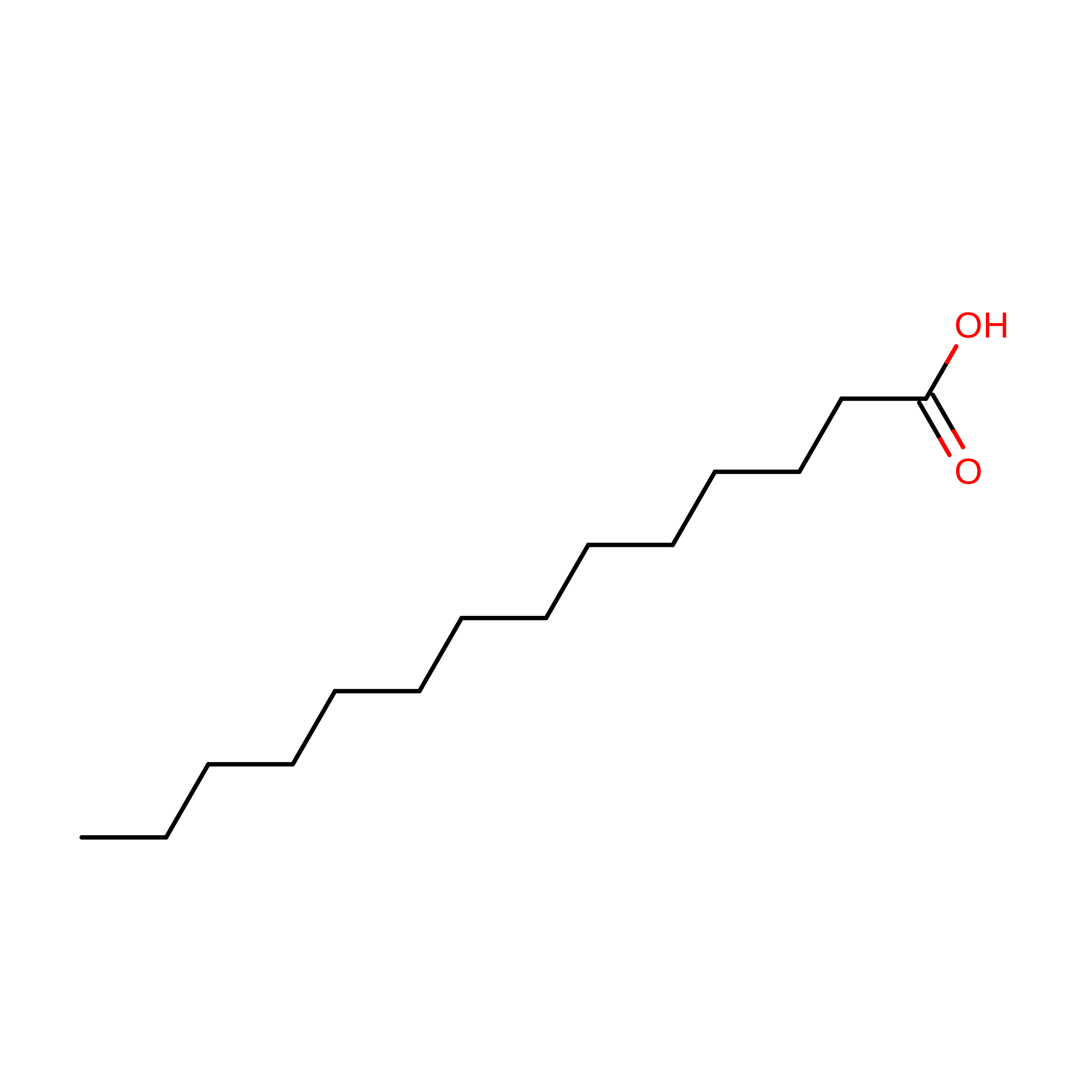
MYRISTIC ACID
C14 H28 O2
TUNFSRHWOTWDNC-UHFFFAOYSA-N

Experimental Data & Validation

Experimental Data

  • Method: X-RAY DIFFRACTION
  • Resolution: 3.00 Å
  • R-Value Free:  0.311 (Depositor), 0.310 (DCC) 
  • R-Value Work:  0.269 (Depositor), 0.272 (DCC) 
Space Group: C 1 2 1
Unit Cell:
Length ( Å )Angle ( ˚ )
a = 184.65α = 90
b = 38.54β = 105.11
c = 96.06γ = 90
Software Package:
Software NamePurpose
XSCALEdata scaling
PHENIXrefinement
PDB_EXTRACTdata extraction
XDSdata reduction
PHASERphasing

Structure Validation

View Full Validation Report


Ligand Structure Quality Assessment 


Entry History 

& Funding Information

Deposition Data


Funding OrganizationLocationGrant Number
Austrian Science FundP27534

Revision History  (Full details and data files)

  • Version 1.0: 2020-03-18
    Type: Initial release
  • Version 1.1: 2020-04-22
    Changes: Database references
  • Version 1.2: 2020-04-29
    Changes: Database references
  • Version 1.3: 2024-01-24
    Changes: Data collection, Database references, Refinement description
  • Version 1.4: 2025-10-01
    Changes: Advisory, Derived calculations, Structure summary