6XTG | pdb_00006xtg

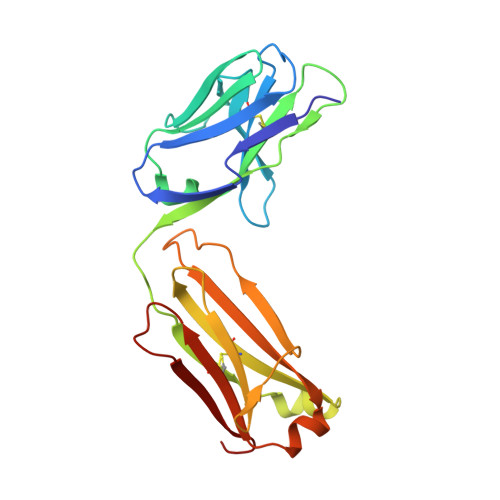
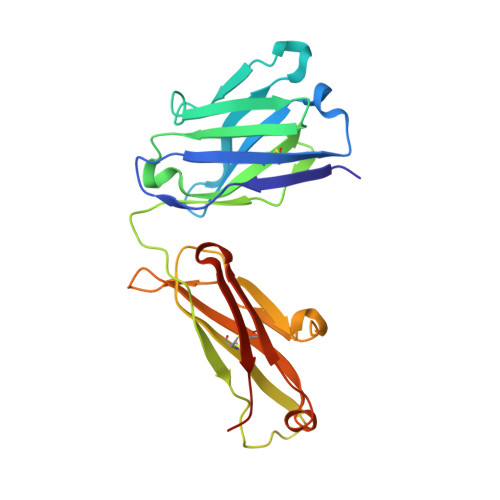
Ab 1116NS19.9 bound to CA19-9


Experimental Data Snapshot

  • Method: X-RAY DIFFRACTION
  • Resolution: 1.55 Å
  • R-Value Free: 
    0.201 (Depositor), 0.204 (DCC) 
  • R-Value Work: 
    0.174 (Depositor), 0.177 (DCC) 
  • R-Value Observed: 
    0.175 (Depositor) 

Starting Model: experimental
View more details

wwPDB Validation 3D Report Full Report

Validation slider image for 6XTG

This is version 1.4 of the entry. See complete history

Literature

Biomolecular Recognition of the Glycan Neoantigen CA19-9 by Distinct Antibodies.

Borenstein-Katz, A.Warszawski, S.Amon, R.Eilon, M.Cohen-Dvashi, H.Leviatan Ben-Arye, S.Tasnima, N.Yu, H.Chen, X.Padler-Karavani, V.Fleishman, S.J.Diskin, R.

(2021) J Mol Biology 433: 167099-167099

  • DOI: https://doi.org/10.1016/j.jmb.2021.167099
  • Primary Citation Related Structures: 
    6XTG, 6XUD, 6XUK, 6XUL, 6XUN

  • PubMed Abstract: 

    Glycans decorate the cell surface, secreted glycoproteins and glycolipids, and altered glycans are often found in cancers. Despite their high diagnostic and therapeutic potential, however, glycans are polar and flexible molecules that are quite challenging for the development and design of high-affinity binding antibodies. To understand the mechanisms by which glycan neoantigens are specifically recognized by antibodies, we analyze the biomolecular recognition of the tumor-associated carbohydrate antigen CA19-9 by two distinct antibodies using X-ray crystallography. Despite the potential plasticity of glycans and the very different antigen-binding surfaces presented by the antibodies, both structures reveal an essentially identical extended CA19-9 conformer, suggesting that this conformer's stability selects the antibodies. Starting from the bound structure of one of the antibodies, we use the AbLIFT computational algorithm to design a variant with seven core mutations in the variable domain's light-heavy chain interface that exhibits tenfold improved affinity for CA19-9. The results reveal strategies used by antibodies to specifically recognize glycan antigens and show how automated antibody-optimization methods may be used to enhance the clinical potential of existing antibodies.


  • Organizational Affiliation
    • Department of Chemical and Structural Biology, Weizmann Institute of Science, 76100 Rehovot, Israel.

Macromolecule Content 

  • Total Structure Weight: 48.4 kDa 
  • Atom Count: 3,795 
  • Modeled Residue Count: 430 
  • Deposited Residue Count: 436 
  • Unique protein chains: 2

Macromolecules

Find similar proteins by:|  3D Structure
Entity ID: 1
MoleculeChains  Sequence LengthOrganismDetailsImage
Light chainA [auth L]214Mus musculusMutation(s): 0 
Find similar proteins by:|  3D Structure
Entity ID: 2
MoleculeChains  Sequence LengthOrganismDetailsImage
Heavy chainB [auth H]222Mus musculusMutation(s): 0 

Oligosaccharides

Help  
Entity ID: 3
MoleculeChains Length2D Diagram GlycosylationD Interactions
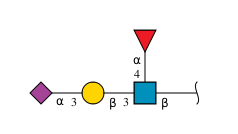
N-acetyl-alpha-neuraminic acid-(2-3)-beta-D-galactopyranose-(1-3)-[alpha-L-fucopyranose-(1-4)]2-acetamido-2-deoxy-beta-D-glucopyranoseC [auth A]4N/A
Glycosylation Resources
GlyTouCan: G00053MO
GlyCosmos: G00053MO
GlyGen: G00053MO

Small Molecules

Ligands 1 Unique
IDChains Name / Formula / InChI Key2D Diagram3D Interactions
NA

Query on NA


Download:Ideal Coordinates CCD File
D [auth L]SODIUM ION
Na
FKNQFGJONOIPTF-UHFFFAOYSA-N

Experimental Data & Validation

Experimental Data

  • Method: X-RAY DIFFRACTION
  • Resolution: 1.55 Å
  • R-Value Free:  0.201 (Depositor), 0.204 (DCC) 
  • R-Value Work:  0.174 (Depositor), 0.177 (DCC) 
  • R-Value Observed: 0.175 (Depositor) 
Space Group: P 21 21 2
Unit Cell:
Length ( Å )Angle ( ˚ )
a = 89.169α = 90
b = 60.197β = 90
c = 84.436γ = 90
Software Package:
Software NamePurpose
PHENIXrefinement
Aimlessdata scaling
PDB_EXTRACTdata extraction
xia2data reduction
PHASERphasing

Structure Validation

View Full Validation Report


Entry History 

Deposition Data

Revision History  (Full details and data files)

  • Version 1.0: 2021-01-27
    Type: Initial release
  • Version 1.1: 2021-08-11
    Changes: Database references
  • Version 1.2: 2021-09-29
    Changes: Data collection, Database references
  • Version 1.3: 2024-01-24
    Changes: Data collection, Refinement description
  • Version 1.4: 2024-10-23
    Changes: Structure summary