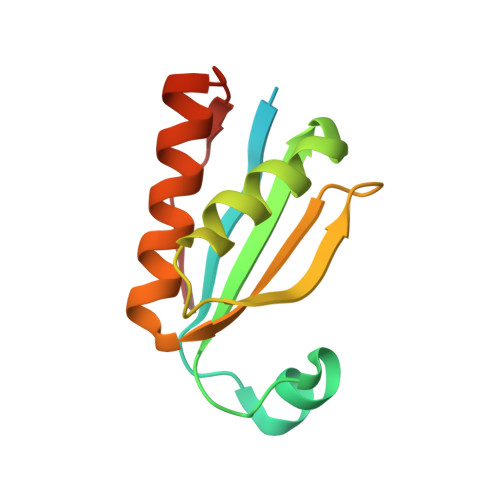
6XPL | pdb_00006xpl

CutR Screw, form 2 with 33.8 angstrom pitch


Experimental Data Snapshot

  • Method: X-RAY DIFFRACTION
  • Resolution: 3.30 Å
  • R-Value Free: 
    0.265 (Depositor), 0.238 (DCC) 
  • R-Value Work: 
    0.219 (Depositor), 0.205 (DCC) 

Starting Model: experimental
View more details

wwPDB Validation 3D Report Full Report

Validation slider image for 6XPL

This is version 1.4 of the entry. See complete history

Literature

Symmetry breaking and structural polymorphism in a bacterial microcompartment shell protein for choline utilization.

Ochoa, J.M.Nguyen, V.N.Nie, M.Sawaya, M.R.Bobik, T.A.Yeates, T.O.

(2020) Protein Sci 29: 2201-2212

  • DOI: https://doi.org/10.1002/pro.3941
  • Primary Citation Related Structures: 
    6XPH, 6XPI, 6XPJ, 6XPK, 6XPL

  • PubMed Abstract: 

    Bacterial microcompartments are protein-based organelles that carry out specialized metabolic functions in diverse bacteria. Their outer shells are built from several thousand protein subunits. Some of the architectural principles of bacterial microcompartments have been articulated, with lateral packing of flat hexameric BMC proteins providing the basic foundation for assembly. Nonetheless, a complete understanding has been elusive, partly owing to polymorphic mechanisms of assembly exhibited by most microcompartment types. An earlier study of one homologous BMC shell protein subfamily, EutS/PduU, revealed a profoundly bent, rather than flat, hexameric structure. The possibility of a specialized architectural role was hypothesized, but artifactual effects of crystallization could not be ruled out. Here we report a series of crystal structures of an orthologous protein, CutR, from a glycyl-radical type choline-utilizing microcompartment from the bacterium Streptococcus intermedius. Depending on crystal form, expression construct, and minor mutations, a range of novel quaternary architectures was observed, including two spiral hexagonal assemblies. A new graphical approach helps illuminate the variations in BMC hexameric structure, with results substantiating the idea that the EutS/PduU/CutR subfamily of BMC proteins may endow microcompartment shells with flexible modes of assembly.


  • Organizational Affiliation
    • UCLA-Molecular Biology Institute, University of California, Los Angeles (UCLA), California, Los Angeles, USA.

Macromolecule Content 

  • Total Structure Weight: 13.28 kDa 
  • Atom Count: 720 
  • Modeled Residue Count: 98 
  • Deposited Residue Count: 123 
  • Unique protein chains: 1

Macromolecules

Find similar proteins by:|  3D Structure
Entity ID: 1
MoleculeChains  Sequence LengthOrganismDetailsImage
Ethanolamine utilization protein EutS123Streptococcus intermedius SK54 = ATCC 27335Mutation(s): 0 
Gene Names: HMPREF1654_00416
UniProt
Find proteins for A0A0E2IV13 (Streptococcus intermedius (strain ATCC 27335 / DSM 20573 / CCUG 32759 / CIP 103248 / JCM 12996 / LMG 17840 / NCTC 11324 / SK54 / 1877))
Explore A0A0E2IV13 
Go to UniProtKB:  A0A0E2IV13
Entity Groups
Sequence Clusters30% Identity50% Identity70% Identity90% Identity95% Identity100% Identity
UniProt GroupA0A0E2IV13
Sequence Annotations
Expand
Reference Sequence

Experimental Data & Validation

Experimental Data

  • Method: X-RAY DIFFRACTION
  • Resolution: 3.30 Å
  • R-Value Free:  0.265 (Depositor), 0.238 (DCC) 
  • R-Value Work:  0.219 (Depositor), 0.205 (DCC) 
Space Group: P 61
Unit Cell:
Length ( Å )Angle ( ˚ )
a = 64.91α = 90
b = 64.91β = 90
c = 33.78γ = 120
Software Package:
Software NamePurpose
XDSdata reduction
XSCALEdata scaling
PHASERphasing
REFMACrefinement
PDB_EXTRACTdata extraction

Structure Validation

View Full Validation Report


Entry History 

& Funding Information

Deposition Data


Funding OrganizationLocationGrant Number
National Institutes of Health/National Institute Of Allergy and Infectious Diseases (NIH/NIAID)United States--

Revision History  (Full details and data files)

  • Version 1.0: 2020-07-22
    Type: Initial release
  • Version 1.1: 2020-09-16
    Changes: Database references
  • Version 1.2: 2020-11-11
    Changes: Database references
  • Version 1.3: 2021-06-30
    Changes: Data collection
  • Version 1.4: 2023-10-18
    Changes: Data collection, Database references, Refinement description