6XHL | pdb_00006xhl

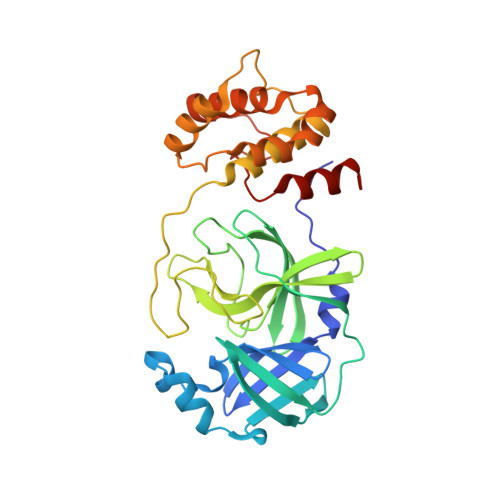
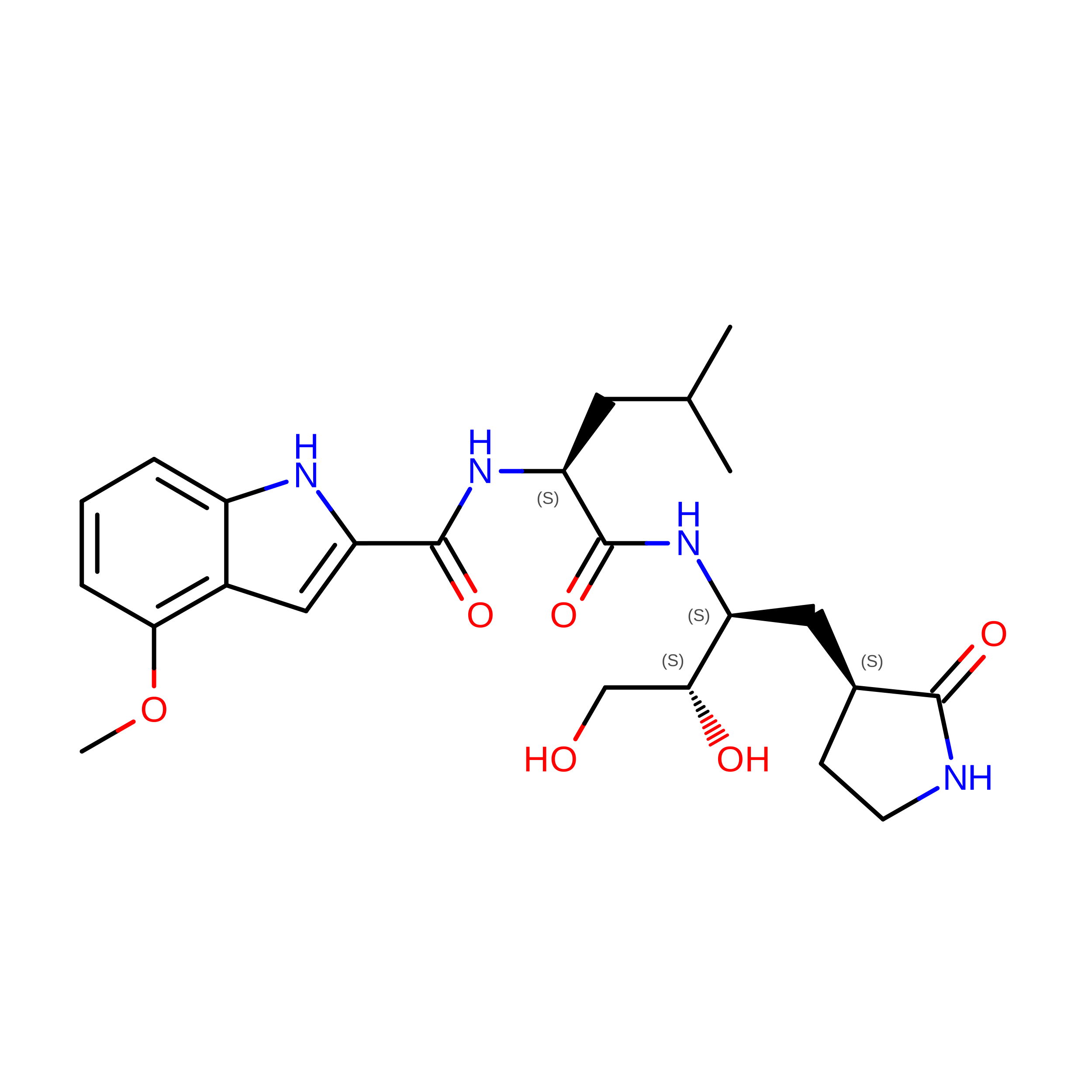
Covalent complex of SARS-CoV main protease with N-[(2S)-1-({(2S,3S)-3,4-dihydroxy-1-[(3S)-2-oxopyrrolidin-3-yl]butan-2-yl}amino)-4-methyl-1-oxopentan-2-yl]-4-methoxy-1H-indole-2-carboxamide


Experimental Data Snapshot

  • Method: X-RAY DIFFRACTION
  • Resolution: 1.47 Å
  • R-Value Free: 
    0.223 (Depositor), 0.228 (DCC) 
  • R-Value Work: 
    0.203 (Depositor), 0.205 (DCC) 
  • R-Value Observed: 
    0.204 (Depositor) 

Starting Model: experimental
View more details

wwPDB Validation 3D Report Full Report

Validation slider image for 6XHL

Ligand Structure Quality Assessment 


This is version 2.2 of the entry. See complete history

Literature

Discovery of Ketone-Based Covalent Inhibitors of Coronavirus 3CL Proteases for the Potential Therapeutic Treatment of COVID-19.

Hoffman, R.L.Kania, R.S.Brothers, M.A.Davies, J.F.Ferre, R.A.Gajiwala, K.S.He, M.Hogan, R.J.Kozminski, K.Li, L.Y.Lockner, J.W.Lou, J.Marra, M.T.Mitchell Jr., L.J.Murray, B.W.Nieman, J.A.Noell, S.Planken, S.P.Rowe, T.Ryan, K.Smith 3rd, G.J.Solowiej, J.E.Steppan, C.M.Taggart, B.

(2020) J Med Chem 63: 12725-12747

  • DOI: https://doi.org/10.1021/acs.jmedchem.0c01063
  • Primary Citation Related Structures: 
    6XHL, 6XHM, 6XHN, 6XHO

  • PubMed Abstract: 

    The novel coronavirus disease COVID-19 that emerged in 2019 is caused by the virus SARS CoV-2 and named for its close genetic similarity to SARS CoV-1 that caused severe acute respiratory syndrome (SARS) in 2002. Both SARS coronavirus genomes encode two overlapping large polyproteins, which are cleaved at specific sites by a 3C-like cysteine protease (3CL pro ) in a post-translational processing step that is critical for coronavirus replication. The 3CL pro sequences for CoV-1 and CoV-2 viruses are 100% identical in the catalytic domain that carries out protein cleavage. A research effort that focused on the discovery of reversible and irreversible ketone-based inhibitors of SARS CoV-1 3CL pro employing ligand-protease structures solved by X-ray crystallography led to the identification of 3 and 4 . Preclinical experiments reveal 4 ( PF-00835231 ) as a potent inhibitor of CoV-2 3CL pro with suitable pharmaceutical properties to warrant further development as an intravenous treatment for COVID-19.


  • Organizational Affiliation
    • Pfizer Worldwide Research and Development, 10770 Science Center Drive, San Diego, California 92121 United States.

Macromolecule Content 

  • Total Structure Weight: 68.82 kDa 
  • Atom Count: 5,122 
  • Modeled Residue Count: 600 
  • Deposited Residue Count: 614 
  • Unique protein chains: 1

Macromolecules

Find similar proteins by:|  3D Structure
Entity ID: 1
MoleculeChains  Sequence LengthOrganismDetailsImage
3C-like proteinase
A, B
307Severe acute respiratory syndrome-related coronavirusMutation(s): 0 
Gene Names: 1a
EC: 3.4.22.69
UniProt
Find proteins for P0C6U8 (Severe acute respiratory syndrome coronavirus)
Explore P0C6U8 
Go to UniProtKB:  P0C6U8
Entity Groups
Sequence Clusters30% Identity50% Identity70% Identity90% Identity95% Identity100% Identity
UniProt GroupP0C6U8
Sequence Annotations
Expand
Reference Sequence

Small Molecules

Ligands 1 Unique
IDChains Name / Formula / InChI Key2D Diagram3D Interactions
V2M
(Subject of Investigation/LOI)

Query on V2M


Download:Ideal Coordinates CCD File
C [auth A],
D [auth B]
N-[(2S)-1-({(2S,3S)-3,4-dihydroxy-1-[(3S)-2-oxopyrrolidin-3-yl]butan-2-yl}amino)-4-methyl-1-oxopentan-2-yl]-4-methoxy-1H-indole-2-carboxamide
C24 H34 N4 O6
FDQSUXUTXIGUIA-PRIDNEQBSA-N

Experimental Data & Validation

Experimental Data

  • Method: X-RAY DIFFRACTION
  • Resolution: 1.47 Å
  • R-Value Free:  0.223 (Depositor), 0.228 (DCC) 
  • R-Value Work:  0.203 (Depositor), 0.205 (DCC) 
  • R-Value Observed: 0.204 (Depositor) 
Space Group: P 1 21 1
Unit Cell:
Length ( Å )Angle ( ˚ )
a = 55.77α = 90
b = 98.49β = 108.31
c = 59.63γ = 90
Software Package:
Software NamePurpose
BUSTERrefinement
autoPROCdata scaling
BUSTERphasing
autoPROCdata reduction

Structure Validation

View Full Validation Report


Ligand Structure Quality Assessment 


Entry History 

Deposition Data

Revision History  (Full details and data files)

  • Version 1.0: 2020-07-08
    Type: Initial release
  • Version 1.1: 2020-11-04
    Changes: Database references, Refinement description
  • Version 1.2: 2020-11-25
    Changes: Database references
  • Version 2.0: 2022-08-03
    Changes: Database references, Derived calculations, Non-polymer description, Structure summary
  • Version 2.1: 2023-10-18
    Changes: Data collection, Refinement description
  • Version 2.2: 2024-11-06
    Changes: Structure summary