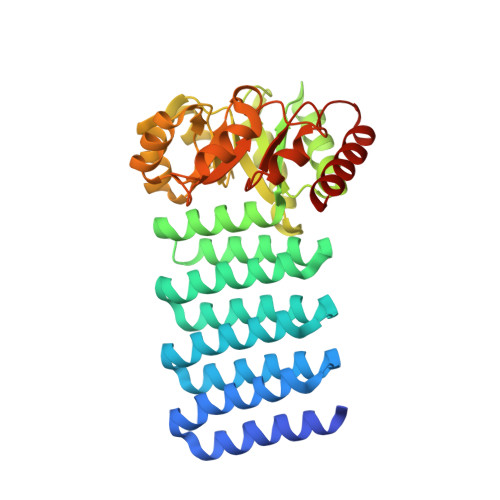
6XH5 | pdb_00006xh5

Hierarchical design of multi-scale protein complexes by combinatorial assembly of oligomeric helical bundle and repeat protein building blocks


Experimental Data Snapshot

  • Method: X-RAY DIFFRACTION
  • Resolution: 3.32 Å
  • R-Value Free: 
    0.265 (Depositor), 0.268 (DCC) 
  • R-Value Work: 
    0.219 (Depositor), 0.223 (DCC) 
  • R-Value Observed: 
    0.222 (Depositor) 

Starting Model: in silico
View more details

wwPDB Validation 3D Report Full Report

Validation slider image for 6XH5

This is version 1.2 of the entry. See complete history

Literature

Design of multi-scale protein complexes by hierarchical building block fusion.

Hsia, Y.Mout, R.Sheffler, W.Edman, N.I.Vulovic, I.Park, Y.J.Redler, R.L.Bick, M.J.Bera, A.K.Courbet, A.Kang, A.Brunette, T.J.Nattermann, U.Tsai, E.Saleem, A.Chow, C.M.Ekiert, D.Bhabha, G.Veesler, D.Baker, D.

(2021) Nat Commun 12: 2294-2294

  • DOI: https://doi.org/10.1038/s41467-021-22276-z
  • Primary Citation Related Structures: 
    6XH5, 6XI6, 6XNS, 6XSS, 6XT4

  • PubMed Abstract: 

    A systematic and robust approach to generating complex protein nanomaterials would have broad utility. We develop a hierarchical approach to designing multi-component protein assemblies from two classes of modular building blocks: designed helical repeat proteins (DHRs) and helical bundle oligomers (HBs). We first rigidly fuse DHRs to HBs to generate a large library of oligomeric building blocks. We then generate assemblies with cyclic, dihedral, and point group symmetries from these building blocks using architecture guided rigid helical fusion with new software named WORMS. X-ray crystallography and cryo-electron microscopy characterization show that the hierarchical design approach can accurately generate a wide range of assemblies, including a 43 nm diameter icosahedral nanocage. The computational methods and building block sets described here provide a very general route to de novo designed protein nanomaterials.


  • Organizational Affiliation
    • Department of Biochemistry, University of Washington, Seattle, WA, USA.

Macromolecule Content 

  • Total Structure Weight: 234.72 kDa 
  • Atom Count: 15,880 
  • Modeled Residue Count: 2,087 
  • Deposited Residue Count: 2,154 
  • Unique protein chains: 1

Macromolecules

Find similar proteins by:|  3D Structure
Entity ID: 1
MoleculeChains  Sequence LengthOrganismDetailsImage
helical fusion design
A, B, C, D, E
A, B, C, D, E, F
359synthetic constructMutation(s): 0 

Experimental Data & Validation

Experimental Data

  • Method: X-RAY DIFFRACTION
  • Resolution: 3.32 Å
  • R-Value Free:  0.265 (Depositor), 0.268 (DCC) 
  • R-Value Work:  0.219 (Depositor), 0.223 (DCC) 
  • R-Value Observed: 0.222 (Depositor) 
Space Group: P 43 21 2
Unit Cell:
Length ( Å )Angle ( ˚ )
a = 166.766α = 90
b = 166.766β = 90
c = 223.512γ = 90
Software Package:
Software NamePurpose
PHENIXrefinement
XDSdata reduction
XDSdata scaling
PHASERphasing

Structure Validation

View Full Validation Report


Entry History 

& Funding Information

Deposition Data


Funding OrganizationLocationGrant Number
Howard Hughes Medical Institute (HHMI)United States--

Revision History  (Full details and data files)

  • Version 1.0: 2021-06-02
    Type: Initial release
  • Version 1.1: 2024-03-06
    Changes: Data collection, Database references
  • Version 1.2: 2024-04-03
    Changes: Refinement description