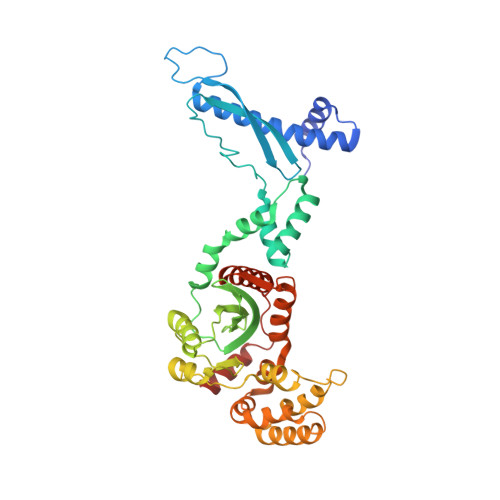
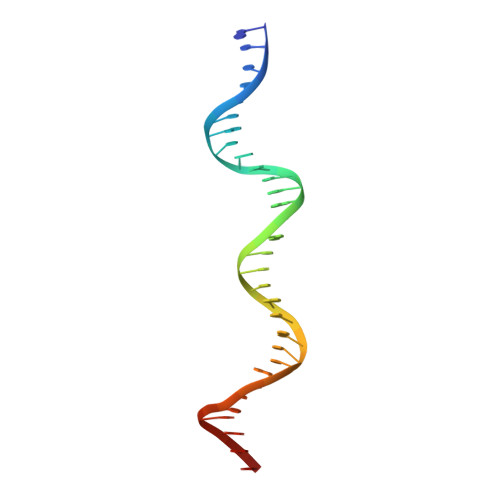
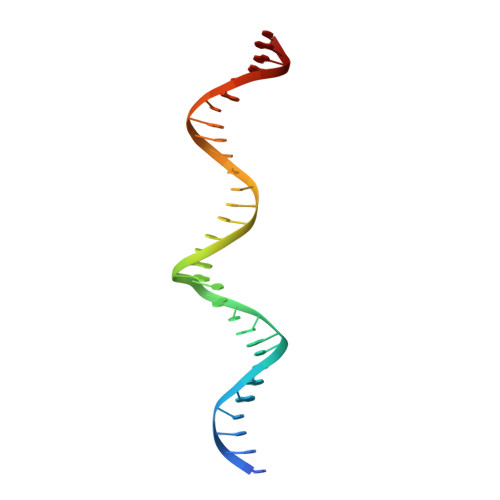
6XGW | pdb_00006xgw

ISCth4 transposase, pre-reaction complex, PRC


Experimental Data Snapshot

  • Method: X-RAY DIFFRACTION
  • Resolution: 3.50 Å
  • R-Value Free: 
    0.296 (Depositor), 0.309 (DCC) 
  • R-Value Work: 
    0.249 (Depositor), 0.260 (DCC) 
  • R-Value Observed: 
    0.252 (Depositor) 

Starting Model: experimental
View more details

wwPDB Validation 3D Report Full Report

Validation slider image for 6XGW

This is version 1.2 of the entry. See complete history

Literature

Structures of ISCth4 transpososomes reveal the role of asymmetry in copy-out/paste-in DNA transposition.

Kosek, D.Hickman, A.B.Ghirlando, R.He, S.Dyda, F.

(2021) EMBO J 40: e105666-e105666

  • DOI: https://doi.org/10.15252/embj.2020105666
  • Primary Citation Related Structures: 
    6XG8, 6XGW, 6XGX

  • PubMed Abstract: 

    Copy-out/paste-in transposition is a major bacterial DNA mobility pathway. It contributes significantly to the emergence of antibiotic resistance, often by upregulating expression of downstream genes upon integration. Unlike other transposition pathways, it requires both asymmetric and symmetric strand transfer steps. Here, we report the first structural study of a copy-out/paste-in transposase and demonstrate its ability to catalyze all pathway steps in vitro. X-ray structures of ISCth4 transposase, a member of the IS256 family of insertion sequences, bound to DNA substrates corresponding to three sequential steps in the reaction reveal an unusual asymmetric dimeric transpososome. During transposition, an array of N-terminal domains binds a single transposon end while the catalytic domain moves to accommodate the varying substrates. These conformational changes control the path of DNA flanking the transposon end and the generation of DNA-binding sites. Our results explain the asymmetric outcome of the initial strand transfer and show how DNA binding is modulated by the asymmetric transposase to allow the capture of a second transposon end and to integrate a circular intermediate.


  • Organizational Affiliation
    • Laboratory of Molecular Biology, National Institute of Diabetes and Digestive and Kidney Diseases, National Institutes of Health, Bethesda, MD, USA.

Macromolecule Content 

  • Total Structure Weight: 114.67 kDa 
  • Atom Count: 7,424 
  • Modeled Residue Count: 819 
  • Deposited Residue Count: 884 
  • Unique protein chains: 1
  • Unique nucleic acid chains: 2

Macromolecules


Find similar proteins by:|  3D Structure
Entity ID: 1
MoleculeChains  Sequence LengthOrganismDetailsImage
Mutator family transposase
A, B
410Acetivibrio thermocellus ATCC 27405Mutation(s): 0 
Gene Names: Cthe_0148Cthe_0356Cthe_0371Cthe_1193Cthe_1874Cthe_3051
UniProt
Find proteins for A3DBR0 (Acetivibrio thermocellus (strain ATCC 27405 / DSM 1237 / JCM 9322 / NBRC 103400 / NCIMB 10682 / NRRL B-4536 / VPI 7372))
Explore A3DBR0 
Go to UniProtKB:  A3DBR0
Entity Groups
Sequence Clusters30% Identity50% Identity70% Identity90% Identity95% Identity100% Identity
UniProt GroupA3DBR0
Sequence Annotations
Expand
Reference Sequence
Find similar nucleic acids by:  (by identity cutoff) 
Entity ID: 2
MoleculeChains LengthOrganismImage
DNA (32-MER)C [auth D]32Acetivibrio thermocellus ATCC 27405
Sequence Annotations
Expand
Reference Sequence
Find similar nucleic acids by:  (by identity cutoff) 
Entity ID: 3
MoleculeChains LengthOrganismImage
DNA (32-MER)D [auth E]32Acetivibrio thermocellus ATCC 27405
Sequence Annotations
Expand
Reference Sequence

Experimental Data & Validation

Experimental Data

  • Method: X-RAY DIFFRACTION
  • Resolution: 3.50 Å
  • R-Value Free:  0.296 (Depositor), 0.309 (DCC) 
  • R-Value Work:  0.249 (Depositor), 0.260 (DCC) 
  • R-Value Observed: 0.252 (Depositor) 
Space Group: P 21 21 21
Unit Cell:
Length ( Å )Angle ( ˚ )
a = 89.578α = 90
b = 99.05β = 90
c = 156.088γ = 90
Software Package:
Software NamePurpose
BUSTERrefinement
PHENIXrefinement
XDSdata reduction
XSCALEdata scaling
PHASERphasing

Structure Validation

View Full Validation Report


Entry History 

Deposition Data

Revision History  (Full details and data files)

  • Version 1.0: 2020-10-14
    Type: Initial release
  • Version 1.1: 2021-01-20
    Changes: Database references
  • Version 1.2: 2023-10-18
    Changes: Data collection, Database references, Refinement description