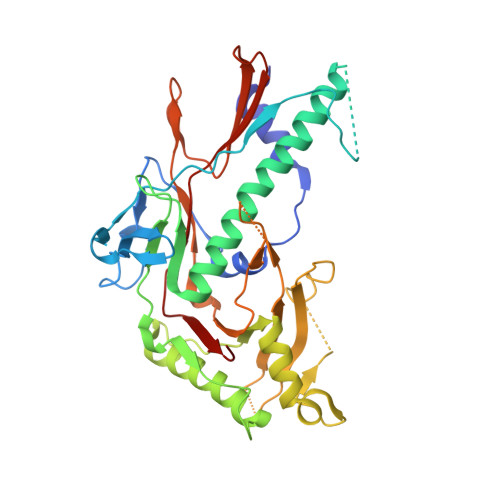
6XGP | pdb_00006xgp

YSD1_17 major capsid protein


Experimental Data Snapshot

  • Method: X-RAY DIFFRACTION
  • Resolution: 2.60 Å
  • R-Value Free: 
    0.258 (Depositor), 0.282 (DCC) 
  • R-Value Work: 
    0.219 (Depositor), 0.239 (DCC) 
  • R-Value Observed: 
    0.221 (Depositor) 

Starting Model: experimental
View more details

wwPDB Validation 3D Report Full Report

Validation slider image for 6XGP

This is version 1.2 of the entry. See complete history

Literature

The architecture and stabilisation of flagellotropic tailed bacteriophages.

Hardy, J.M.Dunstan, R.A.Grinter, R.Belousoff, M.J.Wang, J.Pickard, D.Venugopal, H.Dougan, G.Lithgow, T.Coulibaly, F.

(2020) Nat Commun 11: 3748-3748

  • DOI: https://doi.org/10.1038/s41467-020-17505-w
  • Primary Citation Related Structures: 
    6XGP, 6XGQ, 6XGR

  • PubMed Abstract: 

    Flagellotropic bacteriophages engage flagella to reach the bacterial surface as an effective means to increase the capture radius for predation. Structural details of these viruses are of great interest given the substantial drag forces and torques they face when moving down the spinning flagellum. We show that the main capsid and auxiliary proteins form two nested chainmails that ensure the integrity of the bacteriophage head. Core stabilising structures are conserved in herpesviruses suggesting their ancestral origin. The structure of the tail also reveals a robust yet pliable assembly. Hexameric rings of the tail-tube protein are braced by the N-terminus and a β-hairpin loop, and interconnected along the tail by the splayed β-hairpins. By contrast, we show that the β-hairpin has an inhibitory role in the tail-tube precursor, preventing uncontrolled self-assembly. Dyads of acidic residues inside the tail-tube present regularly-spaced motifs well suited to DNA translocation into bacteria through the tail.


  • Organizational Affiliation
    • Infection & Immunity Program, Biomedicine Discovery Institute & Department of Biochemistry and Molecular Biology, Monash University, Clayton, VIC, Australia.

Macromolecule Content 

  • Total Structure Weight: 79.89 kDa 
  • Atom Count: 5,254 
  • Modeled Residue Count: 657 
  • Deposited Residue Count: 708 
  • Unique protein chains: 1

Macromolecules

Find similar proteins by:|  3D Structure
Entity ID: 1
MoleculeChains  Sequence LengthOrganismDetailsImage
YSD1_17 major capsid protein
A, B
354Bacteriophage sp.Mutation(s): 0 
Gene Names: YSD1_17SAMEA3317914_00017
UniProt
Find proteins for A0A498U580 (Salmonella phage YSD1)
Explore A0A498U580 
Go to UniProtKB:  A0A498U580
Entity Groups
Sequence Clusters30% Identity50% Identity70% Identity90% Identity95% Identity100% Identity
UniProt GroupA0A498U580
Sequence Annotations
Expand
Reference Sequence

Experimental Data & Validation

Experimental Data

  • Method: X-RAY DIFFRACTION
  • Resolution: 2.60 Å
  • R-Value Free:  0.258 (Depositor), 0.282 (DCC) 
  • R-Value Work:  0.219 (Depositor), 0.239 (DCC) 
  • R-Value Observed: 0.221 (Depositor) 
Space Group: P 1 21 1
Unit Cell:
Length ( Å )Angle ( ˚ )
a = 54.396α = 90
b = 91.994β = 102.42
c = 89.032γ = 90
Software Package:
Software NamePurpose
BUSTERrefinement
XDSdata reduction
Aimlessdata scaling
PDB_EXTRACTdata extraction
PHASERphasing

Structure Validation

View Full Validation Report


Entry History 

& Funding Information

Deposition Data


Funding OrganizationLocationGrant Number
National Health and Medical Research Council (NHMRC, Australia)Australia1092262
Australian Research Council (ARC)AustraliaFL130100038
Wellcome TrustUnited Kingdom106077/Z/14/Z

Revision History  (Full details and data files)

  • Version 1.0: 2020-07-01
    Type: Initial release
  • Version 1.1: 2020-08-12
    Changes: Database references
  • Version 1.2: 2023-10-18
    Changes: Data collection, Database references, Refinement description