6WNH | pdb_00006wnh

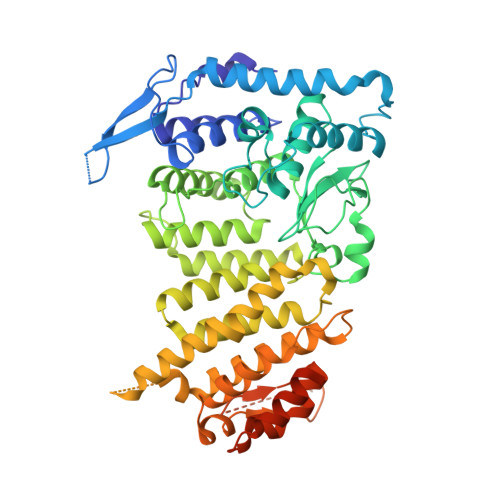
Menin bound to inhibitor M-808

  • Classification: TRANSCRIPTION
  • Organism(s): Homo sapiens
  • Expression System: Escherichia coli
  • Mutation(s): No 

  • Deposited: 2020-04-22 Released: 2020-05-13 
  • Deposition Author(s): Stuckey, J.A.
  • Funding Organization(s): National Institutes of Health/National Cancer Institute (NIH/NCI)

Experimental Data Snapshot

  • Method: X-RAY DIFFRACTION
  • Resolution: 2.10 Å
  • R-Value Free: 
    0.228 (Depositor), 0.239 (DCC) 
  • R-Value Work: 
    0.191 (Depositor), 0.203 (DCC) 
  • R-Value Observed: 
    0.193 (Depositor) 

Starting Model: experimental
View more details

wwPDB Validation 3D Report Full Report

Validation slider image for 6WNH

Ligand Structure Quality Assessment 


This is version 1.2 of the entry. See complete history

Literature

Discovery of M-808 as a Highly Potent, Covalent, Small-Molecule Inhibitor of the Menin-MLL Interaction with StrongIn VivoAntitumor Activity.

Xu, S.Aguilar, A.Huang, L.Xu, T.Zheng, K.McEachern, D.Przybranowski, S.Foster, C.Zawacki, K.Liu, Z.Chinnaswamy, K.Stuckey, J.Wang, S.

(2020) J Med Chem 63: 4997-5010

  • DOI: https://doi.org/10.1021/acs.jmedchem.0c00547
  • Primary Citation Related Structures: 
    6WNH

  • PubMed Abstract: 

    Targeting the menin-MLL protein-protein interaction is a new therapeutic strategy for the treatment of acute leukemia carrying MLL fusion (MLL leukemia). We describe herein the structure-based optimization of a class of covalent menin inhibitors, which led to the discovery of M-808 ( 16 ) as a highly potent and efficacious covalent menin inhibitor. M-808 effectively inhibits leukemia cell growth at low nanomolar concentrations and is capable of achieving partial tumor regression in an MV4;11 xenograft tumor model in mice at a well-tolerated dose schedule. Determination of the co-crystal structure of M-808 in complex with menin provides a structural basis for their high-affinity, covalent interactions. M-808 represents a promising, covalent menin inhibitor for further optimization and evaluation toward developing a new therapy for the treatment of MLL leukemia.

Macromolecule Content 

  • Total Structure Weight: 63.47 kDa 
  • Atom Count: 4,079 
  • Modeled Residue Count: 481 
  • Deposited Residue Count: 550 
  • Unique protein chains: 1

Macromolecules

Find similar proteins by:|  3D Structure
Entity ID: 1
MoleculeChains  Sequence LengthOrganismDetailsImage
Menin550Homo sapiensMutation(s): 0 
Gene Names: MEN1SCG2
UniProt & NIH Common Fund Data Resources
Find proteins for O00255 (Homo sapiens)
Explore O00255 
Go to UniProtKB:  O00255
PHAROS:  O00255
GTEx:  ENSG00000133895 
Entity Groups
Sequence Clusters30% Identity50% Identity70% Identity90% Identity95% Identity100% Identity
UniProt GroupO00255
Sequence Annotations
Expand
Reference Sequence

Small Molecules

Experimental Data & Validation

Experimental Data

  • Method: X-RAY DIFFRACTION
  • Resolution: 2.10 Å
  • R-Value Free:  0.228 (Depositor), 0.239 (DCC) 
  • R-Value Work:  0.191 (Depositor), 0.203 (DCC) 
  • R-Value Observed: 0.193 (Depositor) 
Space Group: I 41
Unit Cell:
Length ( Å )Angle ( ˚ )
a = 153.549α = 90
b = 153.549β = 90
c = 81.283γ = 90
Software Package:
Software NamePurpose
BUSTERrefinement
PDB_EXTRACTdata extraction
HKL-2000data reduction
HKL-2000data scaling
MOLREPphasing

Structure Validation

View Full Validation Report


Ligand Structure Quality Assessment 


Entry History 

& Funding Information

Deposition Data


Funding OrganizationLocationGrant Number
National Institutes of Health/National Cancer Institute (NIH/NCI)United States1-R01-CA208267

Revision History  (Full details and data files)

  • Version 1.0: 2020-05-13
    Type: Initial release
  • Version 1.1: 2020-05-27
    Changes: Database references
  • Version 1.2: 2023-10-18
    Changes: Data collection, Database references, Refinement description