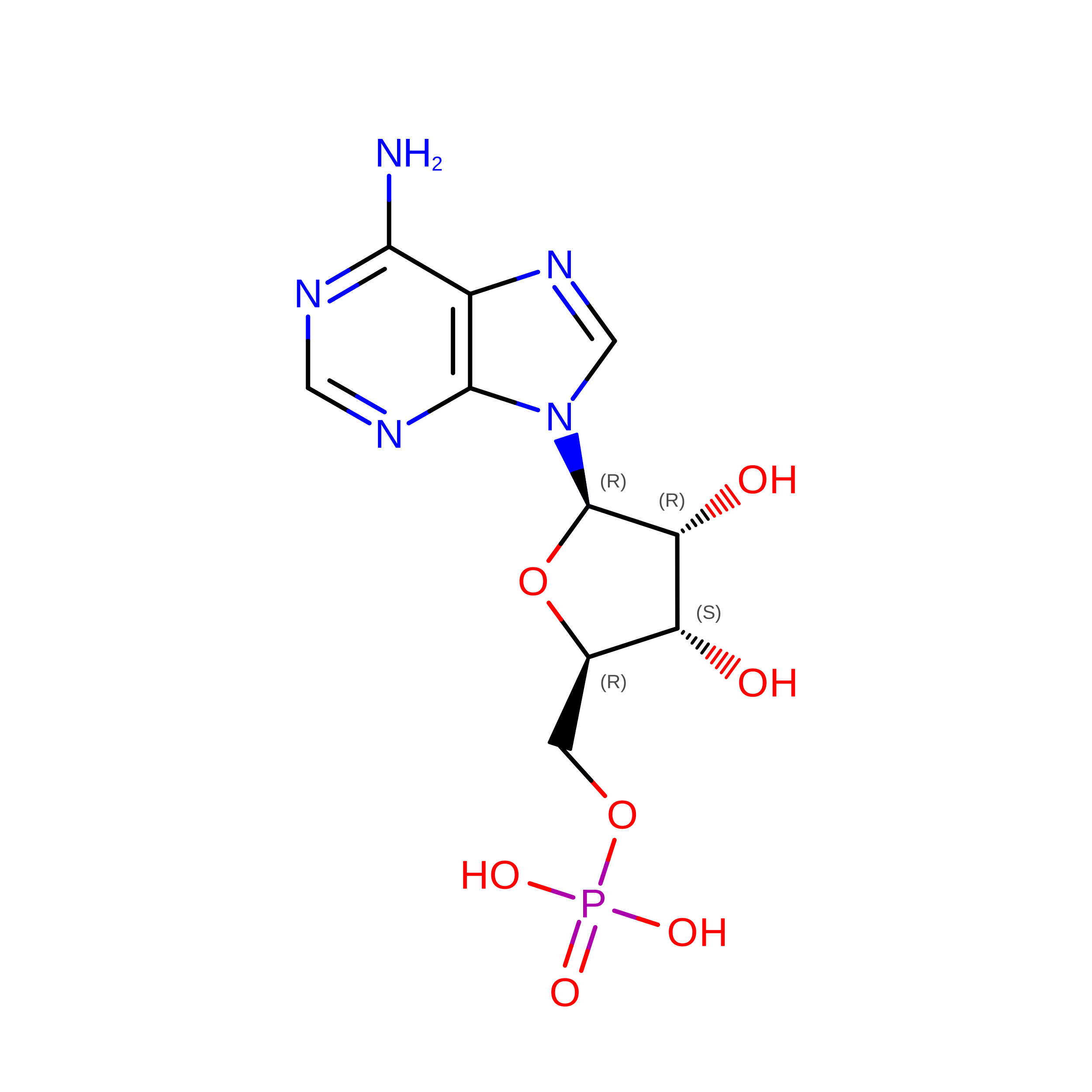
6VVG | pdb_00006vvg

Structure of the Cydia pomonella Granulovirus kinase, PK-1


Experimental Data Snapshot

  • Method: X-RAY DIFFRACTION
  • Resolution: 2.01 Å
  • R-Value Free: 
    0.225 (Depositor), 0.223 (DCC) 
  • R-Value Work: 
    0.193 (Depositor), 0.193 (DCC) 
  • R-Value Observed: 
    0.195 (Depositor) 

Starting Model: experimental
View more details

wwPDB Validation 3D Report Full Report

Validation slider image for 6VVG

Ligand Structure Quality Assessment 


This is version 1.2 of the entry. See complete history

Literature

Granulovirus PK-1 kinase activity relies on a side-to-side dimerization mode centered on the regulatory alpha C helix.

Oliver, M.R.Horne, C.R.Shrestha, S.Keown, J.R.Liang, L.Y.Young, S.N.Sandow, J.J.Webb, A.I.Goldstone, D.C.Lucet, I.S.Kannan, N.Metcalf, P.Murphy, J.M.

(2021) Nat Commun 12: 1002-1002

  • DOI: https://doi.org/10.1038/s41467-021-21191-7
  • Primary Citation Related Structures: 
    6VVG

  • PubMed Abstract: 

    The life cycle of Baculoviridae family insect viruses depends on the viral protein kinase, PK-1, to phosphorylate the regulatory protein, p6.9, to induce baculoviral genome release. Here, we report the crystal structure of Cydia pomenella granulovirus PK-1, which, owing to its likely ancestral origin among host cell AGC kinases, exhibits a eukaryotic protein kinase fold. PK-1 occurs as a rigid dimer, where an antiparallel arrangement of the αC helices at the dimer core stabilizes PK-1 in a closed, active conformation. Dimerization is facilitated by C-lobe:C-lobe and N-lobe:N-lobe interactions between protomers, including the domain-swapping of an N-terminal helix that crowns a contiguous β-sheet formed by the two N-lobes. PK-1 retains a dimeric conformation in solution, which is crucial for catalytic activity. Our studies raise the prospect that parallel, side-to-side dimeric arrangements that lock kinase domains in a catalytically-active conformation could function more broadly as a regulatory mechanism among eukaryotic protein kinases.


  • Organizational Affiliation
    • School of Biological Sciences, University of Auckland, Auckland, New Zealand.

Macromolecule Content 

  • Total Structure Weight: 65.92 kDa 
  • Atom Count: 4,777 
  • Modeled Residue Count: 531 
  • Deposited Residue Count: 558 
  • Unique protein chains: 1

Macromolecules

Find similar proteins by:|  3D Structure
Entity ID: 1
MoleculeChains  Sequence LengthOrganismDetailsImage
Arginine kinase
A, B
279Cydia pomonella granulosis virus (isolate Mexican)Mutation(s): 0 
Gene Names: orf3
UniProt
Find proteins for A0A097P1P8 (Cydia pomonella granulosis virus)
Explore A0A097P1P8 
Go to UniProtKB:  A0A097P1P8
Entity Groups
Sequence Clusters30% Identity50% Identity70% Identity90% Identity95% Identity100% Identity
UniProt GroupA0A097P1P8
Sequence Annotations
Expand
Reference Sequence

Experimental Data & Validation

Experimental Data

  • Method: X-RAY DIFFRACTION
  • Resolution: 2.01 Å
  • R-Value Free:  0.225 (Depositor), 0.223 (DCC) 
  • R-Value Work:  0.193 (Depositor), 0.193 (DCC) 
  • R-Value Observed: 0.195 (Depositor) 
Space Group: P 21 21 21
Unit Cell:
Length ( Å )Angle ( ˚ )
a = 41.937α = 90
b = 115.37β = 90
c = 119.395γ = 90
Software Package:
Software NamePurpose
PHENIXrefinement
Aimlessdata scaling
PDB_EXTRACTdata extraction
XDSdata reduction
PHASERphasing

Structure Validation

View Full Validation Report


Ligand Structure Quality Assessment 


Entry History 

Deposition Data

Revision History  (Full details and data files)

  • Version 1.0: 2021-02-03
    Type: Initial release
  • Version 1.1: 2021-02-24
    Changes: Database references
  • Version 1.2: 2023-10-11
    Changes: Data collection, Database references, Refinement description