6V88 | pdb_00006v88

Solution NMR structure of Dictyostelium discoideum Skp1A (truncated) dimer


Experimental Data Snapshot

  • Method: SOLUTION NMR
  • Conformers Calculated: 100 
  • Conformers Submitted: 20 
  • Selection Criteria: target function 

wwPDB Validation 3D Report Full Report

Validation slider image for 6V88

This is version 1.4 of the entry. See complete history

Literature

Skp1 Dimerization Conceals Its F-Box Protein Binding Site.

Kim, H.W.Eletsky, A.Gonzalez, K.J.van der Wel, H.Strauch, E.M.Prestegard, J.H.West, C.M.

(2020) Biochemistry 59: 1527-1536

  • DOI: https://doi.org/10.1021/acs.biochem.0c00094
  • Primary Citation Related Structures: 
    6V88

  • PubMed Abstract: 

    Skp1 is an adapter that links F-box proteins to cullin-1 in the Skp1/cullin-1/F-box (SCF) protein family of E3 ubiquitin ligases that targets specific proteins for polyubiquitination and subsequent protein degradation. Skp1 from the amoebozoan Dictyostelium forms a stable homodimer in vitro with a K d of 2.5 μM as determined by sedimentation velocity studies yet is monomeric in crystal complexes with F-box proteins. To investigate the molecular basis for the difference, we determined the solution NMR structure of a doubly truncated Skp1 homodimer (Skp1ΔΔ). The solution structure of the Skp1ΔΔ dimer reveals a 2-fold symmetry with an interface that buries ∼750 Å 2 of predominantly hydrophobic surface. The dimer interface overlaps with subsite 1 of the F-box interaction area, explaining why only the Skp1 monomer binds F-box proteins (FBPs). To confirm the model, Rosetta was used to predict amino acid substitutions that might disrupt the dimer interface, and the F97E substitution was chosen to potentially minimize interference with F-box interactions. A nearly full-length version of Skp1 with this substitution (Skp1ΔF97E) behaved as a stable monomer at concentrations of ≤500 μM and actively bound a model FBP, mammalian Fbs1, which suggests that the dimeric state is not required for Skp1 to carry out a basic biochemical function. Finally, Skp1ΔF97E is expected to serve as a monomer model for high-resolution NMR studies previously hindered by dimerization.

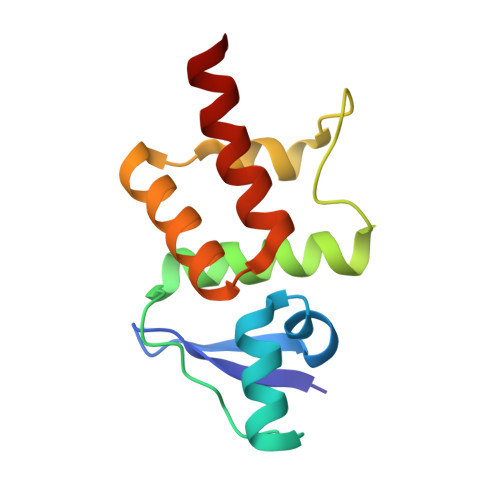
Macromolecule Content 

  • Total Structure Weight: 26 kDa 
  • Atom Count: 1,816 
  • Modeled Residue Count: 232 
  • Deposited Residue Count: 232 
  • Unique protein chains: 1

Macromolecules

Find similar proteins by:|  3D Structure
Entity ID: 1
MoleculeChains  Sequence LengthOrganismDetailsImage
SCF ubiquitin ligase complex protein SKP1a
A, B
116Dictyostelium discoideumMutation(s): 0 
Gene Names: fpaAfp21Afpa1fpa1Askp1ADDB_G0269230
UniProt
Find proteins for P52285 (Dictyostelium discoideum)
Explore P52285 
Go to UniProtKB:  P52285
Entity Groups
Sequence Clusters30% Identity50% Identity70% Identity90% Identity95% Identity100% Identity
UniProt GroupP52285
Sequence Annotations
Expand
Reference Sequence

Experimental Data & Validation

Experimental Data

  • Method: SOLUTION NMR
  • Conformers Calculated: 100 
  • Conformers Submitted: 20 
  • Selection Criteria: target function 

Structure Validation

View Full Validation Report


Entry History 

& Funding Information

Deposition Data


Funding OrganizationLocationGrant Number
National Institutes of Health/National Institute of General Medical Sciences (NIH/NIGMS)United StatesRO1GM037539
National Institutes of Health/National Institute of General Medical Sciences (NIH/NIGMS)United StatesR01GM084383
National Institutes of Health/National Institute of General Medical Sciences (NIH/NIGMS)United StatesP41GM103390

Revision History  (Full details and data files)

  • Version 1.0: 2020-04-15
    Type: Initial release
  • Version 1.1: 2020-05-06
    Changes: Database references
  • Version 1.2: 2022-03-16
    Changes: Author supporting evidence, Database references
  • Version 1.3: 2023-06-14
    Changes: Other
  • Version 1.4: 2024-05-15
    Changes: Data collection, Database references