6UG1 | pdb_00006ug1

Sequence impact in DNA duplex opening by the Rad4/XPC nucleotide excision repair complex


Experimental Data Snapshot

  • Method: X-RAY DIFFRACTION
  • Resolution: 2.83 Å
  • R-Value Free: 
    0.272 (Depositor), 0.273 (DCC) 
  • R-Value Work: 
    0.224 (Depositor), 0.228 (DCC) 
  • R-Value Observed: 
    0.226 (Depositor) 

wwPDB Validation 3D Report Full Report

Validation slider image for 6UG1

This is version 1.2 of the entry. See complete history

Literature

Impact of DNA sequences on DNA 'opening' by the Rad4/XPC nucleotide excision repair complex.

Paul, D.Mu, H.Tavakoli, A.Dai, Q.Chakraborty, S.He, C.Ansari, A.Broyde, S.Min, J.H.

(2021) DNA Repair (Amst) 107: 103194-103194

  • DOI: https://doi.org/10.1016/j.dnarep.2021.103194
  • Primary Citation Related Structures: 
    6UG1

  • PubMed Abstract: 

    Rad4/XPC recognizes diverse DNA lesions to initiate nucleotide excision repair (NER). However, NER propensities among lesions vary widely and repair-resistant lesions are persistent and thus highly mutagenic. Rad4 recognizes repair-proficient lesions by unwinding ('opening') the damaged DNA site. Such 'opening' is also observed on a normal DNA sequence containing consecutive C/G's (CCC/GGG) when tethered to Rad4 to prevent protein diffusion. However, it was unknown if such tethering-facilitated DNA 'opening' could occur on any DNA or if certain structures/sequences would resist being 'opened'. Here, we report that DNA containing alternating C/G's (CGC/GCG) failed to be opened even when tethered; instead, Rad4 bound in a 180°-reversed manner, capping the DNA end. Fluorescence lifetime studies of DNA conformations in solution showed that CCC/GGG exhibits local pre-melting that is absent in CGC/GCG. In MD simulations, CGC/GCG failed to engage Rad4 to promote 'opening' contrary to CCC/GGG. Altogether, our study illustrates how local sequences can impact DNA recognition by Rad4/XPC and how certain DNA sites resist being 'opened' even with Rad4 held at that site indefinitely. The contrast between CCC/GGG and CGC/GCG sequences in Rad4-DNA recognition may help decipher a lesion's mutagenicity in various genomic sequence contexts to explain lesion-determined mutational hot and cold spots.


  • Organizational Affiliation
    • Department of Chemistry and Biochemistry, Baylor University, Waco, TX, 76798, USA.

Macromolecule Content 

  • Total Structure Weight: 78.12 kDa 
  • Atom Count: 5,231 
  • Modeled Residue Count: 576 
  • Deposited Residue Count: 603 
  • Unique protein chains: 2
  • Unique nucleic acid chains: 2

Macromolecules


Find similar proteins by:|  3D Structure
Entity ID: 1
MoleculeChains  Sequence LengthOrganismDetailsImage
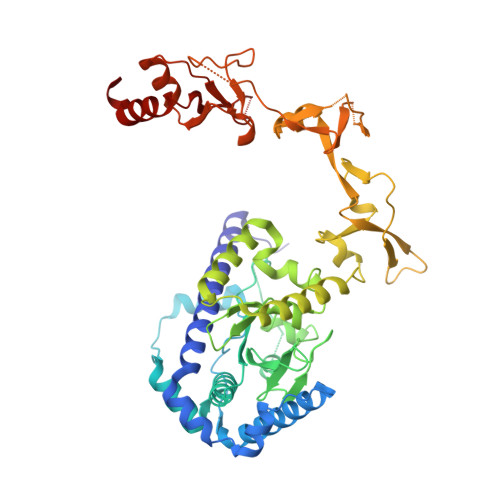
DNA repair protein RAD4504Saccharomyces cerevisiae S288CMutation(s): 0 
Gene Names: RAD4YER162C
UniProt
Find proteins for P14736 (Saccharomyces cerevisiae (strain ATCC 204508 / S288c))
Explore P14736 
Go to UniProtKB:  P14736
Entity Groups
Sequence Clusters30% Identity50% Identity70% Identity90% Identity95% Identity100% Identity
UniProt GroupP14736
Sequence Annotations
Expand
Reference Sequence
Find similar proteins by:|  3D Structure
Entity ID: 2
MoleculeChains  Sequence LengthOrganismDetailsImage
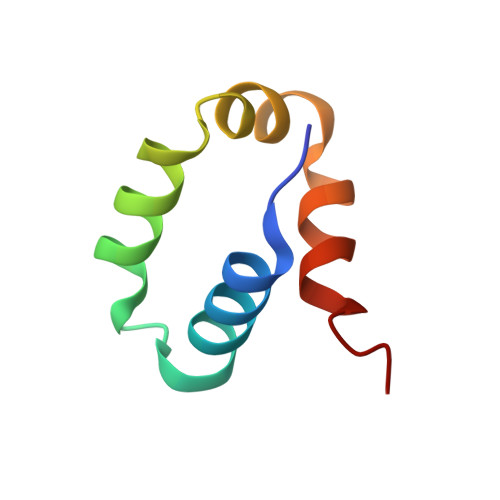
UV excision repair protein RAD23B [auth X]57Saccharomyces cerevisiae S288CMutation(s): 0 
Gene Names: RAD23YEL037CSYGP-ORF29
UniProt
Find proteins for P32628 (Saccharomyces cerevisiae (strain ATCC 204508 / S288c))
Explore P32628 
Go to UniProtKB:  P32628
Entity Groups
Sequence Clusters30% Identity50% Identity70% Identity90% Identity95% Identity100% Identity
UniProt GroupP32628
Sequence Annotations
Expand
Reference Sequence
Find similar nucleic acids by:  Sequence
Entity ID: 3
MoleculeChains LengthOrganismImage
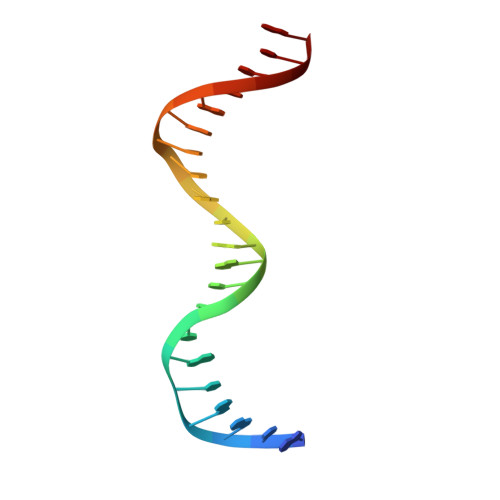
DNA (5'-D(*AP*TP*TP*GP*TP*AP*GP*GP*GP*AP*TP*GP*TP*CP*GP*AP*GP*TP*CP*A)-3')C [auth Y]21Saccharomyces cerevisiae
Sequence Annotations
Expand
Reference Sequence
Find similar nucleic acids by:  Sequence
Entity ID: 4
MoleculeChains LengthOrganismImage
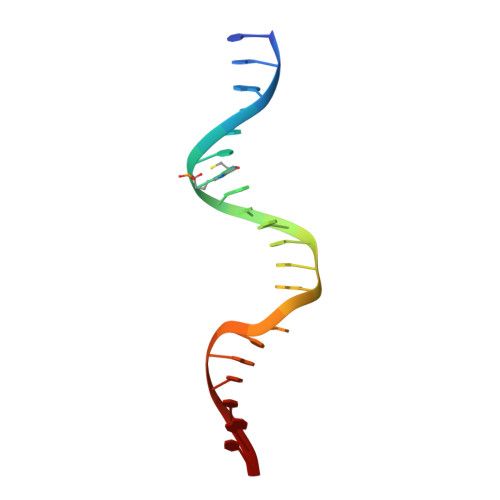
DNA (5'-D(*TP*TP*GP*AP*CP*TP*CP*(G47)P*AP*CP*AP*TP*CP*CP*CP*CP*TP*AP*CP*AP*A)-3')D [auth W]21Saccharomyces cerevisiae
Sequence Annotations
Expand
Reference Sequence

Experimental Data & Validation

Experimental Data

  • Method: X-RAY DIFFRACTION
  • Resolution: 2.83 Å
  • R-Value Free:  0.272 (Depositor), 0.273 (DCC) 
  • R-Value Work:  0.224 (Depositor), 0.228 (DCC) 
  • R-Value Observed: 0.226 (Depositor) 
Space Group: P 1
Unit Cell:
Length ( Å )Angle ( ˚ )
a = 53.244α = 105.51
b = 59.571β = 97.88
c = 78.24γ = 107.14
Software Package:
Software NamePurpose
PHENIXrefinement
d*TREKdata reduction
HKL-2000data scaling
MOLREPphasing

Structure Validation

View Full Validation Report


Entry History 

& Funding Information

Deposition Data


Funding OrganizationLocationGrant Number
National Science Foundation (NSF, United States)United States--

Revision History  (Full details and data files)

  • Version 1.0: 2021-03-31
    Type: Initial release
  • Version 1.1: 2021-09-08
    Changes: Database references
  • Version 1.2: 2024-11-20
    Changes: Data collection, Structure summary