6U5T | pdb_00006u5t

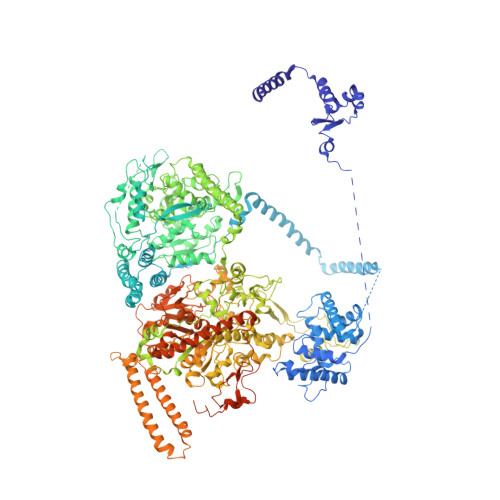
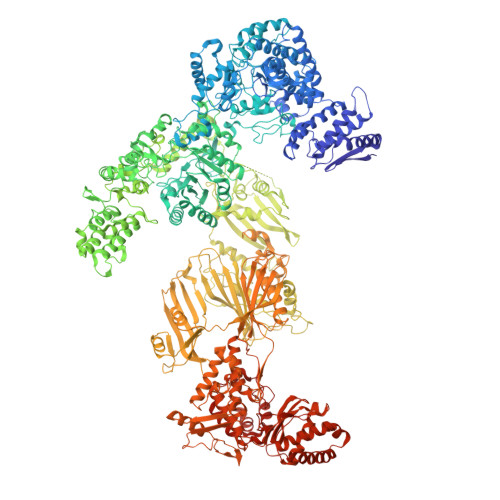
Electron cryomicroscopy Structure of S. cerevisiae FAS in the Apo state


Experimental Data Snapshot

  • Method: ELECTRON MICROSCOPY
  • Resolution: 2.90 Å
  • Aggregation State: PARTICLE 
  • Reconstruction Method: SINGLE PARTICLE 

Starting Model: experimental
View more details

wwPDB Validation 3D Report Full Report

Validation slider image for 6U5T

This is version 2.1 of the entry. See complete history

Literature

Electron cryomicroscopy observation of acyl carrier protein translocation in type I fungal fatty acid synthase.

Lou, J.W.Iyer, K.R.Hasan, S.M.N.Cowen, L.E.Mazhab-Jafari, M.T.

(2019) Sci Rep 9: 12987-12987

  • DOI: https://doi.org/10.1038/s41598-019-49261-3
  • Primary Citation Related Structures: 
    6U5T, 6U5U, 6U5V, 6U5W

  • PubMed Abstract: 

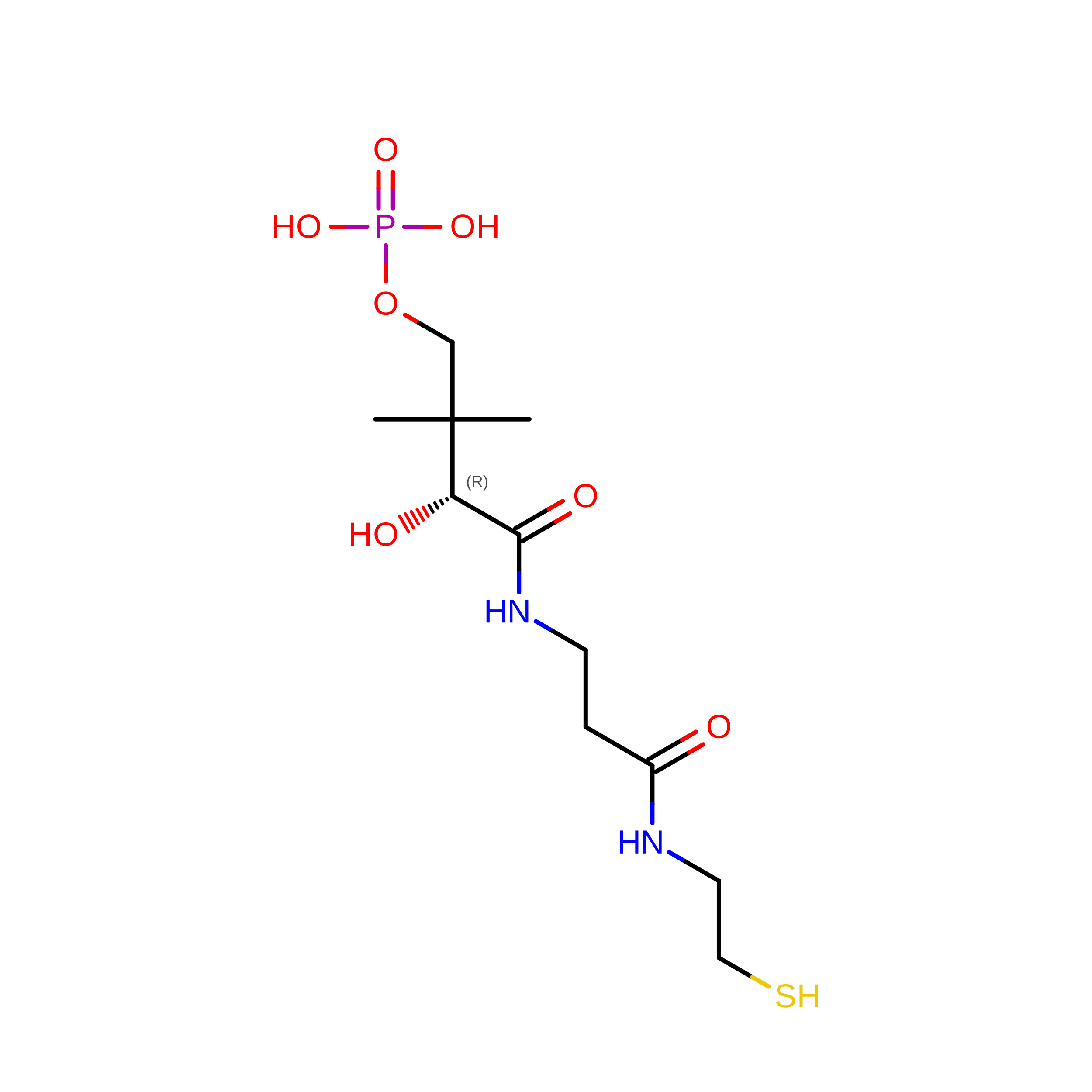
    During fatty acid biosynthesis, acyl carrier proteins (ACPs) from type I fungal fatty acid synthase (FAS) shuttle substrates and intermediates within a reaction chamber that hosts multiple spatially-fixed catalytic centers. A major challenge in understanding the mechanism of ACP-mediated substrate shuttling is experimental observation of its transient interaction landscape within the reaction chamber. Here, we have shown that ACP spatial distribution is sensitive to the presence of substrates in a catalytically inhibited state, which enables high-resolution investigation of the ACP-dependent conformational transitions within the enoyl reductase (ER) reaction site. In two fungal FASs with distinct ACP localization, the shuttling domain is targeted to the ketoacyl-synthase (KS) domain and away from other catalytic centers, such as acetyl-transferase (AT) and ER domains by steric blockage of the KS active site followed by addition of substrates. These studies strongly suggest that acylation of phosphopantetheine arm of ACP may be an integral part of the substrate shuttling mechanism in type I fungal FAS.


  • Organizational Affiliation
    • Department of Medical Biophysics, University of Toronto, Princess Margaret Cancer Research Institute, Toronto, Ontario, Canada.

Macromolecule Content 

  • Total Structure Weight: 439.69 kDa 
  • Atom Count: 28,233 
  • Modeled Residue Count: 3,649 
  • Deposited Residue Count: 3,960 
  • Unique protein chains: 2

Macromolecules

Find similar proteins by:|  3D Structure
Entity ID: 1
MoleculeChains  Sequence LengthOrganismDetailsImage
Fatty acid synthase subunit alpha1,887Saccharomyces cerevisiaeMutation(s): 0 
EC: 2.3.1.86 (PDB Primary Data), 1.1.1.100 (PDB Primary Data), 2.3.1.41 (PDB Primary Data)
UniProt
Find proteins for A0A140KF01 (Saccharomyces cerevisiae)
Explore A0A140KF01 
Go to UniProtKB:  A0A140KF01
Entity Groups
Sequence Clusters30% Identity50% Identity70% Identity90% Identity95% Identity100% Identity
UniProt GroupA0A140KF01
Sequence Annotations
Expand
Reference Sequence
Find similar proteins by:|  3D Structure
Entity ID: 2
MoleculeChains  Sequence LengthOrganismDetailsImage
Fatty acid synthase subunit betaB [auth G]2,073Saccharomyces cerevisiaeMutation(s): 0 
EC: 2.3.1.86 (PDB Primary Data), 4.2.1.59 (PDB Primary Data), 1.3.1.9 (PDB Primary Data), 2.3.1.38 (PDB Primary Data), 2.3.1.39 (PDB Primary Data), 3.1.2.14 (PDB Primary Data)
UniProt
Find proteins for P07149 (Saccharomyces cerevisiae (strain ATCC 204508 / S288c))
Explore P07149 
Go to UniProtKB:  P07149
Entity Groups
Sequence Clusters30% Identity50% Identity70% Identity90% Identity95% Identity100% Identity
UniProt GroupP07149
Sequence Annotations
Expand
Reference Sequence

Small Molecules

Experimental Data & Validation

Experimental Data

  • Method: ELECTRON MICROSCOPY
  • Resolution: 2.90 Å
  • Aggregation State: PARTICLE 
  • Reconstruction Method: SINGLE PARTICLE 
EM Software:
TaskSoftware PackageVersion
RECONSTRUCTIONcryoSPARC2
MODEL REFINEMENTPHENIX

Structure Validation

View Full Validation Report


Entry History 

Deposition Data

Revision History  (Full details and data files)

  • Version 1.0: 2019-10-16
    Type: Initial release
  • Version 2.0: 2019-10-30
    Type: Coordinate replacement
    Reason: Polymer geometry
    Changes: Advisory, Atomic model, Data collection, Derived calculations, Structure summary
  • Version 2.1: 2025-04-02
    Changes: Data collection, Database references, Derived calculations, Refinement description, Structure summary