6U50 | pdb_00006u50

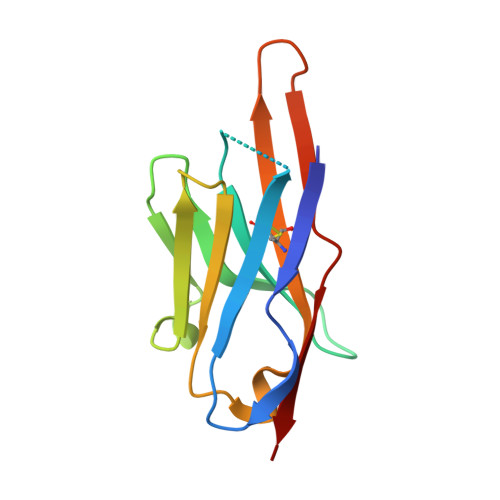
Anti-Sudan ebolavirus Nucleoprotein Single Domain Antibody Sudan B (SB)


Experimental Data Snapshot

  • Method: X-RAY DIFFRACTION
  • Resolution: 1.60 Å
  • R-Value Free: 
    0.214 (Depositor), 0.214 (DCC) 
  • R-Value Work: 
    0.169 (Depositor), 0.172 (DCC) 
  • R-Value Observed: 
    0.174 (Depositor) 

Starting Model: experimental
View more details

wwPDB Validation 3D Report Full Report

Validation slider image for 6U50

This is version 1.5 of the entry. See complete history

Literature

Paratope Duality and Gullying are Among the Atypical Recognition Mechanisms Used by a Trio of Nanobodies to Differentiate Ebolavirus Nucleoproteins.

Sherwood, L.J.Taylor, A.B.Hart, P.J.Hayhurst, A.

(2019) J Mol Biology 431: 4848-4867

  • DOI: https://doi.org/10.1016/j.jmb.2019.10.005
  • Primary Citation Related Structures: 
    6U50, 6U51, 6U52, 6U53, 6U54, 6U55

  • PubMed Abstract: 

    We had previously shown that three anti-Marburg virus nanobodies (VHH or single-domain antibody [sdAb]) targeted a cryptotope within an alpha-helical assembly at the nucleoprotein (NP) C-terminus that was conserved through half a century of viral evolution. Here, we wished to determine whether an anti-Ebola virus sdAb, that was cross-reactive within the Ebolavirus genus, recognized a similar structural feature upstream of the ebolavirus NP C-terminus. In addition, we sought to determine whether the specificities of a less cross-reactive anti-Zaire ebolavirus sdAb and a totally specific anti-Sudan ebolavirus sdAb were the result of exclusion from this region. Binding and X-ray crystallographic studies revealed that the primary determinant of cross-reactivity did indeed appear to be a preference for the helical feature. Specificity, in the case of the Zaire ebolavirus-specific sdAb, arose from the footprint shifting away from the helices to engage more variable residues. While both sdAbs used CDRs, they also had atypical side-on approaches, with framework 2 helping to accommodate parts of the epitope in sizeable paratope gullies. The Sudan ebolavirus-specific sdAb was more remarkable and appeared to bind two C-terminal domains simultaneously via nonoverlapping epitopes-"paratope duality." One mode involved paratope gullying, whereas the other involved only CDRs, with CDR3 restructuring to wedge in between opposing walls of an interdomain crevice. The varied routes used by sdAbs to engage antigens discovered here deepen our appreciation of the small scaffold's architectural versatility and also reveal lucrative opportunities within the ebolavirus NP C-termini that might be leveraged for diagnostics and novel therapeutic targeting.


  • Organizational Affiliation
    • Disease Intervention and Prevention, Texas Biomedical Research Institute, San Antonio, TX, 78227, USA.

Macromolecule Content 

  • Total Structure Weight: 13.17 kDa 
  • Atom Count: 966 
  • Modeled Residue Count: 114 
  • Deposited Residue Count: 120 
  • Unique protein chains: 1

Macromolecules

Find similar proteins by:|  3D Structure
Entity ID: 1
MoleculeChains  Sequence LengthOrganismDetailsImage
Anti-Sudan ebolavirus Nucleoprotein Single Domain Antibody Sudan B (SB)A [auth C]120Lama glamaMutation(s): 0 

Small Molecules

Ligands 1 Unique
IDChains Name / Formula / InChI Key2D Diagram3D Interactions
MPD

Query on MPD


Download:Ideal Coordinates CCD File
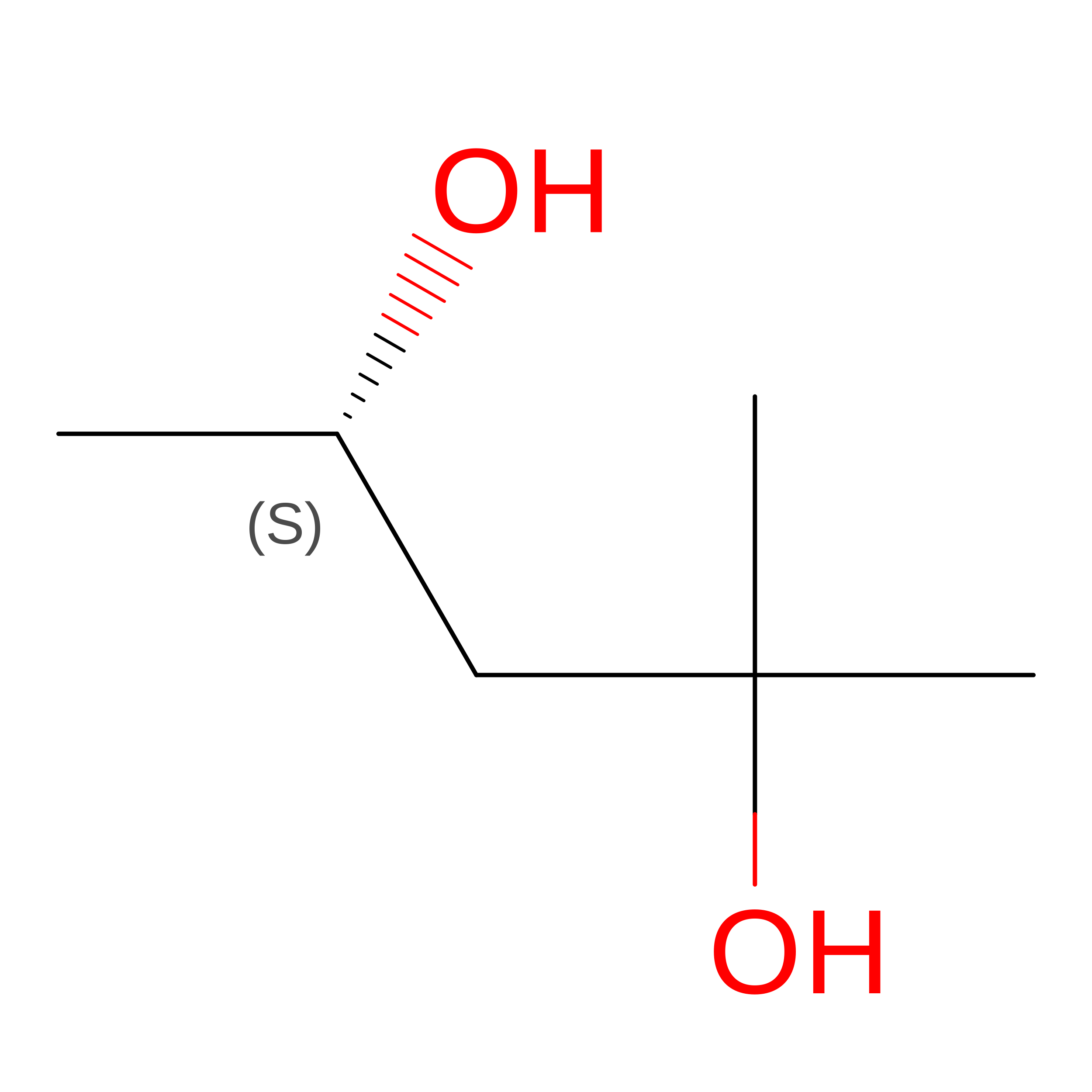
B [auth C](4S)-2-METHYL-2,4-PENTANEDIOL
C6 H14 O2
SVTBMSDMJJWYQN-YFKPBYRVSA-N

Experimental Data & Validation

Experimental Data

  • Method: X-RAY DIFFRACTION
  • Resolution: 1.60 Å
  • R-Value Free:  0.214 (Depositor), 0.214 (DCC) 
  • R-Value Work:  0.169 (Depositor), 0.172 (DCC) 
  • R-Value Observed: 0.174 (Depositor) 
Space Group: P 31 2 1
Unit Cell:
Length ( Å )Angle ( ˚ )
a = 47.839α = 90
b = 47.839β = 90
c = 85.378γ = 120
Software Package:
Software NamePurpose
PHENIXrefinement
XDSdata reduction
XDSdata scaling
PHASERphasing

Structure Validation

View Full Validation Report


Entry History 

& Funding Information

Deposition Data


Funding OrganizationLocationGrant Number
National Institutes of Health/National Institute Of Allergy and Infectious Diseases (NIH/NIAID)United StatesR01 AI112851
National Institutes of Health/National Institute Of Allergy and Infectious Diseases (NIH/NIAID)United StatesR21 AI105568
National Institutes of Health/National Center for Research Resources (NIH/NCRR)United StatesC06 RR012087

Revision History  (Full details and data files)

  • Version 1.0: 2019-11-06
    Type: Initial release
  • Version 1.1: 2019-12-04
    Changes: Author supporting evidence
  • Version 1.2: 2019-12-11
    Changes: Database references
  • Version 1.3: 2020-01-01
    Changes: Database references
  • Version 1.4: 2023-10-11
    Changes: Data collection, Database references, Refinement description
  • Version 1.5: 2024-11-20
    Changes: Structure summary