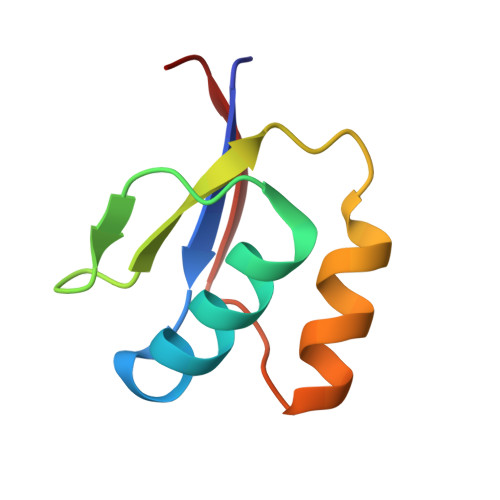
6U2D | pdb_00006u2d

PmtCD peptide exporter basket domain


Experimental Data Snapshot

  • Method: X-RAY DIFFRACTION
  • Resolution: 2.11 Å
  • R-Value Free: 
    0.261 (Depositor), 0.261 (DCC) 
  • R-Value Work: 
    0.209 (Depositor), 0.210 (DCC) 
  • R-Value Observed: 
    0.214 (Depositor) 

wwPDB Validation 3D Report Full Report

Validation slider image for 6U2D

This is version 1.1 of the entry. See complete history

Literature

Structural insight into the Staphylococcus aureus ATP-driven exporter of virulent peptide toxins

Zeytuni, N.Dickey, S.W.Hu, J.Chou, H.T.Worrall, L.J.Alexander, J.A.N.Carlson, M.L.Nosella, M.Duong, F.Yu, Z.Otto, M.Strynadka, N.C.J.

(2020) Sci Adv 6: eabb8219

  • DOI: https://doi.org/10.1126/sciadv.abb8219
  • Primary Citation Related Structures: 
    6U2D, 6XFU, 6XJH, 6XJI

  • PubMed Abstract: 

    Staphylococcus aureus is a major human pathogen that has acquired alarming broad-spectrum antibiotic resistance. One group of secreted toxins with key roles during infection is the phenol-soluble modulins (PSMs). PSMs are amphipathic, membrane-destructive cytolytic peptides that are exported to the host-cell environment by a designated adenosine 5'-triphosphate (ATP)-binding cassette (ABC) transporter, the PSM transporter (PmtABCD). Here, we demonstrate that the minimal Pmt unit necessary for PSM export is PmtCD and provide its first atomic characterization by single-particle cryo-EM and x-ray crystallography. We have captured the transporter in the ATP-bound state at near atomic resolution, revealing a type II ABC exporter fold, with an additional cytosolic domain. Comparison to a lower-resolution nucleotide-free map displaying an "open" conformation and putative hydrophobic inner chamber of a size able to accommodate the binding of two PSM peptides provides mechanistic insight and sets the foundation for therapeutic design.


  • Organizational Affiliation
    • Department of Biochemistry and Molecular Biology and the Centre for Blood Research, University of British Columbia, Vancouver, BC, Canada.

Macromolecule Content 

  • Total Structure Weight: 32.38 kDa 
  • Atom Count: 2,316 
  • Modeled Residue Count: 257 
  • Deposited Residue Count: 264 
  • Unique protein chains: 1

Macromolecules

Find similar proteins by:|  3D Structure
Entity ID: 1
MoleculeChains  Sequence LengthOrganismDetailsImage
ABC transporter ATP-binding protein
A, B, C, D
66Staphylococcus aureusMutation(s): 0 
UniProt
Find proteins for Q2FWW9 (Staphylococcus aureus (strain NCTC 8325 / PS 47))
Explore Q2FWW9 
Go to UniProtKB:  Q2FWW9
Entity Groups
Sequence Clusters30% Identity50% Identity70% Identity90% Identity95% Identity100% Identity
UniProt GroupQ2FWW9
Sequence Annotations
Expand
Reference Sequence

Small Molecules

Ligands 2 Unique
IDChains Name / Formula / InChI Key2D Diagram3D Interactions
IOD

Query on IOD


Download:Ideal Coordinates CCD File
F [auth A]
G [auth A]
I [auth B]
K [auth C]
L [auth C]
F [auth A],
G [auth A],
I [auth B],
K [auth C],
L [auth C],
M [auth C],
N [auth C]
IODIDE ION
I
XMBWDFGMSWQBCA-UHFFFAOYSA-M
SO4

Query on SO4


Download:Ideal Coordinates CCD File
E [auth A],
H [auth B],
J [auth C],
O [auth D],
P [auth D]
SULFATE ION
O4 S
QAOWNCQODCNURD-UHFFFAOYSA-L

Experimental Data & Validation

Experimental Data

  • Method: X-RAY DIFFRACTION
  • Resolution: 2.11 Å
  • R-Value Free:  0.261 (Depositor), 0.261 (DCC) 
  • R-Value Work:  0.209 (Depositor), 0.210 (DCC) 
  • R-Value Observed: 0.214 (Depositor) 
Space Group: C 1 2 1
Unit Cell:
Length ( Å )Angle ( ˚ )
a = 150.19α = 90
b = 39.783β = 108.94
c = 56.499γ = 90
Software Package:
Software NamePurpose
HKL-2000data reduction
HKL-2000data scaling
SHELXphasing
PHENIXrefinement
PDB_EXTRACTdata extraction

Structure Validation

View Full Validation Report


Entry History 

& Funding Information

Deposition Data


Funding OrganizationLocationGrant Number
Canadian Institutes of Health Research (CIHR)CanadaOperating grant

Revision History  (Full details and data files)

  • Version 1.0: 2020-10-14
    Type: Initial release
  • Version 1.1: 2024-03-13
    Changes: Data collection, Database references, Refinement description