6U0Q | pdb_00006u0q

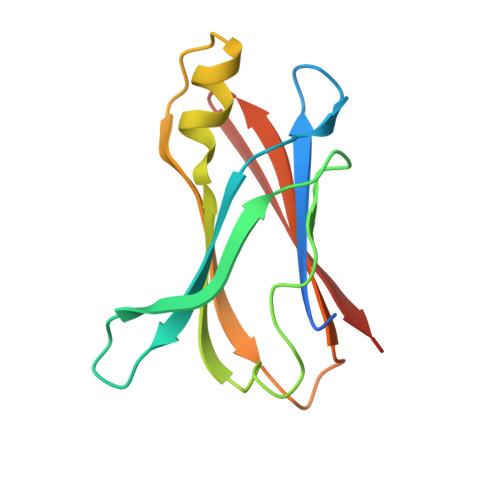
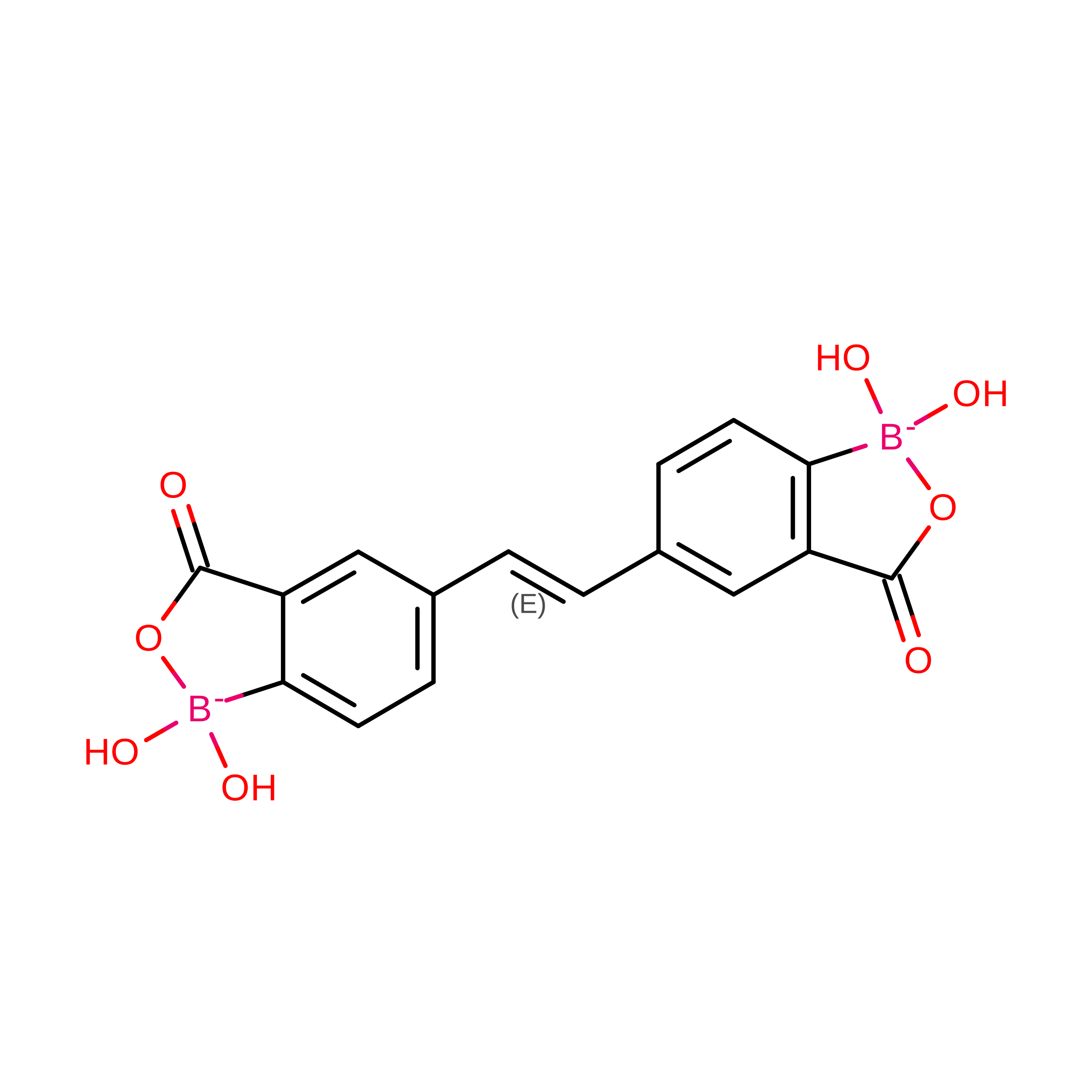
Transthyretin in complex with (E)-5,5'-(ethene-1,2-diyl)bis(1,1-dihydroxy-3-oxo-1,3-dihydrobenzo[c][1,2]oxaborol-1-uide)


Experimental Data Snapshot

  • Method: X-RAY DIFFRACTION
  • Resolution: 1.75 Å
  • R-Value Free: 
    0.222 (Depositor), 0.222 (DCC) 
  • R-Value Work: 
    0.178 (Depositor), 0.179 (DCC) 
  • R-Value Observed: 
    0.181 (Depositor) 

Starting Model: experimental
View more details

wwPDB Validation 3D Report Full Report

Validation slider image for 6U0Q

Ligand Structure Quality Assessment 


This is version 1.4 of the entry. See complete history

Literature

Boronic acid with high oxidative stability and utility in biological contexts.

Graham, B.J.Windsor, I.W.Gold, B.Raines, R.T.

(2021) Proc Natl Acad Sci U S A 118

  • DOI: https://doi.org/10.1073/pnas.2013691118
  • Primary Citation Related Structures: 
    6U0Q

  • PubMed Abstract: 

    Despite their desirable attributes, boronic acids have had a minimal impact in biological contexts. A significant problem has been their oxidative instability. At physiological pH, phenylboronic acid and its boronate esters are oxidized by reactive oxygen species at rates comparable to those of thiols. After considering the mechanism and kinetics of the oxidation reaction, we reasoned that diminishing electron density on boron could enhance oxidative stability. We found that a boralactone, in which a carboxyl group serves as an intramolecular ligand for the boron, increases stability by 10 4 -fold. Computational analyses revealed that the resistance to oxidation arises from diminished stabilization of the p orbital of boron that develops in the rate-limiting transition state of the oxidation reaction. Like simple boronic acids and boronate esters, a boralactone binds covalently and reversibly to 1,2-diols such as those in saccharides. The kinetic stability of its complexes is, however, at least 20-fold greater. A boralactone also binds covalently to a serine side chain in a protein. These attributes confer unprecedented utility upon boralactones in the realms of chemical biology and medicinal chemistry.


  • Organizational Affiliation
    • Department of Chemistry, Massachusetts Institute of Technology, Cambridge, MA 02139.

Macromolecule Content 

  • Total Structure Weight: 28.52 kDa 
  • Atom Count: 2,083 
  • Modeled Residue Count: 231 
  • Deposited Residue Count: 256 
  • Unique protein chains: 1

Macromolecules

Find similar proteins by:|  3D Structure
Entity ID: 1
MoleculeChains  Sequence LengthOrganismDetailsImage
Transthyretin
A, B
128Homo sapiensMutation(s): 0 
Gene Names: TTRPALB
UniProt & NIH Common Fund Data Resources
Find proteins for P02766 (Homo sapiens)
Explore P02766 
Go to UniProtKB:  P02766
PHAROS:  P02766
GTEx:  ENSG00000118271 
Entity Groups
Sequence Clusters30% Identity50% Identity70% Identity90% Identity95% Identity100% Identity
UniProt GroupP02766
Sequence Annotations
Expand
Reference Sequence

Small Molecules

Ligands 1 Unique
IDChains Name / Formula / InChI Key2D Diagram3D Interactions
S2B
(Subject of Investigation/LOI)

Query on S2B


Download:Ideal Coordinates CCD File
C [auth A],
D [auth B]
3-[(~{E})-2-[7,7-bis(oxidanyl)-9-oxidanylidene-8-oxa-7-boranuidabicyclo[4.3.0]nona-1,3,5-trien-3-yl]ethenyl]-7,7-bis(oxidanyl)-8-oxa-7-boranuidabicyclo[4.3.0]nona-1(6),2,4-trien-9-one
C16 H12 B2 O8
SFTURCQVILCIEC-OWOJBTEDSA-N

Experimental Data & Validation

Experimental Data

  • Method: X-RAY DIFFRACTION
  • Resolution: 1.75 Å
  • R-Value Free:  0.222 (Depositor), 0.222 (DCC) 
  • R-Value Work:  0.178 (Depositor), 0.179 (DCC) 
  • R-Value Observed: 0.181 (Depositor) 
Space Group: P 21 21 2
Unit Cell:
Length ( Å )Angle ( ˚ )
a = 43.09α = 90
b = 85.84β = 90
c = 64.25γ = 90
Software Package:
Software NamePurpose
PHENIXrefinement
SAINTdata reduction
SADABSdata scaling
PHASERphasing

Structure Validation

View Full Validation Report


Ligand Structure Quality Assessment 


Entry History 

& Funding Information

Deposition Data


Funding OrganizationLocationGrant Number
National Institutes of Health/National Institute of General Medical Sciences (NIH/NIGMS)United StatesR01 GM044783

Revision History  (Full details and data files)

  • Version 1.0: 2021-01-27
    Type: Initial release
  • Version 1.1: 2021-03-10
    Changes: Database references
  • Version 1.2: 2021-08-18
    Changes: Database references, Derived calculations
  • Version 1.3: 2023-10-11
    Changes: Data collection, Refinement description
  • Version 1.4: 2024-10-16
    Changes: Structure summary