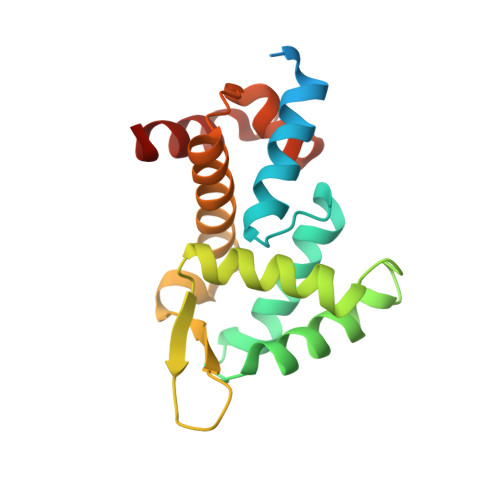
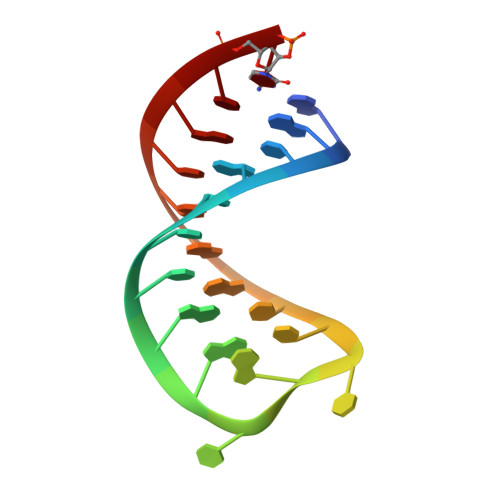
6TQA | pdb_00006tqa

X-ray structure of Roquin ROQ domain in complex with a UCP3 CDE2 SL RNA motif


Experimental Data Snapshot

  • Method: X-RAY DIFFRACTION
  • Resolution: 2.40 Å
  • R-Value Free: 
    0.259 (Depositor), 0.262 (DCC) 
  • R-Value Work: 
    0.197 (Depositor), 0.201 (DCC) 
  • R-Value Observed: 
    0.200 (Depositor) 

Starting Model: experimental
View more details

wwPDB Validation 3D Report Full Report

Validation slider image for 6TQA

This is version 1.3 of the entry. See complete history

Literature

Structural basis for the recognition of transiently structured AU-rich elements by Roquin.

Binas, O.Tants, J.N.Peter, S.A.Janowski, R.Davydova, E.Braun, J.Niessing, D.Schwalbe, H.Weigand, J.E.Schlundt, A.

(2020) Nucleic Acids Res 48: 7385-7403

  • DOI: https://doi.org/10.1093/nar/gkaa465
  • Primary Citation Related Structures: 
    6TQA, 6TQB, 6XWJ, 6XWW, 6XXA, 6XXB

  • PubMed Abstract: 

    Adenylate/uridylate-rich elements (AREs) are the most common cis-regulatory elements in the 3'-untranslated region (UTR) of mRNAs, where they fine-tune turnover by mediating mRNA decay. They increase plasticity and efficacy of mRNA regulation and are recognized by several ARE-specific RNA-binding proteins (RBPs). Typically, AREs are short linear motifs with a high content of complementary A and U nucleotides and often occur in multiple copies. Although thermodynamically rather unstable, the high AU-content might enable transient secondary structure formation and modify mRNA regulation by RBPs. We have recently suggested that the immunoregulatory RBP Roquin recognizes folded AREs as constitutive decay elements (CDEs), resulting in shape-specific ARE-mediated mRNA degradation. However, the structural evidence for a CDE-like recognition of AREs by Roquin is still lacking. We here present structures of CDE-like folded AREs, both in their free and protein-bound form. Moreover, the AREs in the UCP3 3'-UTR are additionally bound by the canonical ARE-binding protein AUF1 in their linear form, adopting an alternative binding-interface compared to the recognition of their CDE structure by Roquin. Strikingly, our findings thus suggest that AREs can be recognized in multiple ways, allowing control over mRNA regulation by adapting distinct conformational states, thus providing differential accessibility to regulatory RBPs.


  • Organizational Affiliation
    • Institute for Organic Chemistry and Chemical Biology, Goethe University Frankfurt and Center for Biomolecular Magnetic Resonance (BMRZ), 60438 Frankfurt, Germany.

Macromolecule Content 

  • Total Structure Weight: 109.25 kDa 
  • Atom Count: 6,938 
  • Modeled Residue Count: 685 
  • Deposited Residue Count: 804 
  • Unique protein chains: 1
  • Unique nucleic acid chains: 1

Macromolecules


Find similar proteins by:|  3D Structure
Entity ID: 1
MoleculeChains  Sequence LengthOrganismDetailsImage
Roquin-1A,
C [auth B],
E [auth C],
G [auth D]
180Mus musculusMutation(s): 0 
Gene Names: Rc3h1Gm551Kiaa2025
EC: 2.3.2.27
UniProt
Find proteins for Q4VGL6 (Mus musculus)
Explore Q4VGL6 
Go to UniProtKB:  Q4VGL6
Entity Groups
Sequence Clusters30% Identity50% Identity70% Identity90% Identity95% Identity100% Identity
UniProt GroupQ4VGL6
Sequence Annotations
Expand
Reference Sequence
Find similar nucleic acids by:  Sequence
Entity ID: 2
MoleculeChains LengthOrganismImage
RNA (5'-R(P*GP*GP*UP*GP*CP*CP*UP*AP*AP*UP*AP*UP*UP*UP*AP*GP*GP*CP*AP*CP*(CCC))-3')B [auth E],
D [auth F],
F [auth G],
H
21Mus musculus
Sequence Annotations
Expand
Reference Sequence

Experimental Data & Validation

Experimental Data

  • Method: X-RAY DIFFRACTION
  • Resolution: 2.40 Å
  • R-Value Free:  0.259 (Depositor), 0.262 (DCC) 
  • R-Value Work:  0.197 (Depositor), 0.201 (DCC) 
  • R-Value Observed: 0.200 (Depositor) 
Space Group: P 1 21 1
Unit Cell:
Length ( Å )Angle ( ˚ )
a = 44.53α = 90
b = 160.66β = 107.96
c = 68.01γ = 90
Software Package:
Software NamePurpose
REFMACrefinement
PDB_EXTRACTdata extraction
XDSdata reduction
XSCALEdata scaling
PHASERphasing

Structure Validation

View Full Validation Report


Entry History 

Deposition Data

Revision History  (Full details and data files)

  • Version 1.0: 2020-05-27
    Type: Initial release
  • Version 1.1: 2020-06-17
    Changes: Database references
  • Version 1.2: 2020-07-29
    Changes: Database references
  • Version 1.3: 2024-01-24
    Changes: Data collection, Database references, Refinement description