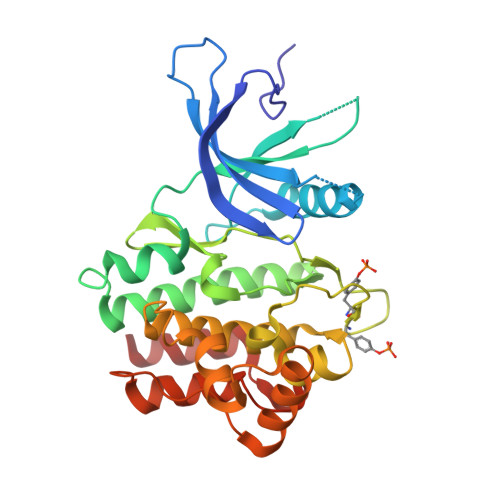
6TPE | pdb_00006tpe

Fragment-based discovery of pyrazolopyridones as JAK1 inhibitors with excellent subtype selectivity


Experimental Data Snapshot

  • Method: X-RAY DIFFRACTION
  • Resolution: 2.87 Å
  • R-Value Free: 
    0.298 (Depositor), 0.295 (DCC) 
  • R-Value Work: 
    0.247 (Depositor) 
  • R-Value Observed: 
    0.249 (Depositor) 

wwPDB Validation 3D Report Full Report

Validation slider image for 6TPE

Ligand Structure Quality Assessment 


This is version 1.2 of the entry. See complete history. 

Literature

Fragment-Based Discovery of Pyrazolopyridones as JAK1 Inhibitors with Excellent Subtype Selectivity.

Hansen, B.B., Jepsen, T.H., Larsen, M., Sindet, R., Vifian, T., Burhardt, M.N., Larsen, J., Seitzberg, J.G., Carnerup, M.A., Jerre, A., Molck, C., Lovato, P., Rai, S., Nasipireddy, V.R., Ritzen, A.

(2020) J Med Chem 63: 7008-7032

  • DOI: https://doi.org/10.1021/acs.jmedchem.0c00359
  • Primary Citation Related Structures: 
    6TPD, 6TPE, 6TPF

  • PubMed Abstract: 

    Herein, we report the discovery of a series of JAK1-selective kinase inhibitors with high potency and excellent JAK family subtype selectivity. A fragment screening hit 1 with a pyrazolopyridone core and a JAK1 bias was selected as the starting point for our fragment-based lead generation efforts. A two-stage strategy was chosen with the dual aims of improving potency and JAK1 selectivity: Optimization of the lipophilic ribose pocket-targeting substituent was followed by the introduction of a variety of P-loop-targeting functional groups. Combining the best moieties from both stages of the optimization afforded compound 40 , which showed excellent potency and selectivity. Metabolism studies in vitro and in vivo together with an in vitro safety evaluation suggest that 40 may be a viable lead compound for the development of highly subtype-selective JAK1 inhibitors.


  • Organizational Affiliation: 
    • Medicinal Chemistry, GVK Biosciences Private Limited, 28 A, IDA Nacharam, Hyderabad 500076, India.

Macromolecule Content 

  • Total Structure Weight: 67.78 kDa 
  • Atom Count: 4,646 
  • Modeled Residue Count: 566 
  • Deposited Residue Count: 582 
  • Unique protein chains: 1

Macromolecules

Find similar proteins by:|  3D Structure
Entity ID: 1
MoleculeChains  Sequence LengthOrganismDetailsImage
Tyrosine-protein kinase JAK1
A, B
291Homo sapiensMutation(s): 0 
Gene Names: JAK1, JAK1A, JAK1B
EC: 2.7.10.2
UniProt & NIH Common Fund Data Resources
Find proteins for P23458 (Homo sapiens)
Explore P23458 
Go to UniProtKB:  P23458
PHAROS:  P23458
GTEx:  ENSG00000162434 
Entity Groups
Sequence Clusters30% Identity50% Identity70% Identity90% Identity95% Identity100% Identity
UniProt GroupP23458
Sequence Annotations
Expand
Reference Sequence

Small Molecules

Ligands 1 Unique
IDChains Name / Formula / InChI Key2D Diagram3D Interactions
NTW
(Subject of Investigation/LOI)

Query on NTW


Download:Ideal Coordinates CCD File
C [auth A],
D [auth B]
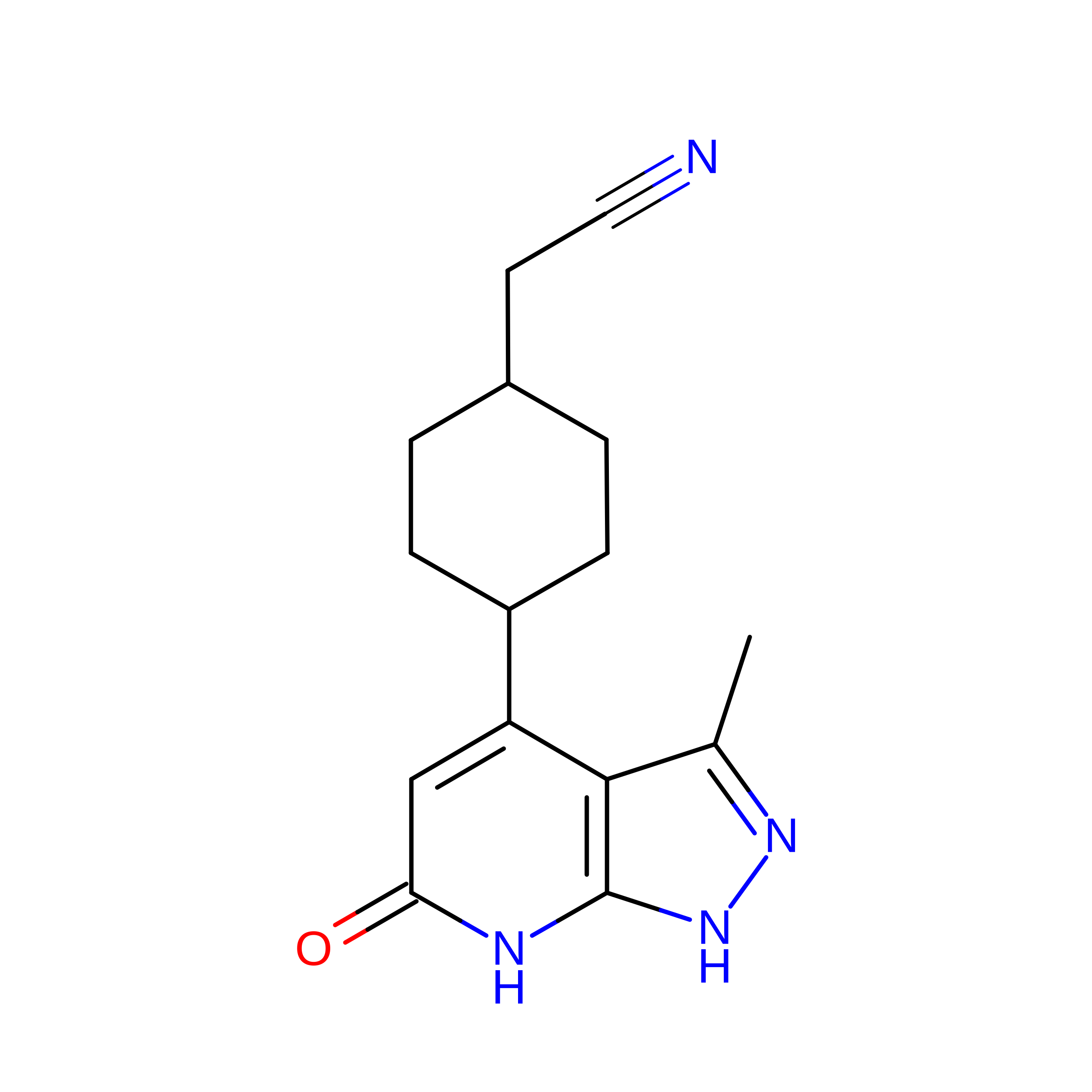
2-[4-(3-methyl-6-oxidanylidene-1,7-dihydropyrazolo[3,4-b]pyridin-4-yl)cyclohexyl]ethanenitrile
C15 H18 N4 O
ZPCWQNHNXIMUEY-XYPYZODXSA-N
Modified Residues  1 Unique
IDChains TypeFormula2D DiagramParent
PTR
Query on PTR
A, B
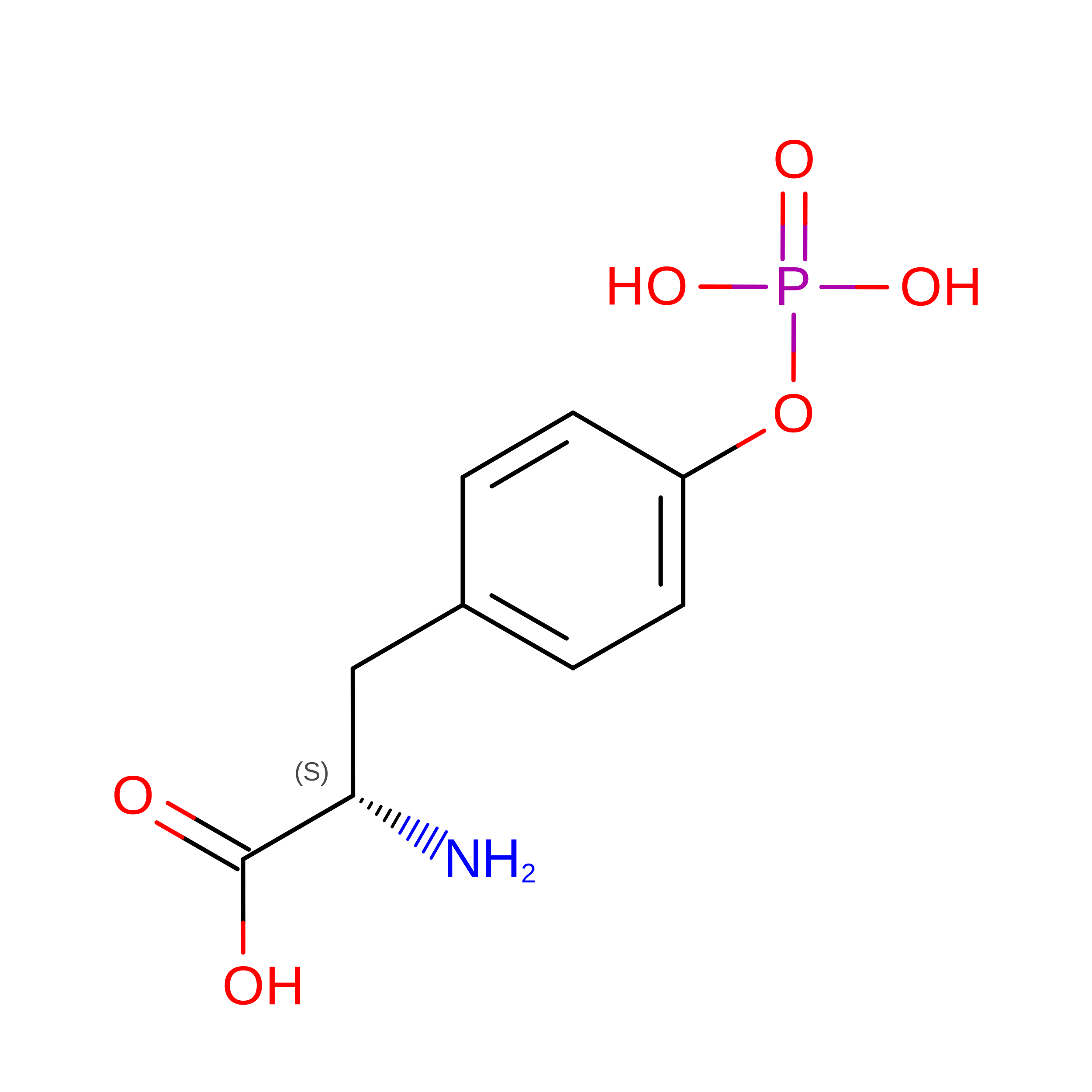
L-PEPTIDE LINKINGC9 H12 N O6 PTYR

Experimental Data & Validation

Experimental Data

  • Method: X-RAY DIFFRACTION
  • Resolution: 2.87 Å
  • R-Value Free:  0.298 (Depositor), 0.295 (DCC) 
  • R-Value Work:  0.247 (Depositor) 
  • R-Value Observed: 0.249 (Depositor) 
Space Group: P 1 21 1
Unit Cell:
Length ( Å )Angle ( ˚ )
a = 42.423α = 90
b = 169.558β = 90.54
c = 43.245γ = 90
Software Package:
Software NamePurpose
XDSdata reduction
XSCALEdata scaling
REFMACrefinement
PDB_EXTRACTdata extraction
REFMACphasing

Structure Validation

View Full Validation Report


Ligand Structure Quality Assessment 


Entry History 

Revision History  (Full details and data files)

  • Version 1.0: 2020-06-10
    Type: Initial release
  • Version 1.1: 2020-07-22
    Changes: Database references
  • Version 1.2: 2024-11-06
    Changes: Advisory, Data collection, Database references, Refinement description, Structure summary