6TN3 | pdb_00006tn3

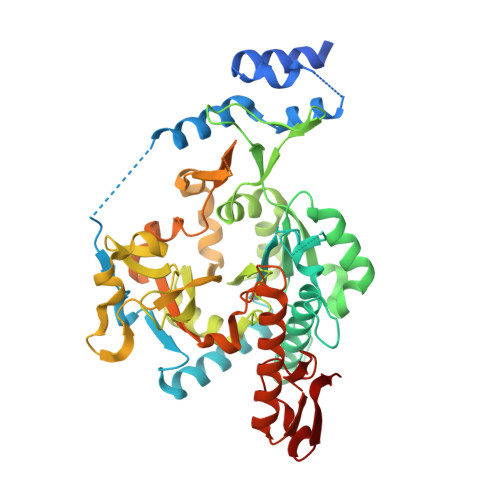
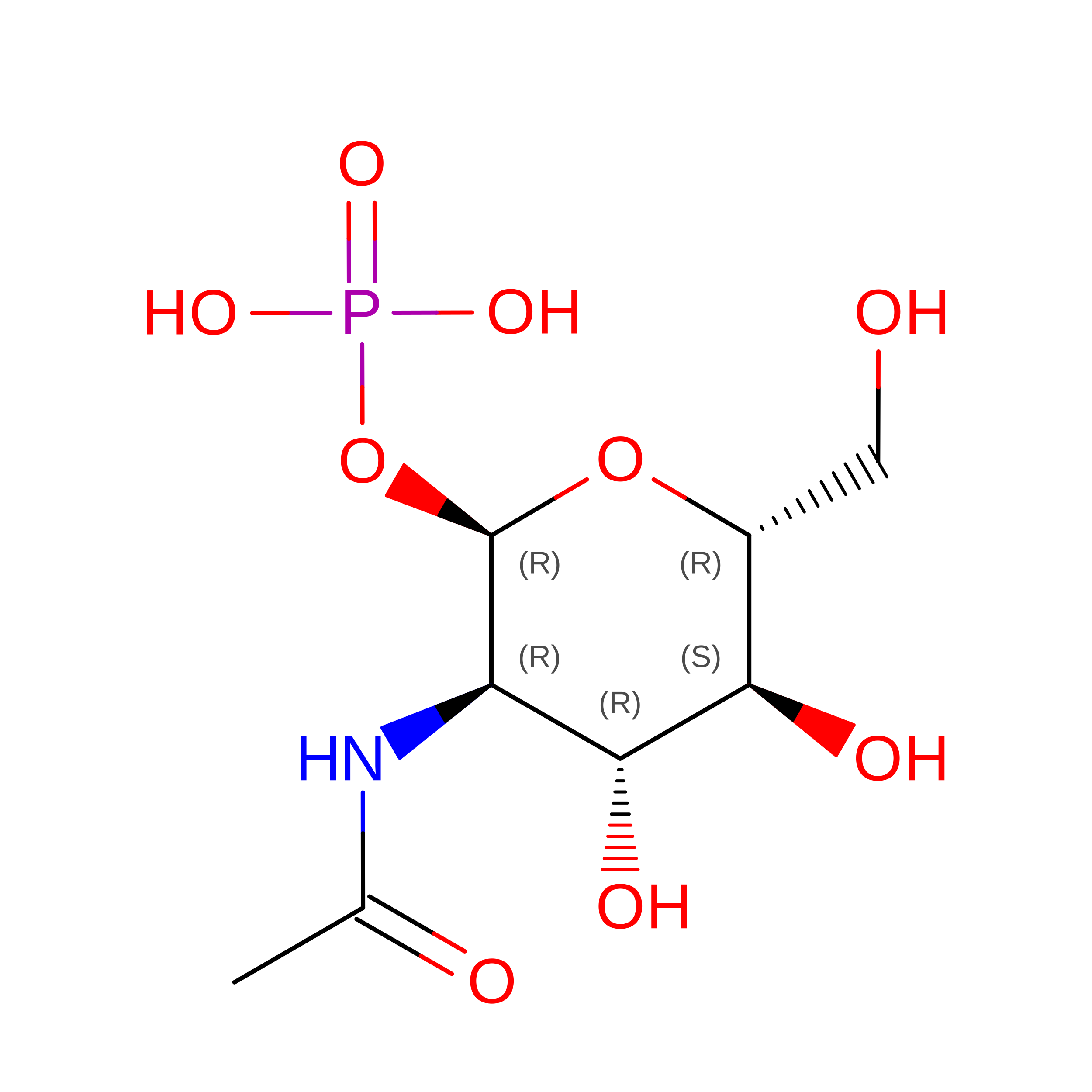
Crystal Structure of Aspergillus fumigatus UDP-N-acetylglucosamine pyrophosphorylase in complex with GlcNAc-1P


Experimental Data Snapshot

  • Method: X-RAY DIFFRACTION
  • Resolution: 2.28 Å
  • R-Value Free: 
    0.259 (Depositor), 0.260 (DCC) 
  • R-Value Work: 
    0.205 (Depositor), 0.206 (DCC) 
  • R-Value Observed: 
    0.208 (Depositor) 

Starting Model: experimental
View more details

wwPDB Validation 3D Report Full Report

Validation slider image for 6TN3

Ligand Structure Quality Assessment 


This is version 2.2 of the entry. See complete history

Literature

A mechanism-inspired UDP- N -acetylglucosamine pyrophosphorylase inhibitor.

Raimi, O.G.Hurtado-Guerrero, R.Borodkin, V.Ferenbach, A.Urbaniak, M.D.Ferguson, M.A.J.van Aalten, D.M.F.

(2020) RSC Chem Biol 1: 13-25

  • DOI: https://doi.org/10.1039/c9cb00017h
  • Primary Citation Related Structures: 
    6TN3

  • PubMed Abstract: 

    UDP- N -acetylglucosamine pyrophosphorylase (UAP1) catalyses the last step in eukaryotic biosynthesis of uridine diphosphate- N -acetylglucosamine (UDP-GlcNAc), converting UTP and GlcNAc-1P to the sugar nucleotide. Gene disruption studies have shown that this gene is essential in eukaryotes and a possible antifungal target, yet no inhibitors of fungal UAP1 have so far been reported. Here we describe the crystal structures of substrate/product complexes of UAP1 from Aspergillus fumigatus that together provide snapshots of catalysis. A structure with UDP-GlcNAc, pyrophosphate and Mg 2+ provides the first Michaelis complex trapped for this class of enzyme, revealing the structural basis of the previously reported Mg 2+ dependence and direct observation of pyrophosphorolysis. We also show that a highly conserved lysine mimics the role of a second metal observed in structures of bacterial orthologues. A mechanism-inspired UTP α,β-methylenebisphosphonate analogue ( me UTP) was designed and synthesized and was shown to be a micromolar inhibitor of the enzyme. The mechanistic insights and inhibitor described here will facilitate future studies towards the discovery of small molecule inhibitors of this currently unexploited potential antifungal drug target.


  • Organizational Affiliation
    • Division of Gene Regulation and Expression, School of Life Sciences, University of Dundee Dow Street DD1 5EH Dundee UK dmfvanaalten@dundee.ac.uk.

Macromolecule Content 

  • Total Structure Weight: 113.98 kDa 
  • Atom Count: 7,374 
  • Modeled Residue Count: 905 
  • Deposited Residue Count: 1,018 
  • Unique protein chains: 1

Macromolecules

Find similar proteins by:|  3D Structure
Entity ID: 1
MoleculeChains  Sequence LengthOrganismDetailsImage
UDP-N-acetylglucosamine pyrophosphorylase
A, B
509Aspergillus fumigatus Af293Mutation(s): 0 
Gene Names: AFUA_7G02180
EC: 2.7.7.23
UniProt
Find proteins for Q4WAR0 (Aspergillus fumigatus (strain ATCC MYA-4609 / CBS 101355 / FGSC A1100 / Af293))
Explore Q4WAR0 
Go to UniProtKB:  Q4WAR0
Entity Groups
Sequence Clusters30% Identity50% Identity70% Identity90% Identity95% Identity100% Identity
UniProt GroupQ4WAR0
Sequence Annotations
Expand
Reference Sequence

Small Molecules

Experimental Data & Validation

Experimental Data

  • Method: X-RAY DIFFRACTION
  • Resolution: 2.28 Å
  • R-Value Free:  0.259 (Depositor), 0.260 (DCC) 
  • R-Value Work:  0.205 (Depositor), 0.206 (DCC) 
  • R-Value Observed: 0.208 (Depositor) 
Space Group: P 21 21 21
Unit Cell:
Length ( Å )Angle ( ˚ )
a = 55.736α = 90
b = 138.14β = 90
c = 145.126γ = 90
Software Package:
Software NamePurpose
SCALAdata scaling
PHENIXrefinement
PDB_EXTRACTdata extraction
HKL-2000data reduction
MOLREPphasing

Structure Validation

View Full Validation Report


Ligand Structure Quality Assessment 


Entry History 

Deposition Data

Revision History  (Full details and data files)

  • Version 1.0: 2020-04-01
    Type: Initial release
  • Version 2.0: 2020-07-29
    Type: Remediation
    Reason: Carbohydrate remediation
    Changes: Advisory, Atomic model, Data collection, Derived calculations, Structure summary
  • Version 2.1: 2021-09-29
    Changes: Data collection, Database references, Structure summary
  • Version 2.2: 2024-01-24
    Changes: Data collection, Refinement description