6SZZ | pdb_00006szz

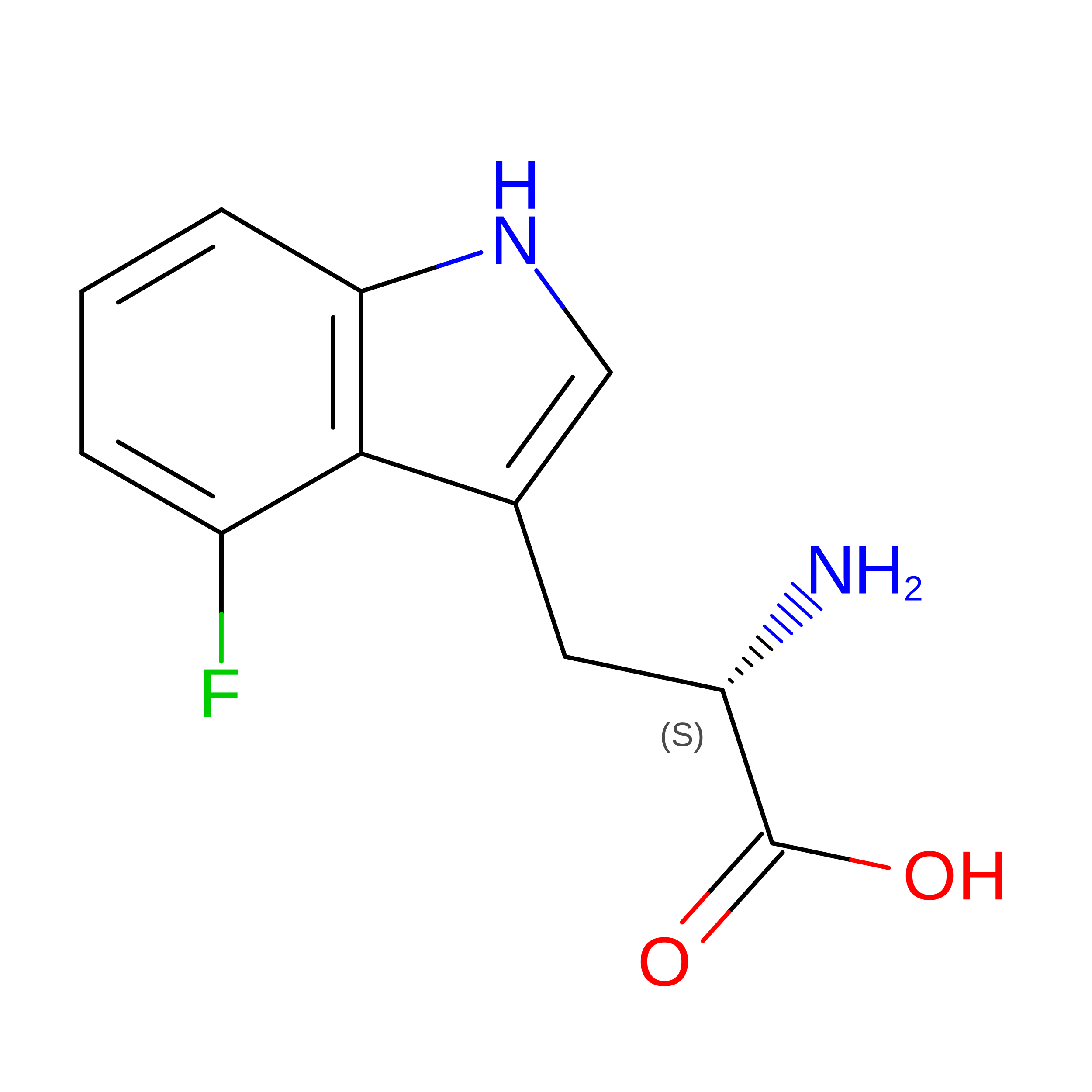
Crystal structure of Cold Shock Protein B (CspB) containing the modified residue 4-F-Trp


Experimental Data Snapshot

  • Method: X-RAY DIFFRACTION
  • Resolution: 2.05 Å
  • R-Value Free: 
    0.231 (Depositor), 0.228 (DCC) 
  • R-Value Work: 
    0.208 (Depositor) 
  • R-Value Observed: 
    0.210 (Depositor) 

Starting Model: experimental
View more details

wwPDB Validation 3D Report Full Report

Validation slider image for 6SZZ

This is version 1.1 of the entry. See complete history

Literature

What does fluorine do to a protein? Thermodynamic, and highly-resolved structural insights into fluorine-labelled variants of the cold shock protein.

Welte, H.Zhou, T.Mihajlenko, X.Mayans, O.Kovermann, M.

(2020) Sci Rep 10: 2640-2640

  • DOI: https://doi.org/10.1038/s41598-020-59446-w
  • Primary Citation Related Structures: 
    6SZZ, 6T00

  • PubMed Abstract: 

    Fluorine labelling represents one promising approach to study proteins in their native environment due to efficient suppressing of background signals. Here, we systematically probe inherent thermodynamic and structural characteristics of the Cold shock protein B from Bacillus subtilis (BsCspB) upon fluorine labelling. A sophisticated combination of fluorescence and NMR experiments has been applied to elucidate potential perturbations due to insertion of fluorine into the protein. We show that single fluorine labelling of phenylalanine or tryptophan residues has neither significant impact on thermodynamic stability nor on folding kinetics compared to wild type BsCspB. Structure determination of fluorinated phenylalanine and tryptophan labelled BsCspB using X-ray crystallography reveals no displacements even for the orientation of fluorinated aromatic side chains in comparison to wild type BsCspB. Hence we propose that single fluorinated phenylalanine and tryptophan residues used for protein labelling may serve as ideal probes to reliably characterize inherent features of proteins that are present in a highly biological context like the cell.


  • Organizational Affiliation
    • Department of Chemistry, Universitätsstrasse 10, Universität Konstanz, DE-78457, Konstanz, Germany.

Macromolecule Content 

  • Total Structure Weight: 7.57 kDa 
  • Atom Count: 548 
  • Modeled Residue Count: 67 
  • Deposited Residue Count: 67 
  • Unique protein chains: 1

Macromolecules

Find similar proteins by:|  3D Structure
Entity ID: 1
MoleculeChains  Sequence LengthOrganismDetailsImage
Cold shock protein CspD67Bacillus subtilisMutation(s): 0 
Gene Names: B4122_0412B4417_4327CJ481_22435DFO69_3150ETA10_05025ETK61_05130ETL41_18150FA024_03420SC09_Contig19orf00064
UniProt
Find proteins for P32081 (Bacillus subtilis (strain 168))
Explore P32081 
Go to UniProtKB:  P32081
Entity Groups
Sequence Clusters30% Identity50% Identity70% Identity90% Identity95% Identity100% Identity
UniProt GroupP32081
Sequence Annotations
Expand
Reference Sequence

Small Molecules

Modified Residues  1 Unique
IDChains TypeFormula2D DiagramParent
4FW
Query on 4FW
A
L-PEPTIDE LINKINGC11 H11 F N2 O2TRP

Experimental Data & Validation

Experimental Data

  • Method: X-RAY DIFFRACTION
  • Resolution: 2.05 Å
  • R-Value Free:  0.231 (Depositor), 0.228 (DCC) 
  • R-Value Work:  0.208 (Depositor) 
  • R-Value Observed: 0.210 (Depositor) 
Space Group: P 43 21 2
Unit Cell:
Length ( Å )Angle ( ˚ )
a = 56.05α = 90
b = 56.05β = 90
c = 55.12γ = 90
Software Package:
Software NamePurpose
PHENIXrefinement
XDSdata reduction
XDSdata scaling
PHASERphasing

Structure Validation

View Full Validation Report


Entry History 

Deposition Data

Revision History  (Full details and data files)

  • Version 1.0: 2020-02-26
    Type: Initial release
  • Version 1.1: 2024-01-24
    Changes: Data collection, Database references, Refinement description