6S4N | pdb_00006s4n

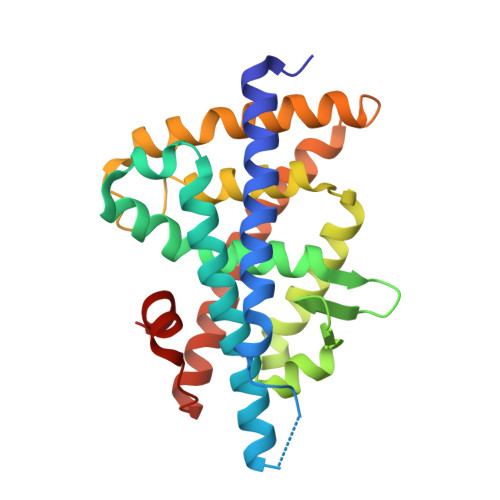
LXRbeta ligand binding domain in comlpex with small molecule inhibitors


Experimental Data Snapshot

  • Method: X-RAY DIFFRACTION
  • Resolution: 1.90 Å
  • R-Value Free: 
    0.245 (Depositor), 0.250 (DCC) 
  • R-Value Work: 
    0.215 (Depositor), 0.219 (DCC) 

wwPDB Validation 3D Report Full Report

Validation slider image for 6S4N

Ligand Structure Quality Assessment 


This is version 1.2 of the entry. See complete history

Literature

Structural analysis identifies an escape route from the adverse lipogenic effects of liver X receptor ligands.

Belorusova, A.Y.Evertsson, E.Hovdal, D.Sandmark, J.Bratt, E.Maxvall, I.Schulman, I.G.Akerblad, P.Lindstedt, E.L.

(2019) Commun Biol 2: 431-431

  • DOI: https://doi.org/10.1038/s42003-019-0675-0
  • Primary Citation Related Structures: 
    6S4N, 6S4T, 6S4U, 6S5K

  • PubMed Abstract: 

    Liver X receptors (LXRs) are attractive drug targets for cardiovascular disease treatment due to their role in regulating cholesterol homeostasis and immunity. The anti-atherogenic properties of LXRs have prompted development of synthetic ligands, but these cause major adverse effects-such as increased lipogenesis-which are challenging to dissect from their beneficial activities. Here we show that LXR compounds displaying diverse functional responses in animal models induce distinct receptor conformations. Combination of hydrogen/deuterium exchange mass spectrometry and multivariate analysis allowed identification of LXR regions differentially correlating with anti-atherogenic and lipogenic activities of ligands. We show that lipogenic compounds stabilize active states of LXRα and LXRβ while the anti-atherogenic expression of the cholesterol transporter ABCA1 is associated with the ligand-induced stabilization of LXRα helix 3. Our data indicates that avoiding ligand interaction with the activation helix 12 while engaging helix 3 may provide directions for development of ligands with improved therapeutic profiles.


  • Organizational Affiliation
    • 1Medicinal Chemistry, Respiratory, Inflammation and Autoimmunity, BioPharmaceuticals R&D, AstraZeneca, Gothenburg, Sweden.

Macromolecule Content 

  • Total Structure Weight: 116.82 kDa 
  • Atom Count: 8,422 
  • Modeled Residue Count: 928 
  • Deposited Residue Count: 980 
  • Unique protein chains: 1

Macromolecules

Find similar proteins by:|  3D Structure
Entity ID: 1
MoleculeChains  Sequence LengthOrganismDetailsImage
Oxysterols receptor LXR-betaA [auth D],
B [auth A],
C [auth B],
D [auth C]
245Homo sapiensMutation(s): 0 
Gene Names: NR1H2LXRBNERUNR
UniProt & NIH Common Fund Data Resources
Find proteins for P55055 (Homo sapiens)
Explore P55055 
Go to UniProtKB:  P55055
PHAROS:  P55055
GTEx:  ENSG00000131408 
Entity Groups
Sequence Clusters30% Identity50% Identity70% Identity90% Identity95% Identity100% Identity
UniProt GroupP55055
Sequence Annotations
Expand
Reference Sequence

Small Molecules

Ligands 2 Unique
IDChains Name / Formula / InChI Key2D Diagram3D Interactions
KUW
(Subject of Investigation/LOI)

Query on KUW


Download:Ideal Coordinates CCD File
E [auth D]
F [auth D]
G [auth D]
H [auth A]
J [auth B]
E [auth D],
F [auth D],
G [auth D],
H [auth A],
J [auth B],
K [auth B],
L [auth C]
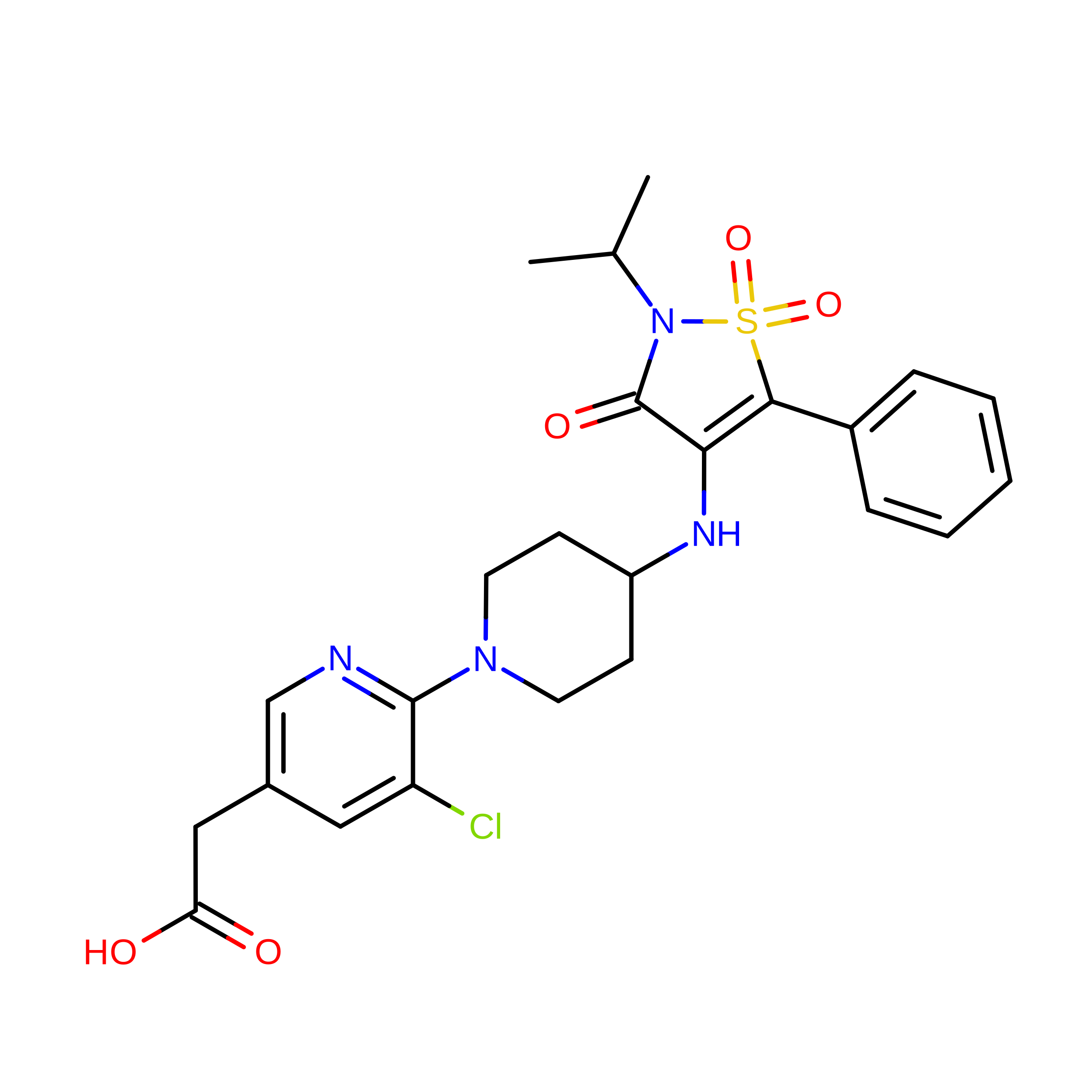
2-[5-chloranyl-6-[4-[[1,1,3-tris(oxidanylidene)-5-phenyl-2-propan-2-yl-1,2-thiazol-4-yl]amino]piperidin-1-yl]pyridin-3-yl]ethanoic acid
C24 H27 Cl N4 O5 S
JSAUQHYJLCPNIF-UHFFFAOYSA-N
SO4

Query on SO4


Download:Ideal Coordinates CCD File
I [auth A]SULFATE ION
O4 S
QAOWNCQODCNURD-UHFFFAOYSA-L

Experimental Data & Validation

Experimental Data

  • Method: X-RAY DIFFRACTION
  • Resolution: 1.90 Å
  • R-Value Free:  0.245 (Depositor), 0.250 (DCC) 
  • R-Value Work:  0.215 (Depositor), 0.219 (DCC) 
Space Group: P 1 21 1
Unit Cell:
Length ( Å )Angle ( ˚ )
a = 55.433α = 90
b = 109.398β = 90.878
c = 88.98γ = 90
Software Package:
Software NamePurpose
REFMACrefinement
MOSFLMdata reduction
SCALAdata scaling
AMoREphasing

Structure Validation

View Full Validation Report


Ligand Structure Quality Assessment 


Entry History 

Deposition Data

Revision History  (Full details and data files)

  • Version 1.0: 2019-11-27
    Type: Initial release
  • Version 1.1: 2019-12-11
    Changes: Database references
  • Version 1.2: 2024-05-15
    Changes: Advisory, Data collection, Database references