6Q0K | pdb_00006q0k

Structure of a MAPK pathway complex


Experimental Data Snapshot

  • Method: ELECTRON MICROSCOPY
  • Resolution: 6.80 Å
  • Aggregation State: PARTICLE 
  • Reconstruction Method: SINGLE PARTICLE 

Starting Models: experimental
View more details

wwPDB Validation 3D Report Full Report

Validation slider image for 6Q0K

This is version 1.3 of the entry. See complete history

Literature

Architecture of autoinhibited and active BRAF-MEK1-14-3-3 complexes.

Park, E.Rawson, S.Li, K.Kim, B.W.Ficarro, S.B.Pino, G.G.Sharif, H.Marto, J.A.Jeon, H.Eck, M.J.

(2019) Nature 575: 545-550

  • DOI: https://doi.org/10.1038/s41586-019-1660-y
  • Primary Citation Related Structures: 
    6NYB, 6PP9, 6Q0J, 6Q0K, 6Q0T

  • PubMed Abstract: 

    RAF family kinases are RAS-activated switches that initiate signalling through the MAP kinase cascade to control cellular proliferation, differentiation and survival 1-3 . RAF activity is tightly regulated and inappropriate activation is a frequent cause of cancer 4-6 ; however, the structural basis for RAF regulation is poorly understood at present. Here we use cryo-electron microscopy to determine autoinhibited and active-state structures of full-length BRAF in complexes with MEK1 and a 14-3-3 dimer. The reconstruction reveals an inactive BRAF-MEK1 complex restrained in a cradle formed by the 14-3-3 dimer, which binds the phosphorylated S365 and S729 sites that flank the BRAF kinase domain. The BRAF cysteine-rich domain occupies a central position that stabilizes this assembly, but the adjacent RAS-binding domain is poorly ordered and peripheral. The 14-3-3 cradle maintains autoinhibition by sequestering the membrane-binding cysteine-rich domain and blocking dimerization of the BRAF kinase domain. In the active state, these inhibitory interactions are released and a single 14-3-3 dimer rearranges to bridge the C-terminal pS729 binding sites of two BRAFs, which drives the formation of an active, back-to-back BRAF dimer. Our structural snapshots provide a foundation for understanding normal RAF regulation and its mutational disruption in cancer and developmental syndromes.


  • Organizational Affiliation
    • Department of Cancer Biology, Dana-Farber Cancer Institute, Boston, MA, USA.

Macromolecule Content 

  • Total Structure Weight: 234.2 kDa 
  • Atom Count: 5,079 
  • Modeled Residue Count: 1,024 
  • Deposited Residue Count: 2,100 
  • Unique protein chains: 2

Macromolecules

Find similar proteins by:|  3D Structure
Entity ID: 1
MoleculeChains  Sequence LengthOrganismDetailsImage
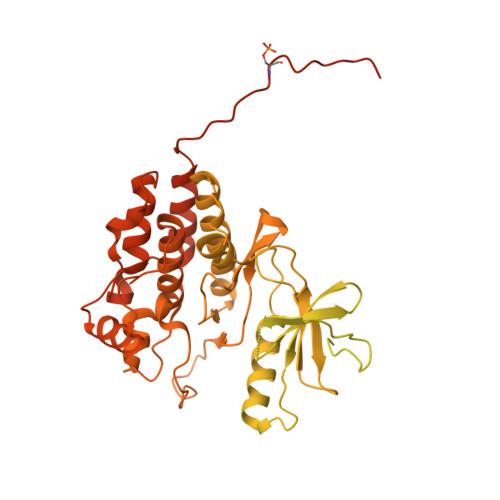
Serine/threonine-protein kinase B-raf
A, B
805Homo sapiensMutation(s): 0 
Gene Names: BRAFBRAF1RAFB1
EC: 2.7.11.1
UniProt & NIH Common Fund Data Resources
Find proteins for P15056 (Homo sapiens)
Explore P15056 
Go to UniProtKB:  P15056
PHAROS:  P15056
GTEx:  ENSG00000157764 
Entity Groups
Sequence Clusters30% Identity50% Identity70% Identity90% Identity95% Identity100% Identity
UniProt GroupP15056
Sequence Annotations
Expand
Reference Sequence
Find similar proteins by:|  3D Structure
Entity ID: 2
MoleculeChains  Sequence LengthOrganismDetailsImage
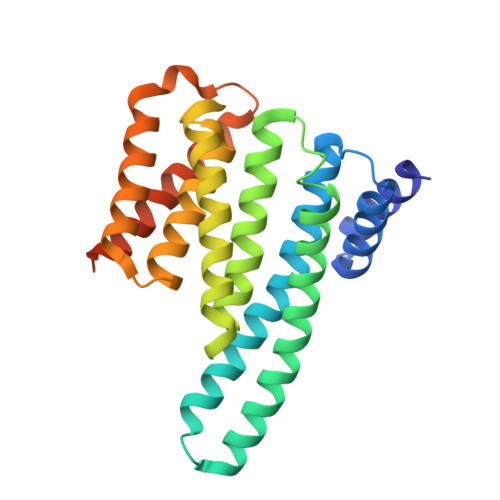
14-3-3 protein zeta/deltaC [auth X],
D [auth Y]
245Homo sapiensMutation(s): 0 
UniProt & NIH Common Fund Data Resources
Find proteins for P63104 (Homo sapiens)
Explore P63104 
Go to UniProtKB:  P63104
PHAROS:  P63104
GTEx:  ENSG00000164924 
Entity Groups
Sequence Clusters30% Identity50% Identity70% Identity90% Identity95% Identity100% Identity
UniProt GroupP63104
Sequence Annotations
Expand
Reference Sequence

Small Molecules

Modified Residues  1 Unique
IDChains TypeFormula2D DiagramParent
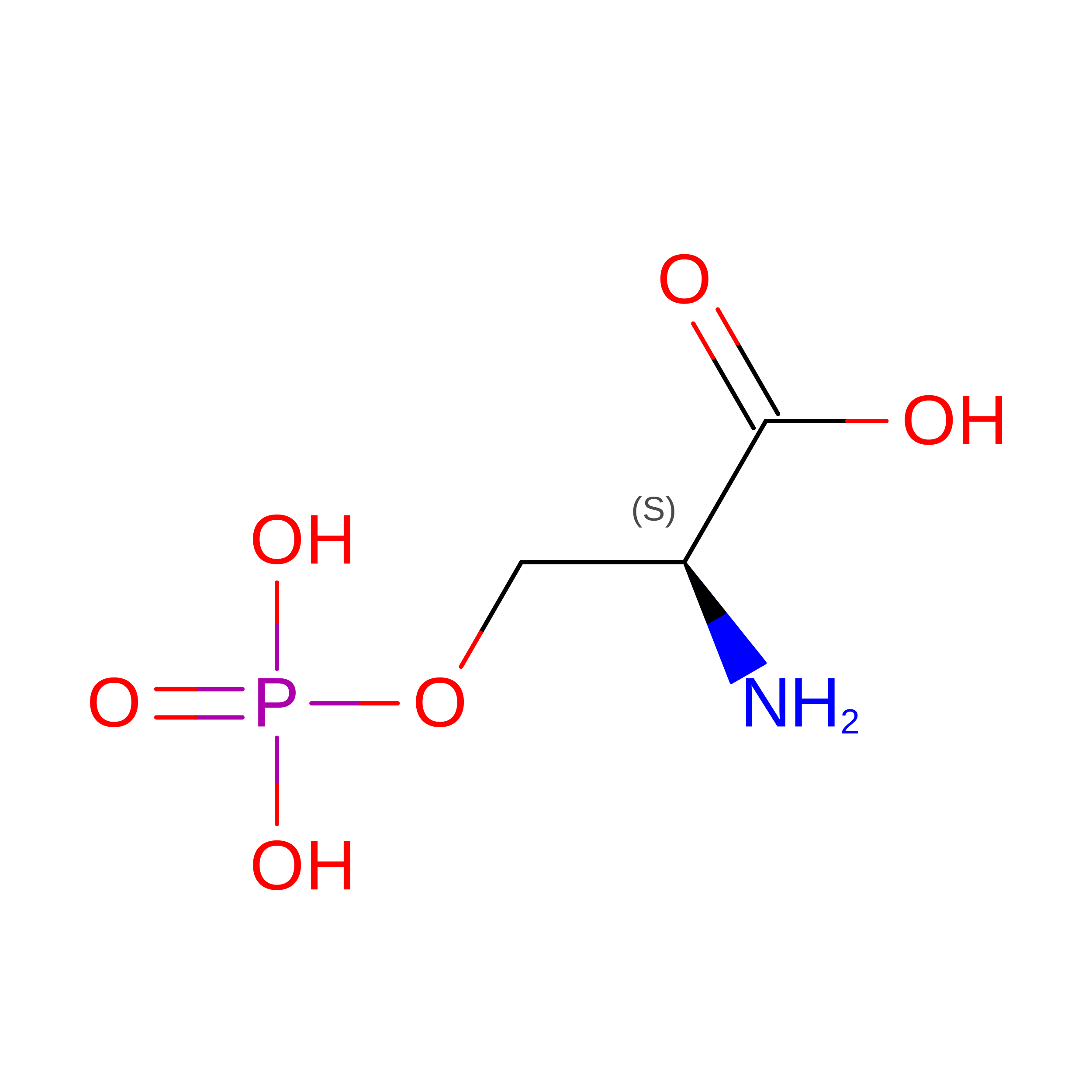
SEP
Query on SEP
A, B
L-PEPTIDE LINKINGC3 H8 N O6 PSER

Experimental Data & Validation

Experimental Data

  • Method: ELECTRON MICROSCOPY
  • Resolution: 6.80 Å
  • Aggregation State: PARTICLE 
  • Reconstruction Method: SINGLE PARTICLE 

Structure Validation

View Full Validation Report


Entry History 

& Funding Information

Deposition Data


Funding OrganizationLocationGrant Number
National Institutes of Health/National Human Genome Research Institute (NIH/NHGRI)United StatesP50CA165962
National Institutes of Health/National Cancer Institute (NIH/NCI)United StatesR50CA221830

Revision History  (Full details and data files)

  • Version 1.0: 2019-10-09
    Type: Initial release
  • Version 1.1: 2019-12-04
    Changes: Author supporting evidence
  • Version 1.2: 2020-04-22
    Changes: Database references
  • Version 1.3: 2024-11-06
    Changes: Data collection, Database references, Refinement description, Structure summary