6P80 | pdb_00006p80

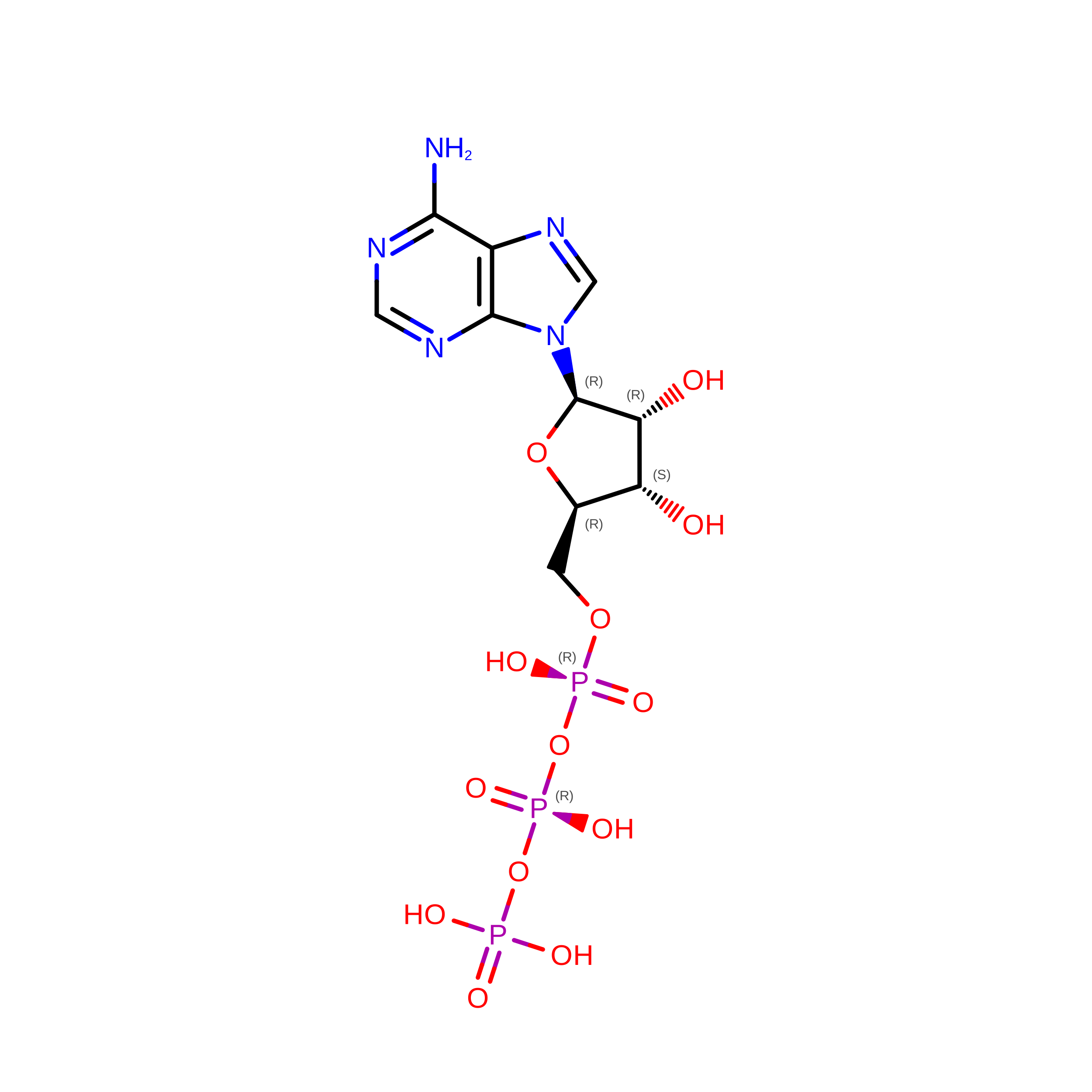
Structure of E. coli MS115-1 CdnC + ATP


Experimental Data Snapshot

  • Method: X-RAY DIFFRACTION
  • Resolution: 1.50 Å
  • R-Value Free: 
    0.189 (Depositor), 0.189 (DCC) 
  • R-Value Work: 
    0.155 (Depositor), 0.157 (DCC) 
  • R-Value Observed: 
    0.157 (Depositor) 

wwPDB Validation 3D Report Full Report

Validation slider image for 6P80

Ligand Structure Quality Assessment 


This is version 1.3 of the entry. See complete history

Literature

HORMA Domain Proteins and a Trip13-like ATPase Regulate Bacterial cGAS-like Enzymes to Mediate Bacteriophage Immunity.

Ye, Q.Lau, R.K.Mathews, I.T.Birkholz, E.A.Watrous, J.D.Azimi, C.S.Pogliano, J.Jain, M.Corbett, K.D.

(2020) Mol Cell 77: 709

  • DOI: https://doi.org/10.1016/j.molcel.2019.12.009
  • Primary Citation Related Structures: 
    6P80, 6P82, 6P8J, 6P8O, 6P8P, 6P8R, 6P8S, 6P8U, 6P8V, 6PB3, 6U7B

  • PubMed Abstract: 

    Bacteria are continually challenged by foreign invaders, including bacteriophages, and have evolved a variety of defenses against these invaders. Here, we describe the structural and biochemical mechanisms of a bacteriophage immunity pathway found in a broad array of bacteria, including E. coli and Pseudomonas aeruginosa. This pathway uses eukaryotic-like HORMA domain proteins that recognize specific peptides, then bind and activate a cGAS/DncV-like nucleotidyltransferase (CD-NTase) to generate a cyclic triadenylate (cAAA) second messenger; cAAA in turn activates an endonuclease effector, NucC. Signaling is attenuated by a homolog of the AAA+ ATPase Pch2/TRIP13, which binds and disassembles the active HORMA-CD-NTase complex. When expressed in non-pathogenic E. coli, this pathway confers immunity against bacteriophage λ through an abortive infection mechanism. Our findings reveal the molecular mechanisms of a bacterial defense pathway integrating a cGAS-like nucleotidyltransferase with HORMA domain proteins for threat sensing through protein detection and negative regulation by a Trip13 ATPase.


  • Organizational Affiliation
    • Department of Cellular and Molecular Medicine, University of California, San Diego, La Jolla, CA, USA.

Macromolecule Content 

  • Total Structure Weight: 36.9 kDa 
  • Atom Count: 2,876 
  • Modeled Residue Count: 318 
  • Deposited Residue Count: 321 
  • Unique protein chains: 1

Macromolecules

Find similar proteins by:|  3D Structure
Entity ID: 1
MoleculeChains  Sequence LengthOrganismDetailsImage
E. coli MS115-1 NucC321Escherichia coli MS 115-1Mutation(s): 0 
Gene Names: HMPREF9540_01758
EC: 2.7.7.85 (UniProt), 2.7.7 (UniProt)
UniProt
Find proteins for D7Y2H2 (Escherichia coli (strain MS 115-1))
Explore D7Y2H2 
Go to UniProtKB:  D7Y2H2
Entity Groups
Sequence Clusters30% Identity50% Identity70% Identity90% Identity95% Identity100% Identity
UniProt GroupD7Y2H2
Sequence Annotations
Expand
Reference Sequence

Experimental Data & Validation

Experimental Data

  • Method: X-RAY DIFFRACTION
  • Resolution: 1.50 Å
  • R-Value Free:  0.189 (Depositor), 0.189 (DCC) 
  • R-Value Work:  0.155 (Depositor), 0.157 (DCC) 
  • R-Value Observed: 0.157 (Depositor) 
Space Group: P 32 2 1
Unit Cell:
Length ( Å )Angle ( ˚ )
a = 76.184α = 90
b = 76.184β = 90
c = 100.498γ = 120
Software Package:
Software NamePurpose
PHENIXrefinement
XDSdata reduction
Aimlessdata scaling
PHENIXphasing

Structure Validation

View Full Validation Report


Ligand Structure Quality Assessment 


Entry History 

Deposition Data

Revision History  (Full details and data files)

  • Version 1.0: 2019-12-25
    Type: Initial release
  • Version 1.1: 2020-01-22
    Changes: Database references
  • Version 1.2: 2020-03-04
    Changes: Database references
  • Version 1.3: 2024-03-13
    Changes: Data collection, Database references, Derived calculations