6P5O | pdb_00006p5o

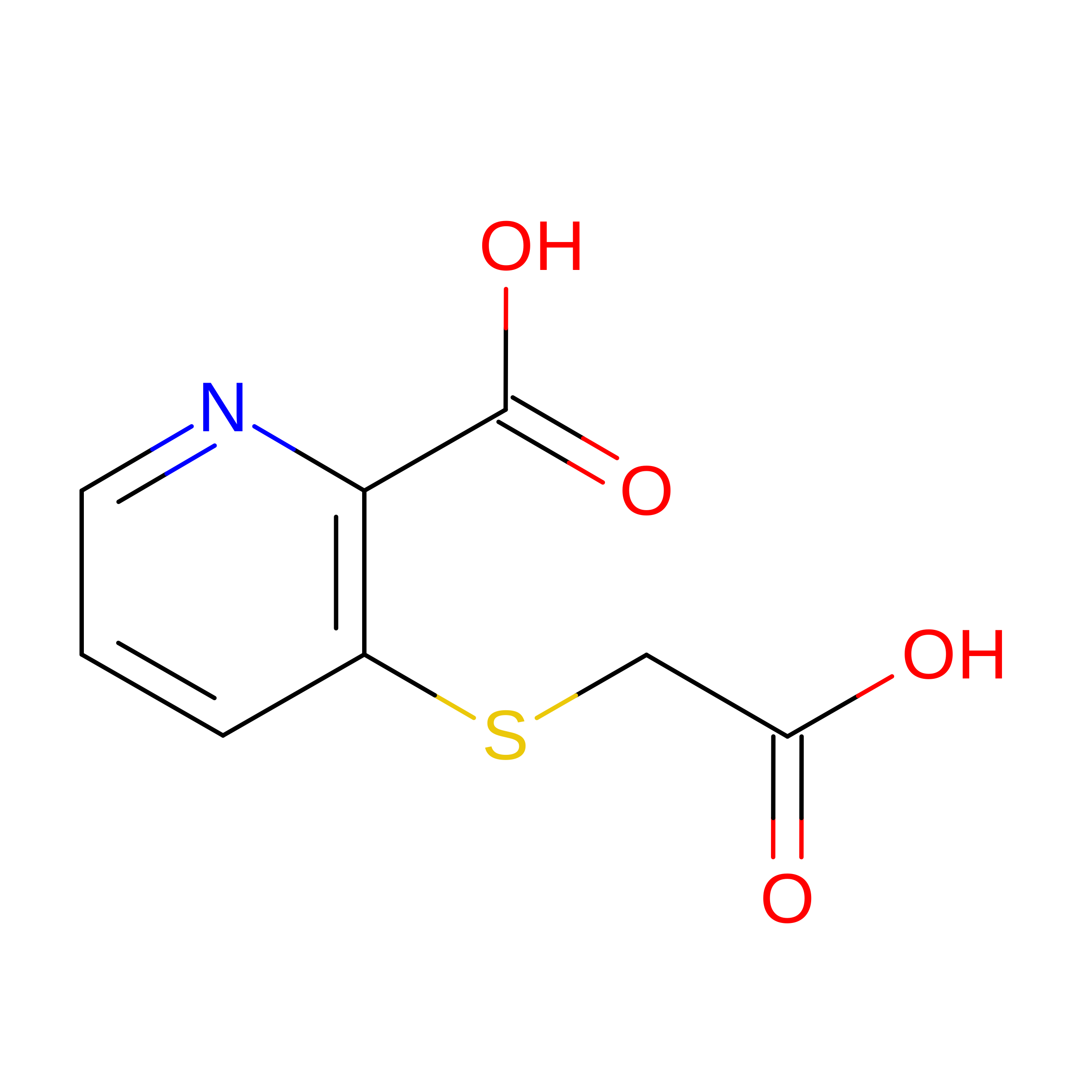
The structure of rat cytosolic PEPCK in complex with 3-(carboxymethylthiol)-picolinic acid


Experimental Data Snapshot

  • Method: X-RAY DIFFRACTION
  • Resolution: 1.49 Å
  • R-Value Free: 
    0.179 (Depositor), 0.185 (DCC) 
  • R-Value Work: 
    0.159 (Depositor), 0.169 (DCC) 
  • R-Value Observed: 
    0.160 (Depositor) 

Starting Model: experimental
View more details

wwPDB Validation 3D Report Full Report

Validation slider image for 6P5O

Ligand Structure Quality Assessment 


This is version 1.3 of the entry. See complete history

Literature

Characterization of 3-[(Carboxymethyl)thio]picolinic Acid: A Novel Inhibitor of Phosphoenolpyruvate Carboxykinase.

Mcleod, M.J.Krismanich, A.P.Assoud, A.Dmitrienko, G.I.Holyoak, T.

(2019) Biochemistry 58: 3918-3926

  • DOI: https://doi.org/10.1021/acs.biochem.9b00583
  • Primary Citation Related Structures: 
    6P5O

  • PubMed Abstract: 

    Phosphoenolpyruvate carboxykinase (PEPCK) has traditionally been characterized for its role in the first committed step of gluconeogenesis. The current understanding of PEPCK's metabolic role has recently expanded to include it serving as a general mediator of tricarboxylic acid cycle flux. Selective inhibition of PEPCK in vivo and in vitro has been achieved with 3-mercaptopicolinic acid (MPA) ( K i ∼ 8 μM), whose mechanism of inhibition has been elucidated only recently. On the basis of crystallographic and mechanistic data of various inhibitors of PEPCK, MPA was used as the initial chemical scaffold to create a potentially more selective inhibitor, 3-[(carboxymethyl)thio]picolinic acid (CMP), which has been characterized both structurally and kinetically here. These data demonstrate that CMP acts as a competitive inhibitor at the OAA/PEP binding site, with its picolinic acid moiety coordinating directly with the M1 metal in the active site ( K i ∼ 29-55 μM). The extended carboxy tail occupies a secondary binding cleft that was previously shown could be occupied by sulfoacetate ( K i ∼ 82 μM) and for the first time demonstrates the simultaneous occupation of both OAA/PEP subsites by a single molecular structure. By occupying both the OAA/PEP binding subsites simultaneously, CMP and similar molecules can potentially be used as a starting point for the creation of additional selective inhibitors of PEPCK.

Macromolecule Content 

  • Total Structure Weight: 69.85 kDa 
  • Atom Count: 5,573 
  • Modeled Residue Count: 619 
  • Deposited Residue Count: 622 
  • Unique protein chains: 1

Macromolecules

Find similar proteins by:|  3D Structure
Entity ID: 1
MoleculeChains  Sequence LengthOrganismDetailsImage
Phosphoenolpyruvate carboxykinase, cytosolic [GTP]622Rattus norvegicusMutation(s): 0 
Gene Names: Pck1
EC: 4.1.1.32 (PDB Primary Data), 2.7.11 (UniProt)
UniProt
Find proteins for P07379 (Rattus norvegicus)
Explore P07379 
Go to UniProtKB:  P07379
Entity Groups
Sequence Clusters30% Identity50% Identity70% Identity90% Identity95% Identity100% Identity
UniProt GroupP07379
Sequence Annotations
Expand
Reference Sequence

Experimental Data & Validation

Experimental Data

  • Method: X-RAY DIFFRACTION
  • Resolution: 1.49 Å
  • R-Value Free:  0.179 (Depositor), 0.185 (DCC) 
  • R-Value Work:  0.159 (Depositor), 0.169 (DCC) 
  • R-Value Observed: 0.160 (Depositor) 
Space Group: P 1 21 1
Unit Cell:
Length ( Å )Angle ( ˚ )
a = 44.409α = 90
b = 118.707β = 109.61
c = 60.863γ = 90
Software Package:
Software NamePurpose
HKL-2000data reduction
HKL-2000data scaling
REFMACrefinement
PDB_EXTRACTdata extraction
MOLREPphasing

Structure Validation

View Full Validation Report


Ligand Structure Quality Assessment 


Entry History 

& Funding Information

Deposition Data


Funding OrganizationLocationGrant Number
Natural Sciences and Engineering Research Council (NSERC, Canada)Canada--

Revision History  (Full details and data files)

  • Version 1.0: 2019-09-18
    Type: Initial release
  • Version 1.1: 2019-10-02
    Changes: Data collection, Database references
  • Version 1.2: 2020-01-08
    Changes: Author supporting evidence
  • Version 1.3: 2023-10-11
    Changes: Data collection, Database references, Derived calculations, Refinement description