6P1A | pdb_00006p1a

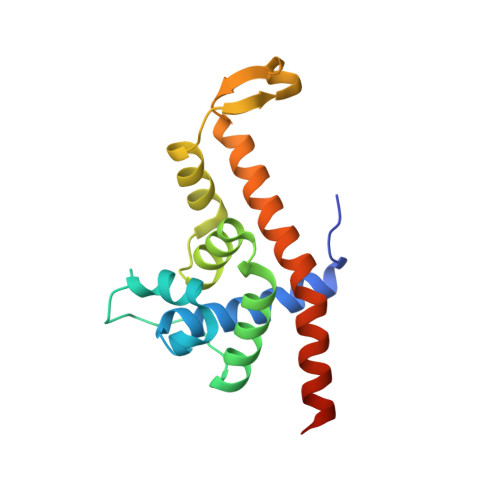
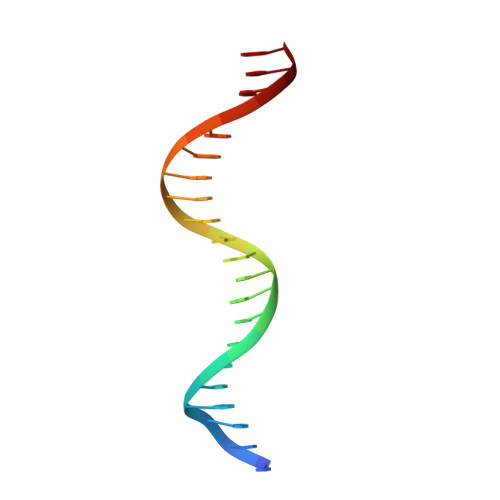
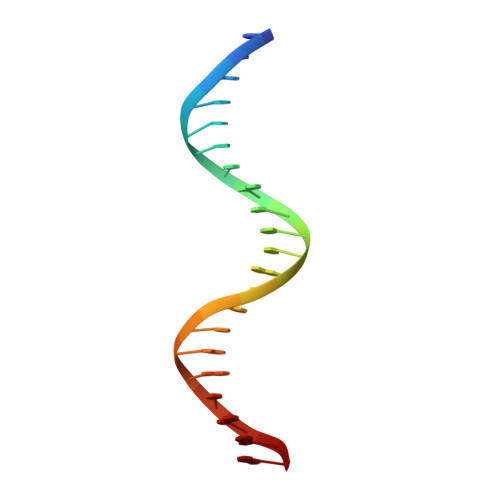
Transcription antitermination factor Q21 in complex with Q21-binding-element DNA


Experimental Data Snapshot

  • Method: X-RAY DIFFRACTION
  • Resolution: 2.84 Å
  • R-Value Free: 
    0.275 (Depositor), 0.273 (DCC) 
  • R-Value Work: 
    0.231 (Depositor), 0.233 (DCC) 
  • R-Value Observed: 
    0.235 (Depositor) 

Starting Model: experimental
View more details

wwPDB Validation 3D Report Full Report

Validation slider image for 6P1A

This is version 1.4 of the entry. See complete history

Literature

Structural basis of Q-dependent antitermination.

Yin, Z.Kaelber, J.T.Ebright, R.H.

(2019) Proc Natl Acad Sci U S A 116: 18384-18390

  • DOI: https://doi.org/10.1073/pnas.1909801116
  • Primary Citation Related Structures: 
    6P18, 6P19, 6P1A, 6P1B, 6P1C

  • PubMed Abstract: 

    Lambdoid bacteriophage Q protein mediates the switch from middle to late bacteriophage gene expression by enabling RNA polymerase (RNAP) to read through transcription terminators preceding bacteriophage late genes. Q loads onto RNAP engaged in promoter-proximal pausing at a Q binding element (QBE) and adjacent sigma-dependent pause element (SDPE) to yield a Q-loading complex, and Q subsequently translocates with RNAP as a pausing-deficient, termination-deficient Q-loaded complex. Here, we report high-resolution structures of 4 states on the pathway of antitermination by Q from bacteriophage 21 (Q21): Q21, the Q21-QBE complex, the Q21-loading complex, and the Q21-loaded complex. The results show that Q21 forms a torus, a "nozzle," that narrows and extends the RNAP RNA-exit channel, extruding topologically linked single-stranded RNA and preventing the formation of pause and terminator hairpins.


  • Organizational Affiliation
    • Waksman Institute, Rutgers University, Piscataway, NJ 08854.

Macromolecule Content 

  • Total Structure Weight: 82.03 kDa 
  • Atom Count: 5,368 
  • Modeled Residue Count: 534 
  • Deposited Residue Count: 570 
  • Unique protein chains: 1
  • Unique nucleic acid chains: 2

Macromolecules


Find similar proteins by:|  3D Structure
Entity ID: 1
MoleculeChains  Sequence LengthOrganismDetailsImage
Q protein
A, B, C
162Escherichia phage 21Mutation(s): 0 
UniProt
Find proteins for Q9XJQ6 (Escherichia phage 21)
Explore Q9XJQ6 
Go to UniProtKB:  Q9XJQ6
Entity Groups
Sequence Clusters30% Identity50% Identity70% Identity90% Identity95% Identity100% Identity
UniProt GroupQ9XJQ6
Sequence Annotations
Expand
Reference Sequence
Find similar nucleic acids by:  Sequence
Entity ID: 2
MoleculeChains LengthOrganismImage
DNA (5'-D(P*CP*TP*CP*AP*TP*TP*GP*AP*GP*CP*AP*AP*AP*TP*GP*AP*GP*CP*AP*AP*G)-3')
D, F
21Escherichia phage 21
Sequence Annotations
Expand
Reference Sequence
Find similar nucleic acids by:  Sequence
Entity ID: 3
MoleculeChains LengthOrganismImage
DNA (5'-D(*CP*TP*TP*GP*CP*TP*CP*AP*TP*TP*TP*GP*CP*TP*CP*AP*AP*TP*GP*AP*G)-3')
E, G
21Escherichia phage 21
Sequence Annotations
Expand
Reference Sequence

Experimental Data & Validation

Experimental Data

  • Method: X-RAY DIFFRACTION
  • Resolution: 2.84 Å
  • R-Value Free:  0.275 (Depositor), 0.273 (DCC) 
  • R-Value Work:  0.231 (Depositor), 0.233 (DCC) 
  • R-Value Observed: 0.235 (Depositor) 
Space Group: P 21 21 2
Unit Cell:
Length ( Å )Angle ( ˚ )
a = 69.573α = 90
b = 263.224β = 90
c = 56.77γ = 90
Software Package:
Software NamePurpose
DENZOdata reduction
SCALEPACKdata scaling
PHASERphasing
PHENIXrefinement
PDB_EXTRACTdata extraction

Structure Validation

View Full Validation Report


Entry History 

& Funding Information

Deposition Data


Funding OrganizationLocationGrant Number
National Institutes of Health/National Institute of Environmental Health Sciences (NIH/NIEHS)United StatesGM041376

Revision History  (Full details and data files)

  • Version 1.0: 2019-06-26
    Type: Initial release
  • Version 1.1: 2019-09-11
    Changes: Data collection, Database references
  • Version 1.2: 2019-09-25
    Changes: Data collection, Database references
  • Version 1.3: 2019-12-18
    Changes: Author supporting evidence
  • Version 1.4: 2023-10-11
    Changes: Data collection, Database references, Refinement description