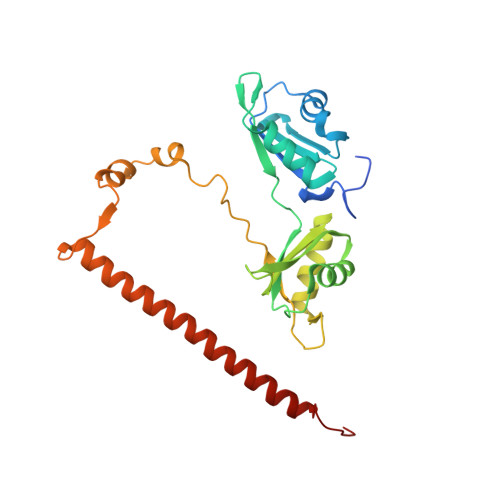
6OWJ | pdb_00006owj

Zn-mediated polymerization of human SFPQ


Experimental Data Snapshot

  • Method: X-RAY DIFFRACTION
  • Resolution: 1.94 Å
  • R-Value Free: 
    0.218 (Depositor), 0.227 (DCC) 
  • R-Value Work: 
    0.176 (Depositor), 0.183 (DCC) 
  • R-Value Observed: 
    0.178 (Depositor) 

Starting Model: experimental
View more details

wwPDB Validation 3D Report Full Report

Validation slider image for 6OWJ

This is version 1.3 of the entry. See complete history

Literature

Structural basis of the zinc-induced cytoplasmic aggregation of the RNA-binding protein SFPQ.

Huang, J.Ringuet, M.Whitten, A.E.Caria, S.Lim, Y.W.Badhan, R.Anggono, V.Lee, M.

(2020) Nucleic Acids Res 48: 3356-3365

  • DOI: https://doi.org/10.1093/nar/gkaa076
  • Primary Citation Related Structures: 
    6OWJ

  • PubMed Abstract: 

    SFPQ is a ubiquitous nuclear RNA-binding protein implicated in many aspects of RNA biogenesis. Importantly, nuclear depletion and cytoplasmic accumulation of SFPQ has been linked to neuropathological conditions such as Alzheimer's disease (AD) and amyotrophic lateral sclerosis (ALS). Here, we describe a molecular mechanism by which SFPQ is mislocalized to the cytoplasm. We report an unexpected discovery of the infinite polymerization of SFPQ that is induced by zinc binding to the protein. The crystal structure of human SFPQ in complex with zinc at 1.94 Å resolution reveals intermolecular interactions between SFPQ molecules that are mediated by zinc. As anticipated from the crystal structure, the application of zinc to primary cortical neurons induced the cytoplasmic accumulation and aggregation of SFPQ. Mutagenesis of the three zinc-coordinating histidine residues resulted in a significant reduction in the zinc-binding affinity of SFPQ in solution and the zinc-induced cytoplasmic aggregation of SFPQ in cultured neurons. Taken together, we propose that dysregulation of zinc availability and/or localization in neuronal cells may represent a mechanism for the imbalance in the nucleocytoplasmic distribution of SFPQ, which is an emerging hallmark of neurodegenerative diseases including AD and ALS.


  • Organizational Affiliation
    • Department of Biochemistry and Genetics, La Trobe Institute for Molecular Science, La Trobe University, Melbourne, Victoria 3086, Australia.

Macromolecule Content 

  • Total Structure Weight: 60.25 kDa 
  • Atom Count: 4,408 
  • Modeled Residue Count: 496 
  • Deposited Residue Count: 526 
  • Unique protein chains: 1

Macromolecules

Find similar proteins by:|  3D Structure
Entity ID: 1
MoleculeChains  Sequence LengthOrganismDetailsImage
Splicing factor, proline- and glutamine-rich
A, B
263Homo sapiensMutation(s): 0 
Gene Names: SFPQPSF
UniProt & NIH Common Fund Data Resources
Find proteins for P23246 (Homo sapiens)
Explore P23246 
Go to UniProtKB:  P23246
PHAROS:  P23246
GTEx:  ENSG00000116560 
Entity Groups
Sequence Clusters30% Identity50% Identity70% Identity90% Identity95% Identity100% Identity
UniProt GroupP23246
Sequence Annotations
Expand
Reference Sequence

Small Molecules

Ligands 1 Unique
IDChains Name / Formula / InChI Key2D Diagram3D Interactions
ZN

Query on ZN


Download:Ideal Coordinates CCD File
C [auth A]ZINC ION
Zn
PTFCDOFLOPIGGS-UHFFFAOYSA-N

Experimental Data & Validation

Experimental Data

  • Method: X-RAY DIFFRACTION
  • Resolution: 1.94 Å
  • R-Value Free:  0.218 (Depositor), 0.227 (DCC) 
  • R-Value Work:  0.176 (Depositor), 0.183 (DCC) 
  • R-Value Observed: 0.178 (Depositor) 
Space Group: P 1 21 1
Unit Cell:
Length ( Å )Angle ( ˚ )
a = 61.23α = 90
b = 62.45β = 95.74
c = 67.88γ = 90
Software Package:
Software NamePurpose
BUSTERrefinement
XDSdata reduction
Aimlessdata scaling
PHASERphasing

Structure Validation

View Full Validation Report


Entry History 

& Funding Information

Deposition Data

  • Released Date: 2020-02-05 
  • Deposition Author(s): Lee, M.

Funding OrganizationLocationGrant Number
Australian Research Council (ARC)AustraliaDE150101243

Revision History  (Full details and data files)

  • Version 1.0: 2020-02-05
    Type: Initial release
  • Version 1.1: 2020-02-19
    Changes: Database references
  • Version 1.2: 2020-04-15
    Changes: Database references
  • Version 1.3: 2023-10-11
    Changes: Data collection, Database references, Derived calculations, Refinement description