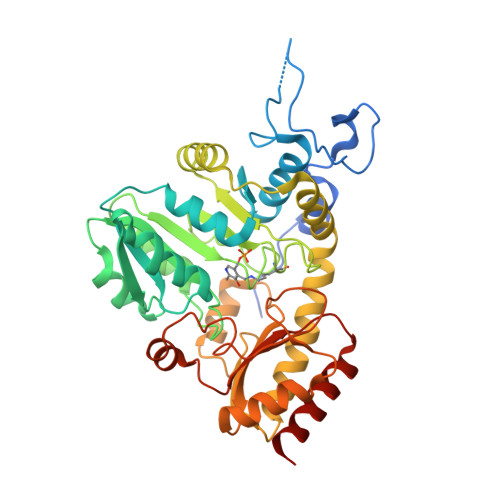
6OVG | pdb_00006ovg

L-Methionine Depletion with an Engineered Human Enzyme Disrupts Prostate Cancer Metabolism


Experimental Data Snapshot

  • Method: X-RAY DIFFRACTION
  • Resolution: 2.72 Å
  • R-Value Free: 
    0.229 (Depositor), 0.210 (DCC) 
  • R-Value Work: 
    0.181 (Depositor) 
  • R-Value Observed: 
    0.183 (Depositor) 

Starting Model: experimental
View more details

wwPDB Validation 3D Report Full Report

Validation slider image for 6OVG

This is version 1.4 of the entry. See complete history

Literature

Enzyme-mediated depletion of serum l-Met abrogates prostate cancer growth via multiple mechanisms without evidence of systemic toxicity.

Lu, W.C.Saha, A.Yan, W.Garrison, K.Lamb, C.Pandey, R.Irani, S.Lodi, A.Lu, X.Tiziani, S.Zhang, Y.J.Georgiou, G.DiGiovanni, J.Stone, E.

(2020) Proc Natl Acad Sci U S A 117: 13000-13011

  • DOI: https://doi.org/10.1073/pnas.1917362117
  • Primary Citation Related Structures: 
    6OVG

  • PubMed Abstract: 

    Extensive studies in prostate cancer and other malignancies have revealed that l-methionine (l-Met) and its metabolites play a critical role in tumorigenesis. Preclinical and clinical studies have demonstrated that systemic restriction of serum l-Met, either via partial dietary restriction or with bacterial l-Met-degrading enzymes exerts potent antitumor effects. However, administration of bacterial l-Met-degrading enzymes has not proven practical for human therapy because of problems with immunogenicity. As the human genome does not encode l-Met-degrading enzymes, we engineered the human cystathionine-γ-lyase (hMGL-4.0) to catalyze the selective degradation of l-Met. At therapeutically relevant dosing, hMGL-4.0 reduces serum l-Met levels to >75% for >72 h and significantly inhibits the growth of multiple prostate cancer allografts/xenografts without weight loss or toxicity. We demonstrate that in vitro, hMGL-4.0 causes tumor cell death, associated with increased reactive oxygen species, S-adenosyl-methionine depletion, global hypomethylation, induction of autophagy, and robust poly(ADP-ribose) polymerase (PARP) cleavage indicative of DNA damage and apoptosis.


  • Organizational Affiliation
    • Department of Chemical Engineering, The University of Texas at Austin, Austin, TX 78712.

Macromolecule Content 

  • Total Structure Weight: 365.92 kDa 
  • Atom Count: 24,368 
  • Modeled Residue Count: 3,093 
  • Deposited Residue Count: 3,320 
  • Unique protein chains: 1

Macromolecules

Find similar proteins by:|  3D Structure
Entity ID: 1
MoleculeChains  Sequence LengthOrganismDetailsImage
Cystathionine gamma-lyase
A, B, C, D, E
A, B, C, D, E, F, G, H
415Homo sapiensMutation(s): 0 
Gene Names: CTH
EC: 4.4.1.1 (PDB Primary Data), 4.4.1.2 (UniProt)
UniProt & NIH Common Fund Data Resources
Find proteins for P32929 (Homo sapiens)
Explore P32929 
Go to UniProtKB:  P32929
PHAROS:  P32929
GTEx:  ENSG00000116761 
Entity Groups
Sequence Clusters30% Identity50% Identity70% Identity90% Identity95% Identity100% Identity
UniProt GroupP32929
Sequence Annotations
Expand
Reference Sequence

Small Molecules

Modified Residues  1 Unique
IDChains TypeFormula2D DiagramParent
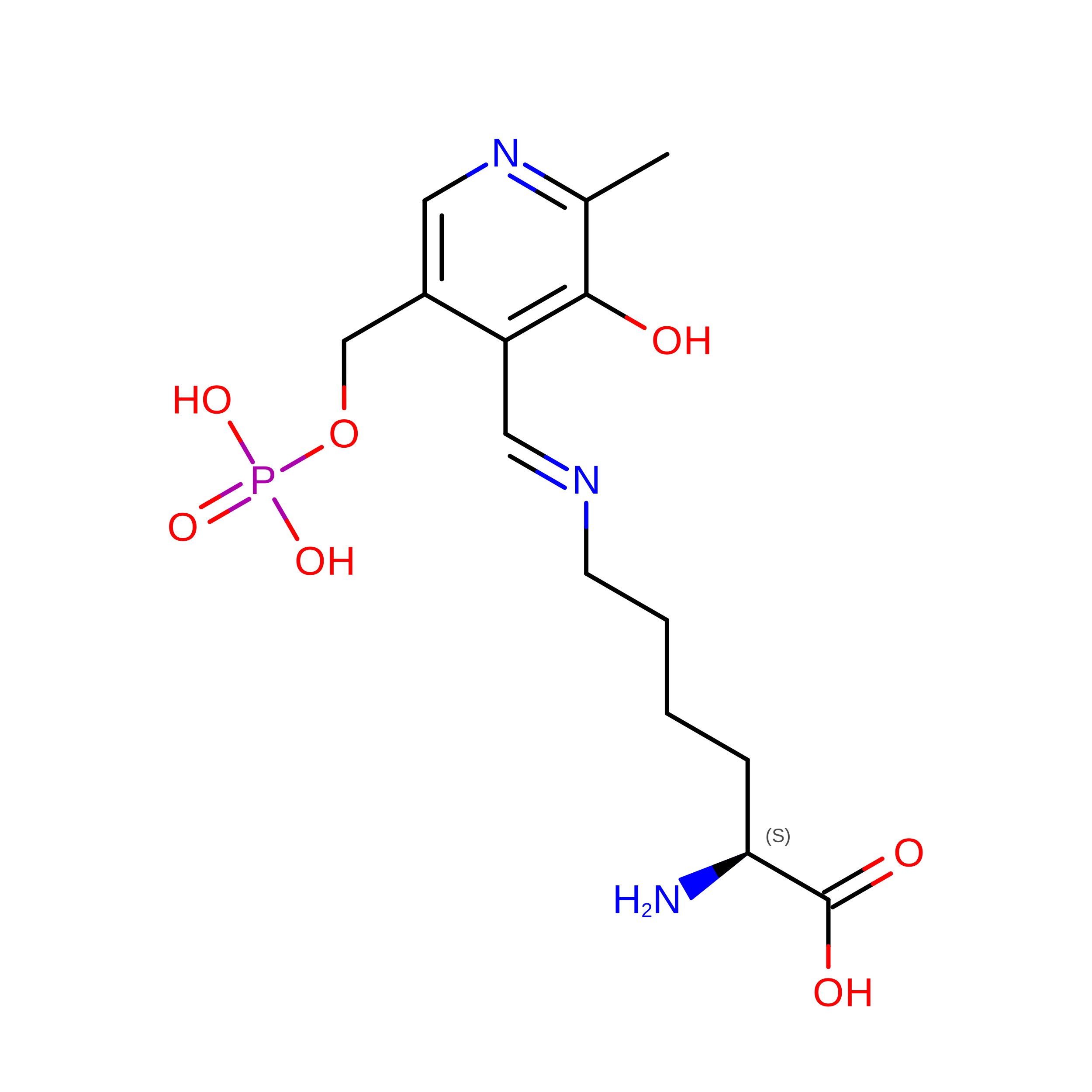
LLP
Query on LLP
A, B, C, D, E
A, B, C, D, E, F, G, H
L-PEPTIDE LINKINGC14 H22 N3 O7 PLYS

Experimental Data & Validation

Experimental Data

  • Method: X-RAY DIFFRACTION
  • Resolution: 2.72 Å
  • R-Value Free:  0.229 (Depositor), 0.210 (DCC) 
  • R-Value Work:  0.181 (Depositor) 
  • R-Value Observed: 0.183 (Depositor) 
Space Group: P 2 21 21
Unit Cell:
Length ( Å )Angle ( ˚ )
a = 113.558α = 90
b = 164.33β = 90
c = 181.696γ = 90
Software Package:
Software NamePurpose
PHENIXrefinement
HKL-2000data reduction
HKL-2000data scaling
PHASERphasing

Structure Validation

View Full Validation Report


Entry History 

& Funding Information

Deposition Data


Funding OrganizationLocationGrant Number
National Institutes of Health/National Center for Research Resources (NIH/NCRR)United StatesR01 GM104896, GM125882,
Welch FoundationUnited StatesF-1778

Revision History  (Full details and data files)

  • Version 1.0: 2020-04-22
    Type: Initial release
  • Version 1.1: 2020-06-03
    Changes: Database references
  • Version 1.2: 2020-06-24
    Changes: Database references
  • Version 1.3: 2023-10-11
    Changes: Data collection, Database references, Refinement description
  • Version 1.4: 2023-11-15
    Changes: Data collection