6OSH | pdb_00006osh

Potent and Selective Antitumor Antibody Targeting a Membrane-Proximal Epitope of ROR2


Experimental Data Snapshot

  • Method: X-RAY DIFFRACTION
  • Resolution: 1.12 Å
  • R-Value Free: 
    0.169 (Depositor), 0.171 (DCC) 
  • R-Value Work: 
    0.162 (Depositor), 0.163 (DCC) 
  • R-Value Observed: 
    0.162 (Depositor) 

Starting Model: experimental
View more details

wwPDB Validation 3D Report Full Report

Validation slider image for 6OSH

This is version 1.3 of the entry. See complete history

Literature

Affinity maturation, humanization, and co-crystallization of a rabbit anti-human ROR2 monoclonal antibody for therapeutic applications.

Goydel, R.S.Weber, J.Peng, H.Qi, J.Soden, J.Freeth, J.Park, H.Rader, C.

(2020) J Biological Chem 295: 5995-6006

  • DOI: https://doi.org/10.1074/jbc.RA120.012791
  • Primary Citation Related Structures: 
    6OSH, 6OSN, 6OSV

  • PubMed Abstract: 

    Antibodies are widely used as cancer therapeutics, but their current use is limited by the low number of antigens restricted to cancer cells. A receptor tyrosine kinase, receptor tyrosine kinase-like orphan receptor 2 (ROR2), is normally expressed only during embryogenesis and is tightly down-regulated in postnatal healthy tissues. However, it is up-regulated in a diverse set of hematologic and solid malignancies, thus ROR2 represents a candidate antigen for antibody-based cancer therapy. Here we describe the affinity maturation and humanization of a rabbit mAb that binds human and mouse ROR2 but not human ROR1 or other human cell-surface antigens. Co-crystallization of the parental rabbit mAb in complex with the human ROR2 kringle domain (hROR2-Kr) guided affinity maturation by heavy-chain complementarity-determining region 3 (HCDR3)-focused mutagenesis and selection. The affinity-matured rabbit mAb was then humanized by complementarity-determining region (CDR) grafting and framework fine tuning and again co-crystallized with hROR2-Kr. We show that the affinity-matured and humanized mAb retains strong affinity and specificity to ROR2 and, following conversion to a T cell-engaging bispecific antibody, has potent cytotoxicity toward ROR2-expressing cells. We anticipate that this humanized affinity-matured mAb will find application for antibody-based cancer therapy of ROR2-expressing neoplasms.


  • Organizational Affiliation
    • Department of Immunology and Microbiology, The Scripps Research Institute, Jupiter, Florida 33458.

Macromolecule Content 

  • Total Structure Weight: 35.02 kDa 
  • Atom Count: 2,812 
  • Modeled Residue Count: 308 
  • Deposited Residue Count: 323 
  • Unique protein chains: 3

Macromolecules

Find similar proteins by:|  3D Structure
Entity ID: 1
MoleculeChains  Sequence LengthOrganismDetailsImage
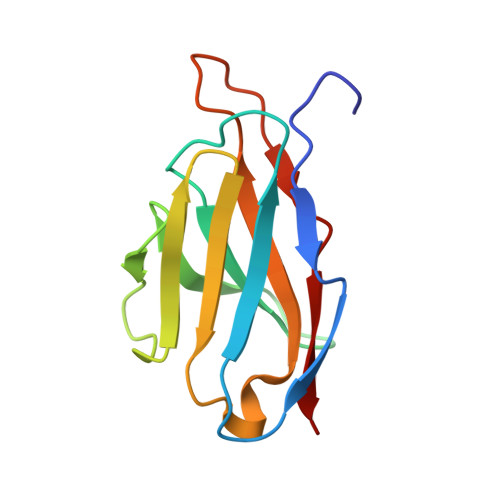
Antibody Light chain variable regionA [auth L]113Oryctolagus cuniculusMutation(s): 0 
Find similar proteins by:|  3D Structure
Entity ID: 2
MoleculeChains  Sequence LengthOrganismDetailsImage
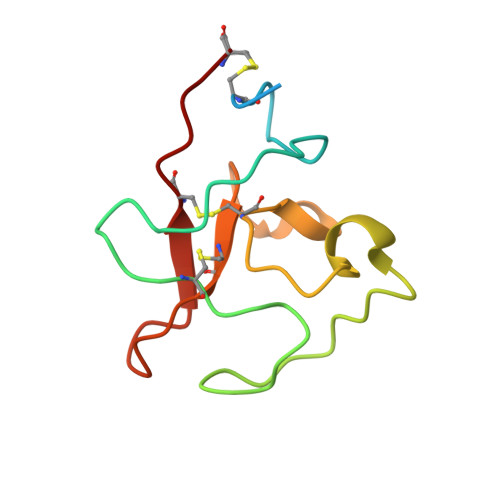
Tyrosine-protein kinase transmembrane receptor ROR2B [auth K]96Homo sapiensMutation(s): 0 
Gene Names: ROR2NTRKR2
EC: 2.7.10.1
UniProt & NIH Common Fund Data Resources
Find proteins for Q01974 (Homo sapiens)
Explore Q01974 
Go to UniProtKB:  Q01974
PHAROS:  Q01974
GTEx:  ENSG00000169071 
Entity Groups
Sequence Clusters30% Identity50% Identity70% Identity90% Identity95% Identity100% Identity
UniProt GroupQ01974
Sequence Annotations
Expand
Reference Sequence
Find similar proteins by:|  3D Structure
Entity ID: 3
MoleculeChains  Sequence LengthOrganismDetailsImage
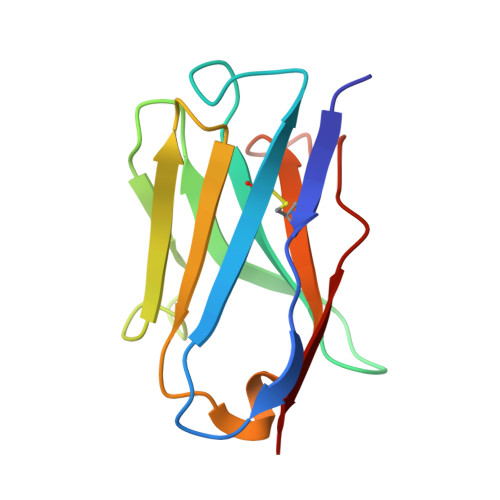
Antibody heavy chain variable regionC [auth H]114Oryctolagus cuniculusMutation(s): 0 

Experimental Data & Validation

Experimental Data

  • Method: X-RAY DIFFRACTION
  • Resolution: 1.12 Å
  • R-Value Free:  0.169 (Depositor), 0.171 (DCC) 
  • R-Value Work:  0.162 (Depositor), 0.163 (DCC) 
  • R-Value Observed: 0.162 (Depositor) 
Space Group: P 21 21 21
Unit Cell:
Length ( Å )Angle ( ˚ )
a = 45.165α = 90
b = 67.201β = 90
c = 89.61γ = 90
Software Package:
Software NamePurpose
PHENIXrefinement
XDSdata reduction
SCALAdata scaling
PHASERphasing

Structure Validation

View Full Validation Report


Entry History 

Deposition Data

Revision History  (Full details and data files)

  • Version 1.0: 2020-04-01
    Type: Initial release
  • Version 1.1: 2020-05-13
    Changes: Database references
  • Version 1.2: 2023-10-11
    Changes: Data collection, Database references, Refinement description
  • Version 1.3: 2024-10-23
    Changes: Structure summary