6OP0 | pdb_00006op0

Asymmetric hTNF-alpha


Experimental Data Snapshot

  • Method: X-RAY DIFFRACTION
  • Resolution: 2.55 Å
  • R-Value Free: 
    0.244 (Depositor), 0.246 (DCC) 
  • R-Value Work: 
    0.185 (Depositor), 0.188 (DCC) 
  • R-Value Observed: 
    0.188 (Depositor) 

Starting Model: other
View more details

wwPDB Validation 3D Report Full Report

Validation slider image for 6OP0

Ligand Structure Quality Assessment 


This is version 1.3 of the entry. See complete history

Literature

Small molecules that inhibit TNF signalling by stabilising an asymmetric form of the trimer.

O'Connell, J.Porter, J.Kroeplien, B.Norman, T.Rapecki, S.Davis, R.McMillan, D.Arakaki, T.Burgin, A.Fox Iii, D.Ceska, T.Lecomte, F.Maloney, A.Vugler, A.Carrington, B.Cossins, B.P.Bourne, T.Lawson, A.

(2019) Nat Commun 10: 5795-5795

  • DOI: https://doi.org/10.1038/s41467-019-13616-1
  • Primary Citation Related Structures: 
    6OOY, 6OOZ, 6OP0

  • PubMed Abstract: 

    Tumour necrosis factor (TNF) is a cytokine belonging to a family of trimeric proteins; it has been shown to be a key mediator in autoimmune diseases such as rheumatoid arthritis and Crohn's disease. While TNF is the target of several successful biologic drugs, attempts to design small molecule therapies directed to this cytokine have not led to approved products. Here we report the discovery of potent small molecule inhibitors of TNF that stabilise an asymmetrical form of the soluble TNF trimer, compromising signalling and inhibiting the functions of TNF in vitro and in vivo. This discovery paves the way for a class of small molecule drugs capable of modulating TNF function by stabilising a naturally sampled, receptor-incompetent conformation of TNF. Furthermore, this approach may prove to be a more general mechanism for inhibiting protein-protein interactions.


  • Organizational Affiliation
    • UCB Pharma, Slough, SL1 3WE, UK. james.oconnell@ucb.com.

Macromolecule Content 

  • Total Structure Weight: 52.8 kDa 
  • Atom Count: 3,182 
  • Modeled Residue Count: 407 
  • Deposited Residue Count: 474 
  • Unique protein chains: 1

Macromolecules

Find similar proteins by:|  3D Structure
Entity ID: 1
MoleculeChains  Sequence LengthOrganismDetailsImage
Tumor necrosis factor
A, B, C
158Homo sapiensMutation(s): 0 
Gene Names: TNFTNFATNFSF2
UniProt & NIH Common Fund Data Resources
Find proteins for P01375 (Homo sapiens)
Explore P01375 
Go to UniProtKB:  P01375
PHAROS:  P01375
GTEx:  ENSG00000232810 
Entity Groups
Sequence Clusters30% Identity50% Identity70% Identity90% Identity95% Identity100% Identity
UniProt GroupP01375
Sequence Annotations
Expand
Reference Sequence

Small Molecules

Ligands 1 Unique
IDChains Name / Formula / InChI Key2D Diagram3D Interactions
A7A
(Subject of Investigation/LOI)

Query on A7A


Download:Ideal Coordinates CCD File
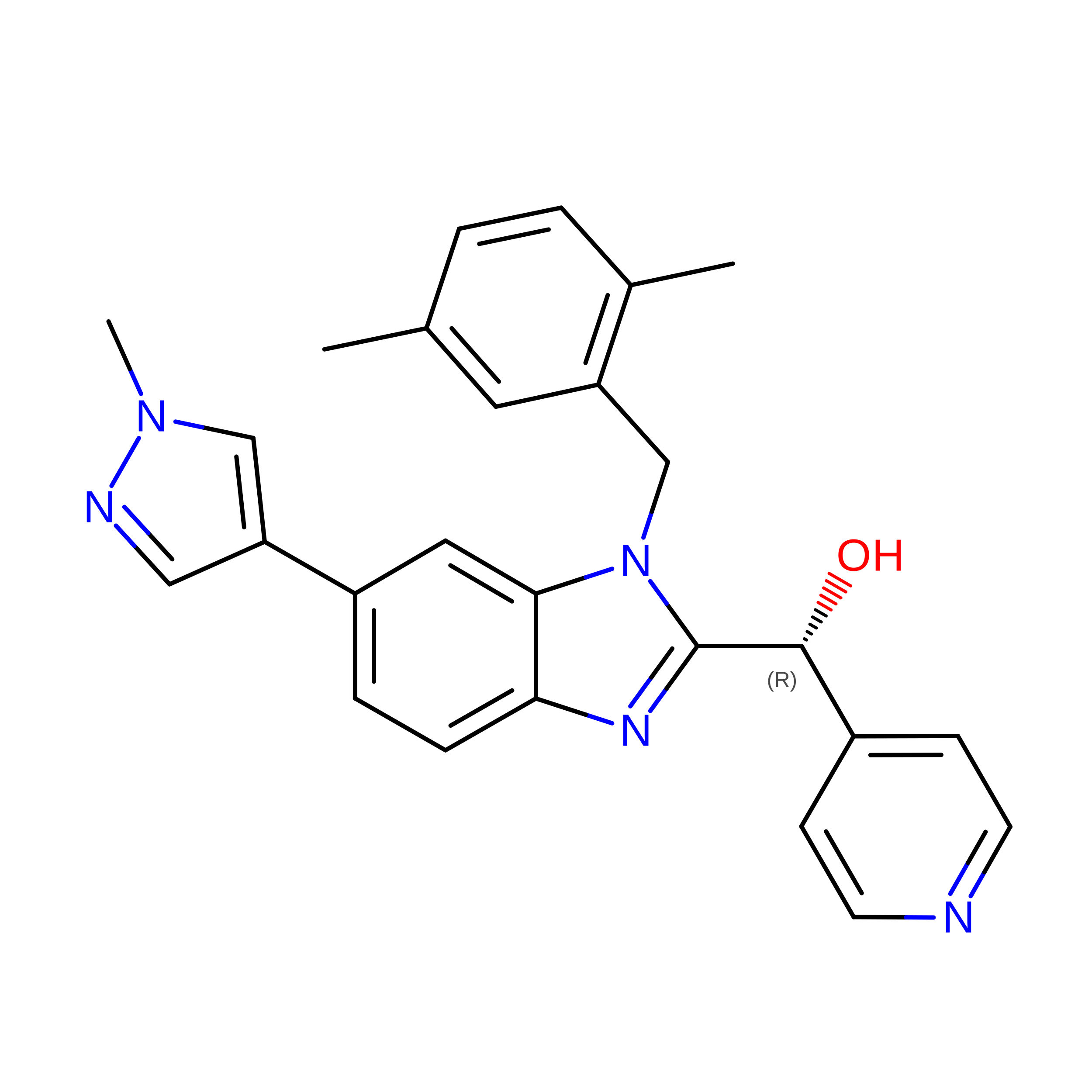
D [auth C](R)-{1-[(2,5-dimethylphenyl)methyl]-6-(1-methyl-1H-pyrazol-4-yl)-1H-benzimidazol-2-yl}(pyridin-4-yl)methanol
C26 H25 N5 O
RZGFWGNCSYUEPR-RUZDIDTESA-N

Experimental Data & Validation

Experimental Data

  • Method: X-RAY DIFFRACTION
  • Resolution: 2.55 Å
  • R-Value Free:  0.244 (Depositor), 0.246 (DCC) 
  • R-Value Work:  0.185 (Depositor), 0.188 (DCC) 
  • R-Value Observed: 0.188 (Depositor) 
Space Group: P 21 21 21
Unit Cell:
Length ( Å )Angle ( ˚ )
a = 54.17α = 90
b = 81.99β = 90
c = 94.17γ = 90
Software Package:
Software NamePurpose
XDSdata reduction
XSCALEdata scaling
REFMACrefinement
PHASERphasing

Structure Validation

View Full Validation Report


Ligand Structure Quality Assessment 


Entry History 

Deposition Data

Revision History  (Full details and data files)

  • Version 1.0: 2019-12-25
    Type: Initial release
  • Version 1.1: 2020-01-01
    Changes: Database references
  • Version 1.2: 2024-04-03
    Changes: Data collection, Database references, Refinement description
  • Version 1.3: 2024-11-06
    Changes: Structure summary