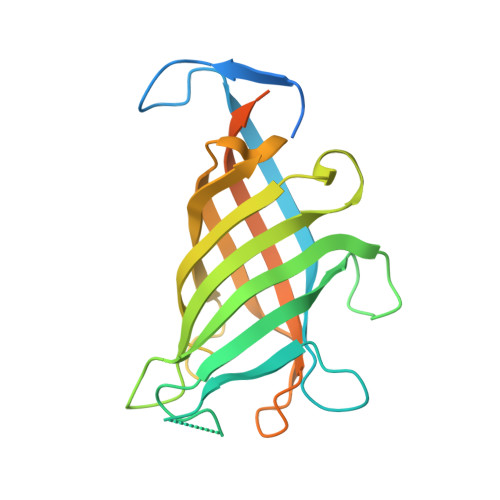
6OOC | pdb_00006ooc

Structure of the pterocarpan synthase dirigent protein GePTS1


Experimental Data Snapshot

  • Method: X-RAY DIFFRACTION
  • Resolution: 2.60 Å
  • R-Value Free: 
    0.238 (Depositor), 0.240 (DCC) 
  • R-Value Work: 
    0.197 (Depositor) 
  • R-Value Observed: 
    0.199 (Depositor) 

Starting Model: experimental
View more details

wwPDB Validation 3D Report Full Report

Validation slider image for 6OOC

This is version 1.2 of the entry. See complete history

Literature

Pterocarpan synthase (PTS) structures suggest a common quinone methide-stabilizing function in dirigent proteins and proteins with dirigent-like domains.

Meng, Q.Moinuddin, S.G.A.Kim, S.J.Bedgar, D.L.Costa, M.A.Thomas, D.G.Young, R.P.Smith, C.A.Cort, J.R.Davin, L.B.Lewis, N.G.

(2020) J Biological Chem 295: 11584-11601

  • DOI: https://doi.org/10.1074/jbc.RA120.012444
  • Primary Citation Related Structures: 
    6OOC, 6OOD

  • PubMed Abstract: 

    The biochemical activities of dirigent proteins (DPs) give rise to distinct complex classes of plant phenolics. DPs apparently began to emerge during the aquatic-to-land transition, with phylogenetic analyses revealing the presence of numerous DP subfamilies in the plant kingdom. The vast majority (>95%) of DPs in these large multigene families still await discovery of their biochemical functions. Here, we elucidated the 3D structures of two pterocarpan-forming proteins with dirigent-like domains. Both proteins stereospecifically convert distinct diastereomeric chiral isoflavonoid precursors to the chiral pterocarpans, (-)- and (+)-medicarpin, respectively. Their 3D structures enabled comparisons with stereoselective lignan- and aromatic terpenoid-forming DP orthologs. Each protein provides entry into diverse plant natural products classes, and our experiments suggest a common biochemical mechanism in binding and stabilizing distinct plant phenol-derived mono- and bis-quinone methide intermediates during different C-C and C-O bond-forming processes. These observations provide key insights into both their appearance and functional diversification of DPs during land plant evolution/adaptation. The proposed biochemical mechanisms based on our findings provide important clues to how additional physiological roles for DPs and proteins harboring dirigent-like domains can now be rationally and systematically identified.


  • Organizational Affiliation
    • Institute of Biological Chemistry, Washington State University, Pullman, Washington, USA.

Macromolecule Content 

  • Total Structure Weight: 145.59 kDa 
  • Atom Count: 7,914 
  • Modeled Residue Count: 1,009 
  • Deposited Residue Count: 1,320 
  • Unique protein chains: 1

Macromolecules

Find similar proteins by:|  3D Structure
Entity ID: 1
MoleculeChains  Sequence LengthOrganismDetailsImage
Dirigent protein
A, B, C, D, E
A, B, C, D, E, F
220Glycyrrhiza echinataMutation(s): 0 
Gene Names: PTS1
EC: 4.2.1.139
UniProt
Find proteins for A0A1V1FH01 (Glycyrrhiza echinata)
Explore A0A1V1FH01 
Go to UniProtKB:  A0A1V1FH01
Entity Groups
Sequence Clusters30% Identity50% Identity70% Identity90% Identity95% Identity100% Identity
UniProt GroupA0A1V1FH01
Sequence Annotations
Expand
Reference Sequence

Experimental Data & Validation

Experimental Data

  • Method: X-RAY DIFFRACTION
  • Resolution: 2.60 Å
  • R-Value Free:  0.238 (Depositor), 0.240 (DCC) 
  • R-Value Work:  0.197 (Depositor) 
  • R-Value Observed: 0.199 (Depositor) 
Space Group: P 31 2 1
Unit Cell:
Length ( Å )Angle ( ˚ )
a = 162.572α = 90
b = 162.572β = 90
c = 99.763γ = 120
Software Package:
Software NamePurpose
PHENIXrefinement
PDB_EXTRACTdata extraction
XDSdata reduction
Aimlessdata scaling
PHASERphasing

Structure Validation

View Full Validation Report


Entry History 

& Funding Information

Deposition Data

  • Released Date: 2020-04-29 
  • Deposition Author(s): Smith, C.A.

Funding OrganizationLocationGrant Number
Department of Energy (DOE, United States)United StatesDE-FG-0397ER20259

Revision History  (Full details and data files)

  • Version 1.0: 2020-04-29
    Type: Initial release
  • Version 1.1: 2020-11-11
    Changes: Database references
  • Version 1.2: 2023-10-11
    Changes: Data collection, Database references, Refinement description