6OKD | pdb_00006okd

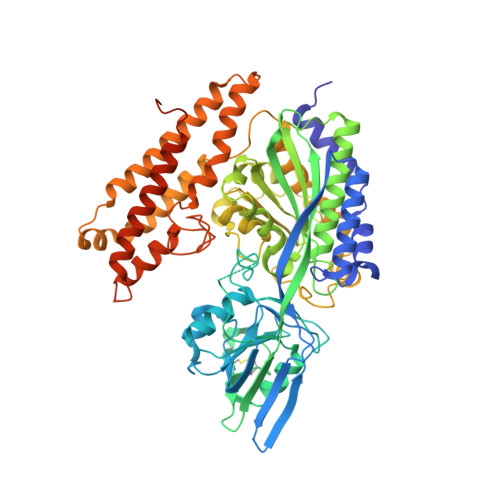
Crystal Structure of human transferrin receptor in complex with a cystine-dense peptide


Experimental Data Snapshot

  • Method: X-RAY DIFFRACTION
  • Resolution: 1.85 Å
  • R-Value Free: 
    0.187 (Depositor), 0.196 (DCC) 
  • R-Value Work: 
    0.163 (Depositor), 0.174 (DCC) 
  • R-Value Observed: 
    0.164 (Depositor) 

Starting Model: experimental
View more details

wwPDB Validation 3D Report Full Report

Validation slider image for 6OKD

Ligand Structure Quality Assessment 


This is version 1.5 of the entry. See complete history. 

Literature

A TfR-Binding Cystine-Dense Peptide Promotes Blood-Brain Barrier Penetration of Bioactive Molecules.

Crook, Z.R., Girard, E., Sevilla, G.P., Merrill, M., Friend, D., Rupert, P.B., Pakiam, F., Nguyen, E., Yin, C., Ruff, R.O., Hopping, G., Strand, A.D., Finton, K.A.K., Coxon, M., Mhyre, A.J., Strong, R.K., Olson, J.M.

(2020) J Mol Biol 432: 3989-4009

  • DOI: https://doi.org/10.1016/j.jmb.2020.04.002
  • Primary Citation Related Structures: 
    6OKD, 6OKE

  • PubMed Abstract: 

    The impenetrability of the blood-brain barrier (BBB) to most conventional drugs impedes the treatment of central nervous system (CNS) disorders. Interventions for diseases like brain cancer, neurodegeneration, or age-associated inflammatory processes require varied approaches to CNS drug delivery. Cystine-dense peptides (CDPs) have drawn recent interest as drugs or drug-delivery vehicles. Found throughout the phylogenetic tree, often in drug-like roles, their size, stability, and protein interaction capabilities make CDPs an attractive mid-size biologic scaffold to complement conventional antibody-based drugs. Here, we describe the identification, maturation, characterization, and utilization of a CDP that binds to the transferrin receptor (TfR), a native receptor and BBB transporter for the iron chaperone transferrin. We developed variants with varying binding affinities (K D as low as 216 pM), co-crystallized it with the receptor, and confirmed murine cross-reactivity. It accumulates in the mouse CNS at ~25% of blood levels (CNS blood content is only ~1%-6%) and delivers neurotensin, an otherwise non-BBB-penetrant neuropeptide, at levels capable of modulating CREB signaling in the mouse brain. Our work highlights the utility of CDPs as a diverse, easy-to-screen scaffold family worthy of inclusion in modern drug discovery strategies, demonstrated by the discovery of a candidate CNS drug delivery vehicle ready for further optimization and preclinical development.


  • Organizational Affiliation: 
    • Clinical Research Division, Fred Hutchinson Cancer Research Center, 1100 Fairview Ave N, Seattle, WA 98109, USA.

Macromolecule Content 

  • Total Structure Weight: 164.22 kDa 
  • Atom Count: 11,117 
  • Modeled Residue Count: 1,321 
  • Deposited Residue Count: 1,442 
  • Unique protein chains: 2

Macromolecules

Find similar proteins by:|  3D Structure
Entity ID: 1
MoleculeChains  Sequence LengthOrganismDetailsImage
Transferrin receptor protein 1
A, B
670Homo sapiensMutation(s): 0 
Gene Names: TFRC
UniProt & NIH Common Fund Data Resources
Find proteins for P02786 (Homo sapiens)
Explore P02786 
Go to UniProtKB:  P02786
PHAROS:  P02786
GTEx:  ENSG00000072274 
Entity Groups
Sequence Clusters30% Identity50% Identity70% Identity90% Identity95% Identity100% Identity
UniProt GroupP02786
Glycosylation
Glycosylation Sites: 2Go to GlyGen: P02786-1
Sequence Annotations
Expand
Reference Sequence
Find similar proteins by:|  3D Structure
Entity ID: 2
MoleculeChains  Sequence LengthOrganismDetailsImage
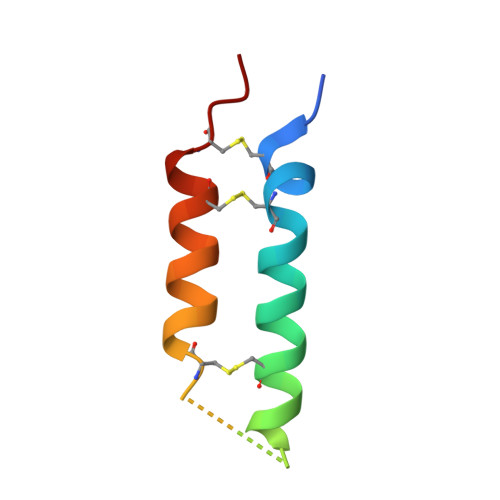
transferrin receptor binding cystine-dense peptide
C, D
51Monosiga brevicollisMutation(s): 0 
Gene Names: cytochrome BC1 complex subunit 6
Entity Groups
Sequence Clusters30% Identity50% Identity70% Identity90% Identity95% Identity100% Identity
Sequence Annotations
Expand
Reference Sequence

Small Molecules

Ligands 3 Unique
IDChains Name / Formula / InChI Key2D Diagram3D Interactions
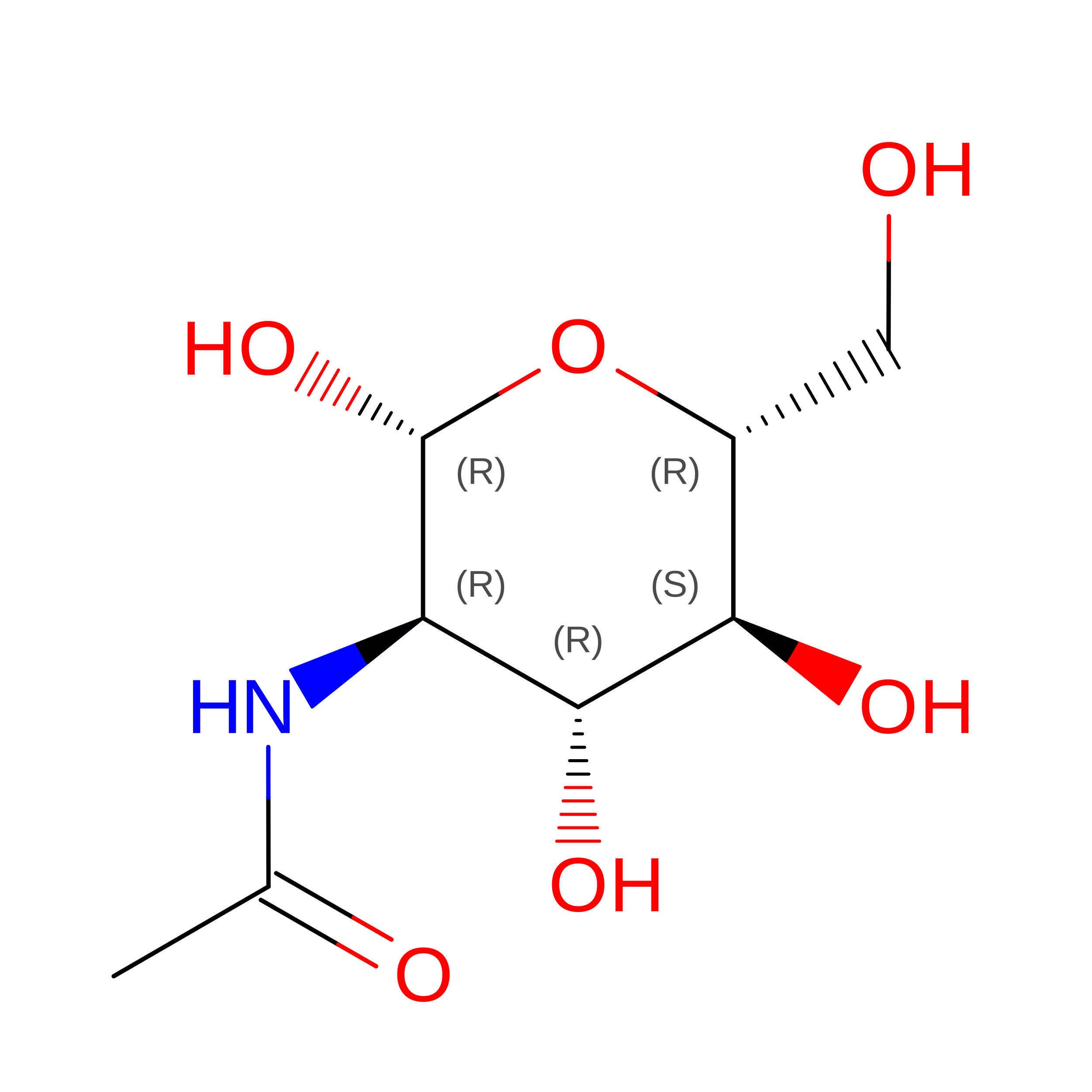
NAG

Query on NAG


Download:Ideal Coordinates CCD File
J [auth A],
K [auth A],
S [auth B],
T [auth B]
2-acetamido-2-deoxy-beta-D-glucopyranose
C8 H15 N O6
OVRNDRQMDRJTHS-FMDGEEDCSA-N
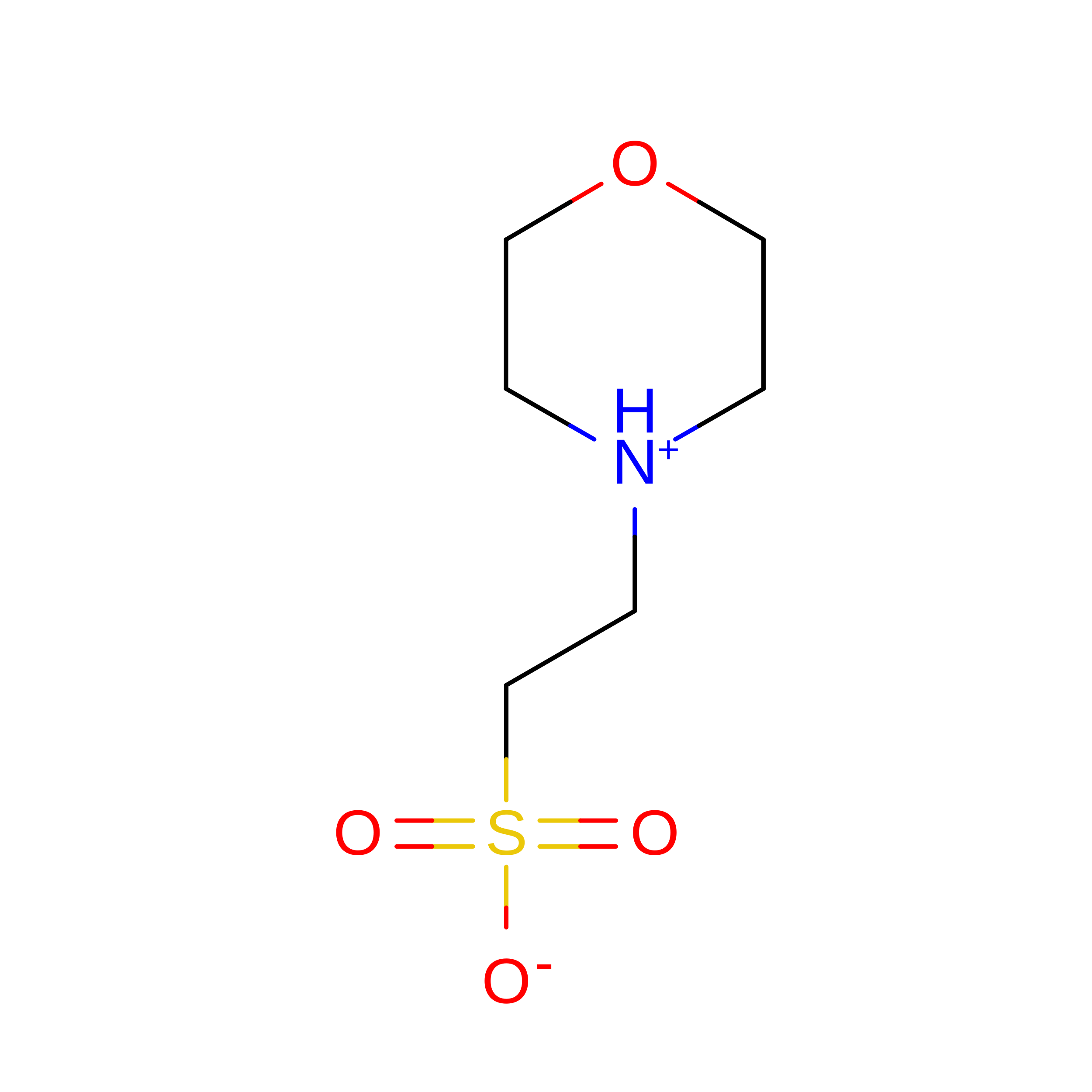
MES

Query on MES


Download:Ideal Coordinates CCD File
E [auth A],
L [auth B]
2-(N-MORPHOLINO)-ETHANESULFONIC ACID
C6 H13 N O4 S
SXGZJKUKBWWHRA-UHFFFAOYSA-N
GOL

Query on GOL


Download:Ideal Coordinates CCD File
F [auth A]
G [auth A]
H [auth A]
I [auth A]
M [auth B]
F [auth A],
G [auth A],
H [auth A],
I [auth A],
M [auth B],
N [auth B],
O [auth B],
P [auth B],
Q [auth B],
R [auth B]
GLYCEROL
C3 H8 O3
PEDCQBHIVMGVHV-UHFFFAOYSA-N

Experimental Data & Validation

Experimental Data

  • Method: X-RAY DIFFRACTION
  • Resolution: 1.85 Å
  • R-Value Free:  0.187 (Depositor), 0.196 (DCC) 
  • R-Value Work:  0.163 (Depositor), 0.174 (DCC) 
  • R-Value Observed: 0.164 (Depositor) 
Space Group: C 1 2 1
Unit Cell:
Length ( Å )Angle ( ˚ )
a = 102.601α = 90
b = 145.5β = 90.02
c = 133.494γ = 90
Software Package:
Software NamePurpose
REFMACrefinement
DENZOdata reduction
SCALEPACKdata scaling
PHASERphasing
PDB_EXTRACTdata extraction

Structure Validation

View Full Validation Report


Ligand Structure Quality Assessment 


Entry History 

Deposition Data

Revision History  (Full details and data files)

  • Version 1.0: 2020-04-15
    Type: Initial release
  • Version 1.1: 2020-05-06
    Changes: Database references
  • Version 1.2: 2020-07-08
    Changes: Database references
  • Version 1.3: 2020-07-29
    Type: Remediation
    Reason: Carbohydrate remediation
    Changes: Data collection, Derived calculations, Structure summary
  • Version 1.4: 2023-10-11
    Changes: Data collection, Database references, Refinement description, Structure summary
  • Version 1.5: 2024-10-30
    Changes: Structure summary